
Patterns everywhere: from the walls to the floors, right through to the furniture
A unique visual and sensory experience featuring hand-painted silk, raffia, oxidised copper and cork: bespoke surfaces in the style of Verner Panton.

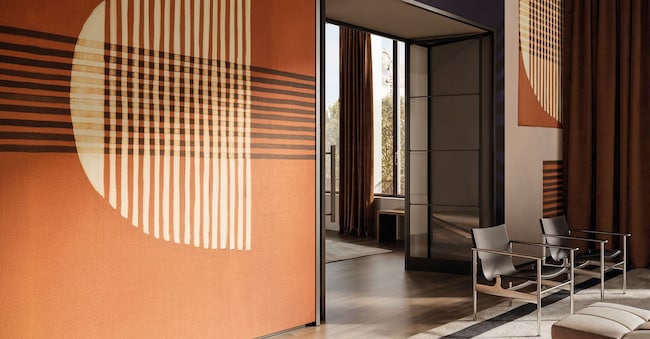
In 1970, aboard a ship moored on the Rhine, Verner Panton presented Visiona 2: a habitable landscape made up of psychedelic fabrics, tactile elements and coloured lights that transformed the interior into an almost extraterrestrial setting. It was not merely an installation, but a new concept of living. Homes of the 1970s ceased to be neutral containers and became immersive environments, where walls, floors and furnishings merged into a single visual and sensory experience. It was the decade of domestic utopias, radical architecture and confidence in the future. In 2026, the centenary of the designer’s birth, the Vitra Design Museum is dedicating a retrospective to him: Verner Panton: Form, Colour, Space. This is not a nostalgic look back: rather, it is a testament to just how relevant that vision remains today.
Today, we are seeing a conscious reinterpretation of that imagery. Patterns are once again becoming a compositional language, whilst colour serves as a structure that defines space, rather than merely decorating it. In the 1970s, amidst radical design and utopian experiments, the idea of the interior as a continuous system took hold: walls, furnishings and architecture all contribute to the same visual composition. That intuition now finds a more measured, yet equally ambitious, expression. Surfaces and floors become active elements, guiding perception, modulating light and redefining proportions. Decoration does not merely overlay the space; it constructs it.
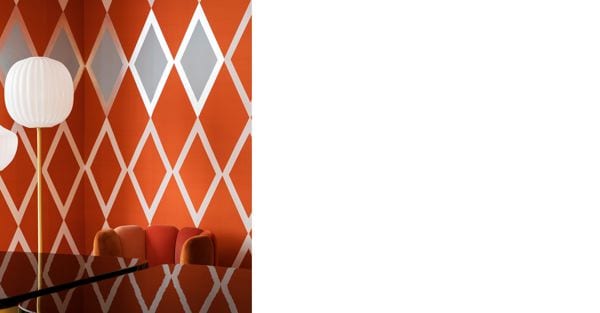
This context also encompasses a broader transformation: moving away from a mass-production approach in favour of an increasingly bespoke design philosophy. Projects conceived for a specific location, tailored to the architecture, and developed in dialogue with those who envision and inhabit that space. These are no longer replicable products, but solutions that arise from a design and find their meaning only within that context. It is here that the design language of the 1970s meets contemporary luxury: not through mere reference, but through the possibility of creating unique interiors, where design, materials and colour define an identity that cannot be replicated.
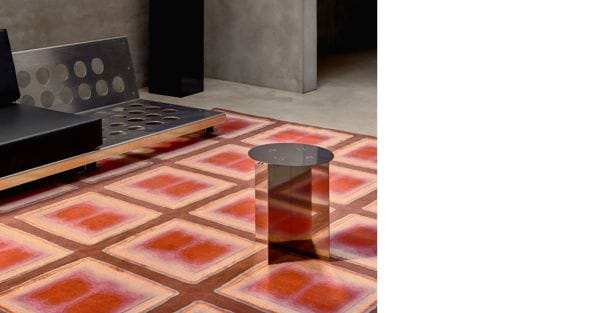
This is the context in which contemporary designs are being developed. Glamora’s wall coverings, presented at Maison&Objet in Paris, achieve an effective synthesis in the Terracina composition (from 91 euros per square metre): a design punctuated by lines and blocks of colour that is arranged rhythmically in an undulating pattern, expanding and contracting within the space. The project lends itself to bespoke installations, adapting colour, scale and material to suit the architecture. At the opposite end of the spectrum, yet with the same drive for uniqueness, de Gournay’s hand-painted wallpapers interact with India Mahdavi’s decorative language (€835 per panel). Each project begins as a landscape on silk, adapted with millimetre precision to the environment, with colours and details tailored to the individual space. Companies such as Fabscarte work exclusively on commission, developing bespoke wallpapers based on an idea and a dialogue with interior designers. Arte Wallcovering, making its Milanese debut during the Design Week 2026, showcased textured surfaces in which raffia, cork and natural fibres transform the wall into an expressive element.
The carpet, in turn, becomes a field of research with cc-tapis: in Kwangho Lee’s The Colour of Copper collection (€10,714), the oxidation of the metal takes shape in chromatic variations and hand-woven geometries from Nepal, combining silk and Himalayan wool in pieces that can also be made to measure. At the same time, colour definitively breaks free from its decorative role to become structure. The Kerakoll Colors project, with its 1,500 coordinated shades, constructs a colour system that spans materials and surfaces, transforming the space into a continuous field of variations and depth (from 2.51 euros per square metre). More than mere objects, these are tools for creating unique environments, where decoration merges with architecture and space once again becomes, as in the 1970s, an experience.

