Pnrr

SBB, 1,400 kilometres of network completed with Ertms system

EUR 2.5 billion investment; technology upgrade on 21 lines from North to South

by M.Mor.
3' min read

3' min read

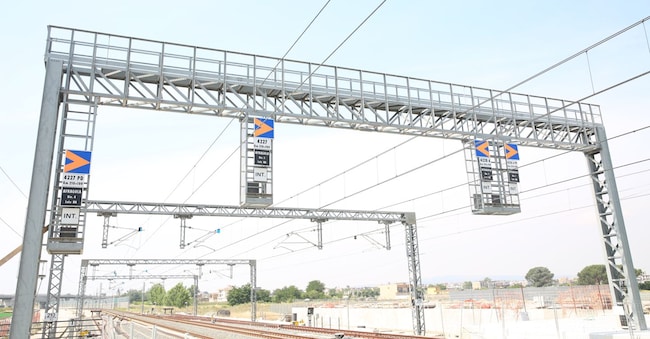
Rete ferroviaria italiana (Rfi), a company of the Fs group, has completed the installation of the advanced Ertms (European Rail Transport Management System) on 1,400 kilometres of its network, thus reaching, as planned, the medium-term goal set by the Pnrr for the development of the European rail transport management system. The project is financed with EUR 2.5 billion from the NRRP funds and will affect a total of approximately 2,800 kilometres of network to be completed by June 2026, in line with the strategic objective of extending Ertms technology, already adopted on high-speed lines, to the entire network managed by Rfi


Loading...

Rfi explains in a note: "The technological upgrades (updating) that have just been completed represent a tangible example of the benefits deriving from the 1,200 worksites active every day and the growing number of interruptions in recent years, which have gone from 160,000 in 2023 to 345,000 planned for 2025, most of them during periods of lower influx of commuter workers and students".

The affected lines

.


The works, carried out by Hitachi, Alstom, Mermec, and Progress Rail, involved a total of about 2,000 workers, including technicians from the Fs Italiane group, from the operating companies Rfi and Italferr, and from contractors. There are 21 lines or sections of lines that have benefited from the Ertms equipping, out of a total of 1.489 kilometres: in the north Domodossola-Arona, Gallarate-Rho, Merano-Bolzano, Rovigo-Chioggia; in the centre Direttissima Florence-Rome, Viareggio-Bivio Arcola, Grosseto-Civitavecchia, Civitanova Marche-Albacina, Terni-Sulmona, Campoleone-Nettuno, Ciampino-Frascati/Albano, Roccasecca-Avezzano; in the South Rome-Naples High Speed (Ertms technology upgrade in operation), Lamezia Terme Centrale-Catanzaro Lido, Catanzaro Lido-Sibari; in the Islands Cagliari-Oristano, Oristano-Chilivani, Chilivani-Olbia-Golfo Aranci, Siracusa-Canicattì, Caltanissetta Xirbi-Aragona Caldare-Lercara, Alcamo-Trapani via Castelvetrano.

L’Ertms


Ertms is the most advanced system on the international railway signalling scene and has therefore been chosen by the European Union as the single standard for the supervision and control of train spacing. This technology is able to guarantee greater reliability of the infrastructure, leading to an improvement in traffic regularity and service quality. In addition to higher performance, Ertms also saves on operating and maintenance costs compared to traditional signalling systems.


The activities will continue in the coming months and will affect conventional lines, urban nodes and the European corridors throughout Italy, including the Direttissima Rome-Florence, where work has already been carried out on the Rovezzano-Orvieto section, and in the coming months the technology will be activated on the remaining 105 kilometres between Orvieto and Settebagni, including the relevant interconnections.

L’interoperabilità


Ertms promotes interoperability between rail operators from different countries and improves performance by increasing reliability, allowing more trains to pass through and contributing to greater punctuality. Through the information exchanged continuously via radio between the trackside and on-board subsystems, it is possible to follow the train's progress, moment by moment, providing the driver with all the indications necessary for driving in advance, with the activation of emergency braking in the event that all parameters are not respected or the train's speed exceeds the permitted one.


An interoperable radio technology applied so far to high-speed trains but designed to be adaptable to all types of trains, which will be progressively extended to conventional lines by coordinating the equipping of trainsets in parallel. An action that will bring benefits in terms of landscape, with the elimination of signalling systems that today line the tracks, and in terms of the environment, thanks to the energy savings inherent in the system that allows the speed, acceleration and braking of trains to be regulated.


Copyright reserved ©
Loading...

Brand connect

Loading...

Newsletter

Notizie e approfondimenti sugli avvenimenti politici, economici e finanziari.

Iscriviti