
Fs, Mundys and Webuild lead projects for new mobility
Trains, airports, high-speed railways, metros: the decisive challenge for decarbonisation lies in the transport system

4' min read
4' min read
In Italy, the sectors most responsible for polluting emissions are transport (28%), energy and heat production (20%) and residential and commercial consumption (16%). This is according to a study by the Politecnico di Milano. Any decarbonisation strategy must consider this distribution to be effective. And today, leading the major projects to make transport more sustainable are three large national groups: Ferrovie dello Stato (FS), Mundys and Webuild, which also stand out in Statista and Sole 24 Ore's Sustainability Leaders list.
Fs is committed to fleet renewal: high-speed (Frecce), intercity and regional trains. Regional trains include the new Rock and Pop trainsets, financed with green bonds, which reduce fuel consumption by 30% compared to previous-generation trains. By 2027, Trenitalia's (FS) new regional trains will number more than 700, including electric double-decker, single-decker and hybrids, thanks to an investment of more than EUR 7 billion.
Mundys is at the forefront of the air transport decarbonisation process, which has the following objectives: to transform airports into true energy hubs, capable of self-producing, storing and distributing clean energy; to adopt Saf (Sustainable aviation fuel) on a large scale; and to promote innovative financing instruments. Mundys is present in the sector through two hubs: Aeroporti di Roma (Fiumicino and Ciampino), the main airport operator in Italy; Aéroports de la Côte d'Azur (Nice, Cannes and Saint Tropez), the second airport operator in France.
Webuild is among the leaders in sustainable mobility on a global scale, with projects that aim to decongest traffic and reduce pollution in urban centres. In Italy, some of the main railway lines under construction see Webuild's full involvement, starting with the Brenner base tunnel, the railway link under the Alps, which will play a key role in the transnational connection between Fortezza (Italy) and Innsbruck (Austria). Webuild is also realising other strategic railway works for the country: the Verona-Padua; the Milan-Genoa with the Third Pass; and the Naples-Bari (all high-speed lines).
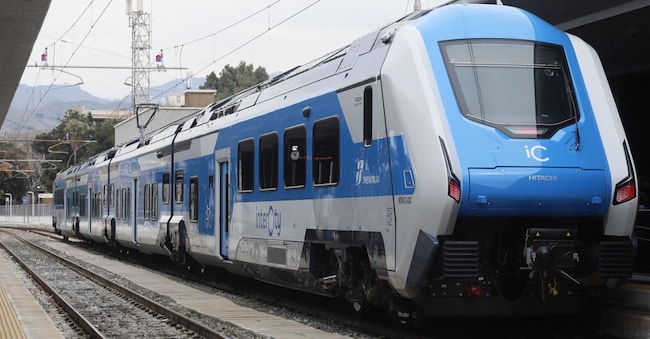
SF's hybrid Intercity
.Among the latest additions to Trenitalia's fleet are hybrid Intercity trains produced in Hitachi's Italian factories. These trains feature hybrid technology with a triple power supply: diesel, electric and battery. The hybrid trainset can run with diesel engines on non-electrified lines, with electric motors on electrified lines, and with batteries to run the first and last mile on non-electrified lines (e.g. when entering and leaving stations). Hybrid technology cuts CO2 emissions by 83% compared to diesel-powered trains. The seats are upholstered in fabric made from 100% recycled plastics. In recent months, FS has been running the first train on an experimental basis exclusively with Hvo biofuel, which contributes to reducing CO2 emissions by more than 80%. Finally, high speed: among the features of the new generation of Frecciarossa 1000, symbol of technology and innovation, is the increase in the recyclability rate to 97.1% (+2.7% compared to the previous fleet). In addition to Italy, the Frecciarossa 1000 is designed to travel on seven European rail networks: France, Germany, Spain, Austria, Switzerland, the Netherlands and Belgium.


