
Fs, Snam and Hitachi green the historic ALn668 railcars
A project to promote sustainable mobility: reducing CO2 emissions by 80%
by Marco Morino
3' min read
3' min read
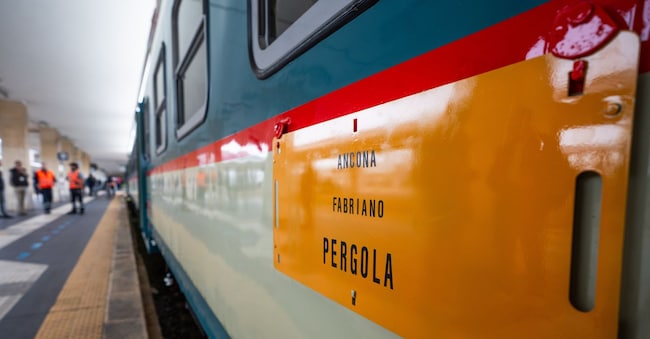
The project to convert two historic ALn668 diesel railcars of Fondazione Fs Italiane (Gruppo Fs) to liquid natural gas has been completed. The conversion work was carried out in collaboration with Hitachi Rail, which conducted the feasibility study, as well as the design and execution of the work, including the homologation process with Ansfisa, and Snam (Greenture), which took care of the activities relating to the organisation and management of logistics through the construction of a special vehicle dedicated to refuelling the ALn.
The presentation event, held in the historic Locomotive Depot at Fabriano station (Ancona), was attended by the Marche Region's Councillor for Infrastructure, Francesco Baldelli, the mayor of Fabriano, Daniela Ghergo, the general manager of the Italian Railways Foundation, Luigi Cantamessa, and the managers of Greenture (Snam), Emanuele Gesù, and Hitachi Rail, Giovanni Bifulco.
The project
.The regeneration project stems from a Memorandum of Understanding signed in 2019 by FS, through the FS Foundation, with Snam and Hitachi Rail, which aims to convert part of the current fleet of historical and tourist trains from diesel to LNG and BioGnl, to make them greener, with the goal of promoting and fully exploiting sustainable mobility.
The reconversion of the first two ALn668 railcars, carried out in Trenitalia's cyclic maintenance workshops in Rimini, involved transforming the fuel supply from diesel to LNG, a fuel that makes it possible to greatly reduce polluting emissions of nitrogen oxides, sulphur oxides, and particulate matter, and to limit carbon dioxide emissions by 20%. This conversion will also allow the railcars, without any other type of engine modification, to use BioGnl, a biofuel that can reduce CO2 emissions by an average of 80%, and in some cases even achieve 'carbon negative' results.
Says Emanuele Gesù of Greenture (Snam): 'What has been inaugurated shows how transition, even in the railway sector, is possible thanks to strategic synergies between companies. Greenture has also built a mobile unit dedicated to refuelling the converted ALn668 railcars, which will allow direct refuelling of the biofuel at the stations where the historical and tourist trains will stop.


