
Tariffs at 15% on EU goods, agreement with the US closer
Brussels might accept the so-called reciprocal tariffs to avoid the US president's threat to increase them to 30% as of 1 August. The acceleration, announced by the Financial Times, would also affect the auto sector, but Trump's signature is still missing
3' min read
3' min read
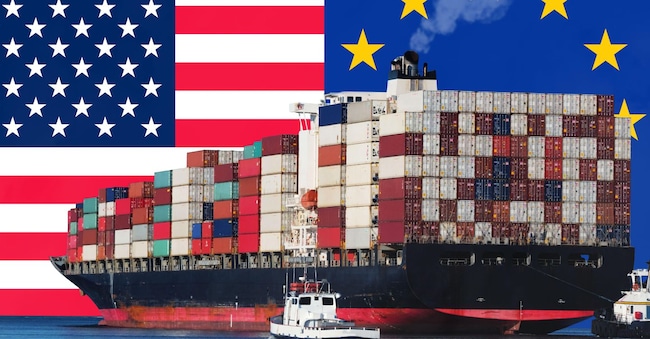
The European Union and the United States are reported to be close to reaching a trade agreement that would impose 15% tariffs on European products, essentially mirroring the one just announced between USA and Japan. The Financial Times was the first to report the news, citing its sources. Confirmation that negotiations are taking place on these terms came from various diplomatic sources in Brussels, at the end of a Coreper meeting in which the permanent EU ambassadors were updated on the status of negotiations by Trade Commissioner Maros Sefcovic. In the meantime, until an agreement to avert the 30% US tariffs announced by President Donald Trump as of 1 August is actually made official, Brussels is refining its countermeasures and now seems ready to consider the use of the so-called anti-coercion instrument, which can also affect US services.
According to various sources, the agreement being finalised would also concern the strategic European automotive sector, currently subject to tariffs of 25% (with the EU in return being ready to accept the recognition of certain American technical standards) and the pharmaceutical sector, but not steel, on which the 50% tariffs would therefore remain. Some products such as aircraft, alcohol and medical devices would instead be exempt from tariffs on both sides of the Atlantic.
Until Trump signs, who has the final say, experience shows that agreements cannot be taken for granted. Hence Brussels' decision to also accelerate on countermeasures in case of a no-deal. Today, European Commission spokesman Olof Gill announced the decision to fuse the two lists of countermeasures already developed: the one on 21 billion US goods to respond to the 50% US tariffs on steel and aluminium, already approved and frozen, and the one on 72 billion products drawn up to cope with the new US tariffs that will be announced on 1 August, still to be approved by governments. "To make our countermeasures clearer, simpler, and more effective," Gill explained, "we will combine Lists 1 and 2 into a single list (which will not go into effect until 7 August) and submit it to the member states for approval. A vote, it was later learned, should take place as early as tomorrow, Thursday.
This would affect just under a third of the US export of goods to Europe (EUR 335 billion last year), including such iconic products as Bourbon and Boeing aircraft, with tariffs that would be equal to the 30 per cent threatened by Trump in the lletter sent to Brussels on 12 July.
Among the member states, however, the so-called bazooka is also gaining support, i.e. the use of the anti-coercion instrument, which would make it easier to strike at services, an area in which the United States has a trade surplus with the EU, also thanks to digital giants such as Amazon, Microsoft, Netflix or Uber. The 'nuclear option' now counts Germany among its supporters, and, according to various sources, a broad majority of countries in favour is taking shape, according to some even that qualified majority needed to adopt it.


