Rationing

Fuel restrictions at 4 airports: priority flights and why traffic is not at risk (for now)

The airports involved are Linate, Bologna, Treviso and Venice. At the moment, however, the warning came from only one supplier

by Lorenzo Pace

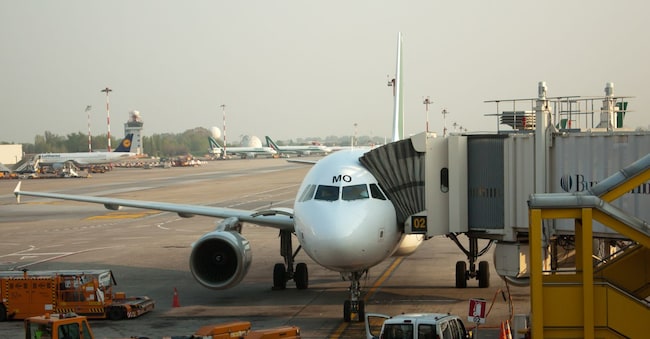
18/04/2013 Milano, Aeroporto Linate, nella foto la pista con un aereo collegato al finger Flavia Scalambretti  / AGF

3' min read

Translated by AI
Versione italiana

3' min read

Translated by AI
Versione italiana

The first Notam arrived on 4 April at dawn. It is an official notice to report critical and urgent flight management information. The recipient, at 5.30 a.m., is Linate airport in Milan. 'Reduced availability of jet A1 fuel supplied by "Air BP Italia"', it reads.

Reduced fuel availability

Translated: there is a 'reduced availability' of fuel on the part of the refuelling company and, for this reason, services 'for operators contractually bound to Air BP Italia may be subject to restrictions'. The warning also has a deadline: it will end at 11.30pm on Thursday 9 April. And it is linked, clearly, to the continuing conflict in the Middle East. In particular, to the almost total blockade of the Strait of Hormuz, through which large quantities of oil pass, necessary to obtain paraffin, i.e. the standard aircraft fuel.

Loading...

The other airports

But the Notam does not only reach Milan. In the afternoon, three other recipient airports were added. At 5pm, it was the turn of the Veneto airports: Treviso's Antonio Canova and Venice's Marco Polo. For the latter, the deadline is 1.59am on the night of 10 April, two hours later than for Treviso. Shortly afterwards it is the turn of Bologna's Guglielmo Marconi. The end, here, is scheduled for midnight on 9 April.

The same applies to Linate: the Notam 'alerts airlines to arrive substantially full at these destinations, given that fuel storage at airports is certainly not sufficient in itself'. This was explained by the president of the National Civil Aviation Authority (Enac), Pierluigi Di Palma, to RaiNews24.

Priority flights

Some bulletins contain additional information. In Bologna and Treviso, 'priority will be given to medical flights, state flights and flights longer than three hours'. For other flights, however, 'the maximum amount of fuel available will be 2000 litres per aircraft'. In the bulletin for Venice airport, on the other hand, pilots are asked 'to calculate a sufficient amount of fuel starting from the previous airport to complete the subsequent flight segments'.

"No alarmism"

The first reaction is not to be 'alarmist'. It comes from Save, the company that manages two of the airports involved, namely Venice and Treviso. The fuel limitations, reads a note, 'are not significant' and 'no limitation is placed on intercontinental flights and the Schengen area and operations are guaranteed without any alarmism'. This is because the companies responsible for refuelling the planes are different. Air Bp is currently the only one to notify a restriction.

Easter holidays

Then there is the question of timing. Because the period of restrictions corresponds to the Easter holidays, when the number of flights and therefore the necessary fuel increases. For Di Palma, the situation 'is obviously linked to the holidays'. And so 'it is not a current problem', but one that 'will come in the future'. The same message comes from Italy's main hub, Fiumicino, where at least the summer season is considered safe.

The emergency ahead

The emergency may come later, considering that next Thursday the last tanker loaded with paraffin will arrive in Europe from the Persian Gulf. Everything will depend on the situation in the Strait of Hormuz. Because the argument is the same for automotive fuels: one fifth of the world's crude oil passes through that stretch, which divides the Arabian Peninsula from Iran. Or at least it should, since ship traffic has been reduced to the point where less than ten ships a day can pass through. The effects can be seen in the Brent quotations. At the end of February, just before the US and Israeli attack on Iran, the price of a barrel was around 70 dollars. A distant memory, because on Friday it closed at 109 dollars a barrel (and on the evening of 31 March it touched 120 dollars).

The alarm also came from the International Energy Agency and Brussels. A few days ago, Energy Commissioner Dan Jorgensen called on EU members to 'consider promoting cost-saving measures, with particular attention to the transport sector'. Including, therefore, civil flights.

Copyright reserved ©
Loading...

Brand connect

Loading...

Newsletter

Notizie e approfondimenti sugli avvenimenti politici, economici e finanziari.

Iscriviti