Transport and the environment

High fuel prices? In Cremona the buses are now all electric

More than 15 million euro investment from 2022 to date to reduce public transport climate emissions in the Lombard capital by 70 per cent

by Giulia Riva

Autobus elettrici a Cremona

4' min read

Translated by AI
Versione italiana

4' min read

Translated by AI
Versione italiana

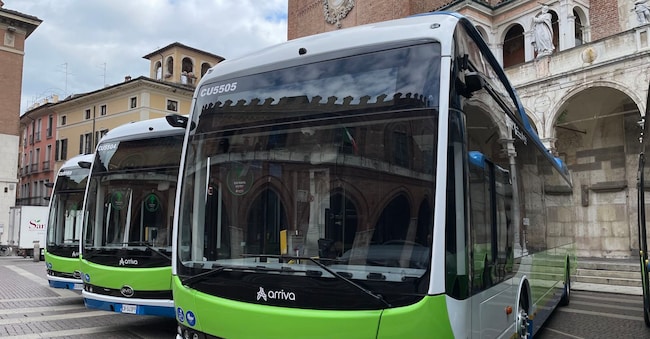
While the war in Iran is driving up fuel prices and leaving more and more people around the world stranded, finding the petrol station dry or unable to cope with the rising costs, Cremona has become the first city in Lombardy where the city bus fleet for public transport is 100 per cent electric.

Flotta green: how much does it cost

There are 34 electric vehicles now in service in the city, the last 3 operating since the beginning of April. A green turning point that has matured over time: experimentation on the use of electric-powered buses began in 2022 and required a total investment of 15.3 million euro, realised with the support of funding allocated to Cremona by the National Strategic Plan for Sustainable Mobility (Psnms) - for 6.8 million - and Pnrr funds amounting to 5.6 million. Arriva Italia, which manages the fleet, contributed 2.9 million euro to co-finance the purchase of the vehicles and - in collaboration with Enel X Italia - built the electrical system serving the bus recharging infrastructure, which cost 500 thousand euros.

Loading...

Then, in partnership with Bia Power, an intelligent system for optimising recharging was introduced, allowing energy to be purchased at the most convenient times.

Caro carburanti, autotrasporto verso il fermo a maggio

The investments included training courses - aimed at both drivers and workshop personnel - to address the specificities of the new vehicles, with a special focus on fire precautions in electric vehicles: 95 employees received refresher training, including drivers and technical personnel.

Minus 70 per cent climate-changing emissions and zero smog

Cremona has at its disposal 4 types of zero-emission vehicles, with different sizes to suit the city streets: the largest bus - the BYD K9UB model - is 12 metres long and can accommodate up to 84 passengers: 23 people seated plus another 61 standing. The slimmest vehicle is the Yutong E7 model, which in 7 metres in length carries up to 30 passengers (10 seated, 20 standing).

The city's mayor, Andrea Virgilio, speaks of a "historic and concrete step towards the future of sustainable mobility" and says that "these new vehicles, which are small in size, fit perfectly into the context of the historic centre and will be used on the lines that run through it. Their introduction also responds to a precise objective we had set ourselves: to progressively replace the oldest and most impactful vehicles with modern, sustainable solutions that are fully compatible with the characteristics of the urban fabric,' he says.

Overall, a vehicle has autonomy to cover, on average, between 250 and 300 km per day.

Allarme carburante per gli aerei, timori per i voli estivi

Comparing the climate-altering emissions of diesel and electric vehicles - that is, comparing the tonnes of CO₂ equivalent to the kilometres travelled, based on the databases of the Istituto Superiore per la Protezione e la Ricerca Ambientale (Ispra) - in 2025, a reduction in climate-altering emissions of over 70% is estimated for Cremona. The environmental advantage of electric buses is even more marked with regard to the pollutants responsible for urban smog, for which there is a total reduction compared to diesel vehicles.

In addition to the advantages in terms of ecological sustainability, the Cremona buses are now distinguished by greater ease of payment: it is possible to pay for your ticket directly on board, in contactless mode, by swiping your card on the validator both when getting on and off (to calculate the correct route).

The differences between urban and suburban transport

The Cremona case, for now, seems unique. "At the moment, we have no other similar projects" to this one, "where the goal was to achieve 100% electrification of the urban fleet," Arriva Italia points out. "In the other areas in which we operate, in fact, the service is mainly extra-urban: in this contextelectrification isstill complex to plan, especially because of the criticalities related to vehicle autonomy, timing and recharging infrastructure, which are less easily adapted to longer and more variable distances," the transport company explains.

Fmi: "Misure contro il caro energia rischiano di aggravare la crisi"

"This is why we have chosen to diversify the fleet's energy solutions, also focusing on alternative fuels such as HVO (diesel produced from waste vegetable oils and animal fats, ndr) and biomethane. In particular, we have recently activated a biomethane fuelling plant at our Brescia site. This diversification makes it possible not only to reduce emissions, but also to limit the risks linked to dependence on a single energy source, increasing the overall resilience of the service,' the company continues.

"In any case, electric remains a strategic guideline for development: we are in fact investing in this technology in other territories as well, such as Brescia and Bergamo, adopting, however, a gradual approach that is consistent with local operational specificities. The challenge is to progressively extend the use of electric vehicles also to suburban contexts: in this direction, we have already provided for the introduction of suburban electric vehicles in the most recent procurement procedures. The very rapid evolution of technologies, in terms of autonomy, performance and recharging solutions, makes the possibility of extending the areas of use of electric vehicles over time more and more concrete," he assures.

Copyright reserved ©
Loading...

Brand connect

Loading...

Newsletter

Notizie e approfondimenti sugli avvenimenti politici, economici e finanziari.

Iscriviti