Made in Italy

Furniture, production districts as an engine of competitiveness

At the Salone del Mobile focus on territories: discussion table launched between FederlegnoArredo and local confederations of industry. Framework agreement signed with Marche for exports

by R.I.T.
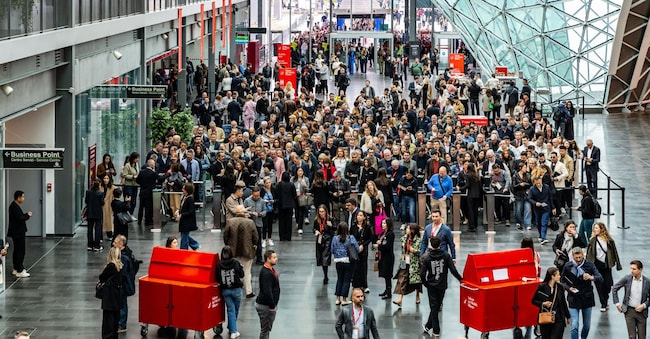
 (©Giulia Copercini)

5' min read

Translated by AI
Versione italiana

5' min read

Translated by AI
Versione italiana

Territorial specificities are at the heart of Italian competitiveness. It is no mystery that production districts - strongly rooted and united supply chains that enable manufacturing to find the craft, technical and technological skills within a few kilometres to guarantee the quality of final products - represent a typically Italian industrial model that has proven its effectiveness over the years.

All the more so in recent years, with repeated supply crises since the pandemic and now threatening to flare up again with the war in Iran.

Loading...

The wood-furniture supply chain - currently playing a leading role at the Salone del Mobile in Milan - is a model in this respect, with one of the supply chains of Italian manufacturing.

Districts, Lombardy in the lead

The wood-furniture production districts are the beating heart of a supply chain that, in 2025, despite a very complex economic and geopolitical context, have been able to interpret and react to the crisis, managing to look to new markets and maintain their position in traditional ones. Istat data processed by FederlegnoArredo's Study Centre photograph the different trends and outline their peculiarities and specificities.

The total turnover of the Lombardy Wood-Furniture Sector in 2025 will amount to just over Euro 10.6 billion, divided between Euro 3.8 billion for wood and Euro 6.9 billion for furniture; the trade balance is positive for Euro 2.4 billion, the highest among all Italian regions. A result that places it in first place among the wood-furnishing districts in terms of turnover, number of companies and employees. There are in fact 7,975 companies in the sector in Lombardy, of which 4,318 are in the furniture sector (54%) and 3,657 in the wood sector (46%). The number of employees is 50,942, of which 31,377 for furniture and 19,565 for wood.

Lombardy is also the leading region (with a share of 29% of the total) in terms of the export value of the supply chain of approximately 4.7 billion euro in 2025, with a slight variation of -1% compared to 2024, of which more than 3 billion is for furniture alone, 57% of the turnover of furniture production in Lombardy is destined for export (3.1 billion euro in 2025 at -2% compared to 2024) reaching more than 180 countries

A round table with the regions

In the setting of the Salone del Mobile in Milan, the first meeting was held in the presence of the Tavolo Delegati Legno-Arredo di Confindustria, promoted and coordinated by FederlegnoArredo, which involves chairmen and representatives of the wood-furniture sections of 15 territorial Confindustries.

"The initiative represents a concrete step in the path launched by the Federation to strengthen the dialogue between companies, territories and the association system, confirming FederlegnoArredo's central role as a point of reference for the Italian wood-furniture supply chain," said Fla's general manager, Carlo Piemonte. "A moment of direct confrontation between the delegates of the territorial Confindustries to systematise best practices and identify the priorities of the sector: one above all that of training a qualified workforce. The meeting at the Salone del Mobile marks the beginning of this strategic collaboration at national level'. The Table's path will continue in the coming weeks with an in-depth study dedicated precisely to the topic of Education, identified as a strategic area for the sector's growth and competitiveness.

Marches, framework agreement for internationalisation

A framework agreement between the Marche Region, FederlegnoArredo and Confindustria Marche will also be signed, also at the Salone del Mobile, representing a strategic regional industrial policy tool aimed at supporting the wood-furniture supply chain, one of the region's identity sectors with the greatest international vocation.

The agreement aims to align regional policies with European and national trajectories on innovation, sustainability, digital transformation and human capital, strengthening the system of institutional and production relations together with the territory. The operational core will be the definition of a strategic system project for the 'Home and Furnishings' sector, developed with the involvement of research centres, universities and innovation hubs, and accompanied by a public-private steering committee that will coordinate actions in the medium-long term.

In detail, the agreement between bodies aims to promote coordinated access to European funds, also with a view to the new 2028-2034 programming, to strengthen the processes of aggregation between companies, to support technological innovation and the green and digital transition, and to accompany companies in their internationalisation paths, also through support for the certifications required by non-EU markets.

"The wood-furniture supply chain is one of the driving forces of the economy in the Marche region: it accounts for 7.7% of regional industry and over 765 million euro in exports, 5.7% of Marche exports. A production system that is strongly oriented towards international markets, which today we want to accompany into a new phase of growth," explains Marche regional councillor Giacomo Bugaro.

'The agreement puts on the ground a clear operational model to support the supply chain: integration between European, national and regional resources, support for certifications for access to foreign markets, strengthening of skills and investments in innovation and sustainability,' adds Carlo Piemonte. The objective is to concretely accompany companies, especially SMEs, in the transformation and internationalisation processes, while enhancing the value of the Marche production system, renowned for its craft traditions and innovation. In 2025, it reached a value of about EUR 3.7 billion, ranking fourth in terms of both turnover and export value in the wood-furniture sector, confirming its position as one of the main poles of furniture production in Italia.

The figures confirm the central role of the Marche region, with a trade balance of 660 million euro, more than 1,800 companies and 18,700 employees, 74% of whom are employed in furniture production, according to data from the FederlegnoArredo Study Centre. The Marche district is characterised by extraordinary production in the kitchen sector, which accounts for 26% of the national kitchen turnover. The sector contributes significantly to the image and competitiveness of Made in Italy in the world. Despite the global challenges, the Marche region maintains a prominent position in furniture exports: the sector covers 67% of the exports of the entire wood-furniture chain.

"This agreement pushes on the priorities that Confindustria Marche has been highlighting for some time as strategic for our companies: skills, innovation and digitalisation, aiming at a coordinated industrial policy between the regional and national spheres," says Roberto Cardinali, President of Confindustria Marche. The wood-furniture sector has a history of quality and prestige in our region and a significant weight in the regional GDP and exports. The constitution of a public-private control room can become a national model for the setting up and implementation of strategic interventions, so as to enhance the value of a supply chain that is important for the economy of the Marche region, also with the support of institutional and technological partners'.

Copyright reserved ©

Brand connect

Loading...

Newsletter

Notizie e approfondimenti sugli avvenimenti politici, economici e finanziari.

Iscriviti