
Gabriele Stötzer: the body as a struggle for self-affirmation
At the Gropius Bau in Berlin, the largest institutional retrospective ever dedicated to an East German artist

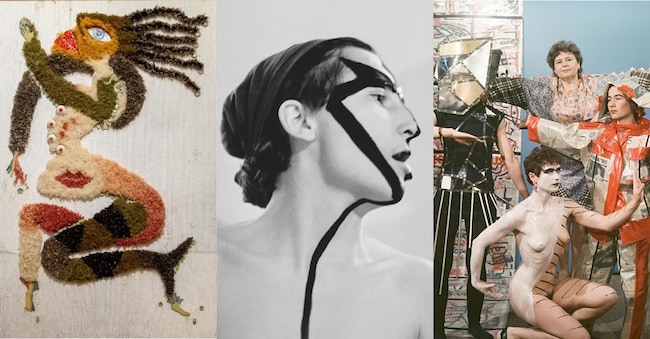
There is no middle ground. You’re either in it, or you’re not. This is the sense of urgency that runs through Dabei sein und nicht schweigen — Essere presenti e non rimanere in silenzio — the exhibition that the Gropius Bau in Berlin is dedicating to Gabriele Stötzer. A living manifesto of an existence that has never ceased to assert itself, in every possible form: the body, the gaze, the hands, scattered across canvases, display cases, notebooks and screens. In every room, one senses the need to be fully present — in experimentation, in solitude, in shared creations.
An unprecedented retrospective
Curated in close collaboration with the artist, the exhibition brings together around 150 works and is the largest exhibition ever dedicated to a female artist from the GDR. The exhibition spans half a century of artistic exploration — painting, literature, photography, textile art, Super 8 films, performance art and public interventions — revealing the coherence of a body of work that has consistently explored themes of justice, gender and self-determination. Through an experimental and often radical artistic language, Stötzer has developed counter-narratives to state power and patriarchy, opening up spaces for desire, resistance and feminist solidarity.
Prison and the choice to stay
The artist’s biography is inextricably linked to the political history of a divided Germany. Expelled in 1976 from the Erfurt School of Education for taking part in a protest, Stötzer spent five months in pre-trial detention for signing a petition, followed by a one-year prison sentence at Hoheneck women’s prison for defamation of the state. In the years that followed, the Stasi subjected her to constant surveillance, systematically obstructing her artistic collaborations.
Unlike many of her colleagues, Stötzer refused to be transferred to West Germany, believing that such a move would ultimately legitimise her dissent in the eyes of the regime by turning it into a source of income. Instead, she chose to stay, transforming the GDR into a laboratory for collective artistic practice and feminist activism, modelled on the solidarity she had experienced whilst in detention.
Erfurt’s underground scene
A leading figure in the city’s underground scene, Stötzer squatted in buildings and organised workshops, artist studios, exhibitions and actions in public spaces. His strategies — both individual and collective — remain a point of reference today when considering the authoritarian tendencies of contemporary politics.

