Inconvenient art

Gabrielle Goliath: when a work becomes a political case

The South African artist of 'Elegy' explains the reasons for her work after South Africa's withdrawal from the Venice Biennale

by Maria Adelaide Marchesoni

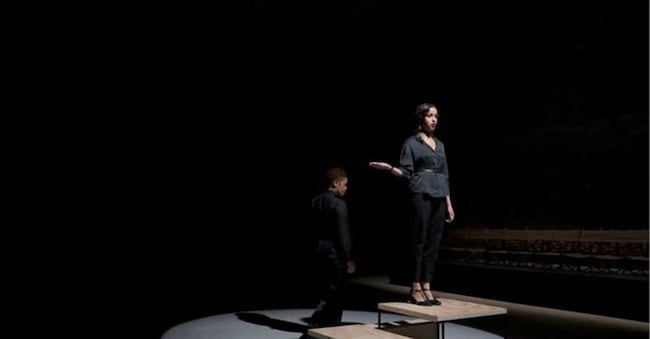
Gabrielle Goliath, “Elegy - for two ancestors” performance at the Sale d’Armi during the 2024 Venice Biennale (photo by J Macdonald)

8' min read

Translated by AI
Versione italiana

8' min read

Translated by AI
Versione italiana

A work chosen to represent a country, a political intervention calling for its exclusion and a controversy that ends up engulfing the entire national participation. The case that led South Africa to cancel its presence at the upcoming 61st Venice Biennale revolves around the work of Gabrielle Goliath and the request by Culture Minister Gayton McKenzie to remove her work "Elegy", unanimously selected for the South African Pavilion. A decision that reopened the debate on the relationship between national representation and freedom of artistic expression.

At the centre of the controversy is a new iteration of 'Elegy', a performance and installation project that has run through the artist's research for years. The work interweaves memory and violence, linking the colonial past and the legacy of apartheid with contemporary tragedies. In the version intended for the Biennale, this interweaving went so far as to include the death of women and children in Gaza, with a reference to the mourning for the disappearance of the Palestinian poetess Heba Abu Nada: an element that, according to the minister, would have made the work politically inappropriate for a context of national representation.

Loading...

"Elegy" was presented in Italia in 2024 by the Raffaella Cortese gallery and, on 16 April next, the second exhibition by Gabrielle Goliath will be inaugurated in the Milan gallery's spaces, with an unprecedented body of work that explores the multiple meanings of the term bearing (portare, support), returning to traditional techniques such as oil, watercolour and pastel. (The price range of the drawings and photographs is between $5,000 and $50,000; the video installations between $60,000 and $150,000).
Goliath's immersive and often in-progress installations have been exhibited throughout South Africa and internationally. He has received numerous awards, including the Future Generation Art Prize - Special Prize (2019), and participated in the main exhibition of the 60th Venice Biennale with the work 'Personal Accounts'. An international journey that makes the significance of the case even more evident.
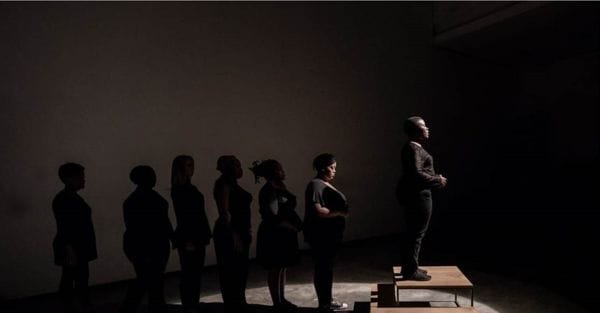
Gabrielle Goliath, “Elegy - Eunice Ntombifuthi Dube” (2018) at the Centre for the Less Good Idea in Johannesburg (photo by Stella Tate, all images courtesy the artist)

We spoke with Gabrielle Goliath about Elegy, memory and responsibility, and what happens when a work of art becomes a political battleground. In the project you designed for the National Pavilion, how did you choose to present the Palestinian tragedy in Gaza?

"Elegy" is a memorial performance project that I have been staging in South Africa and around the world for over ten years. As a political work of mourning, it addresses the theme of the economy of life differentially valued, that is, those continuously recycled conditions that make some lives worth remembering and others not. Commemorating the women and LGBTIQ+ people killed in South Africa was a way of rejecting this systematic denial, this cold calculation of gender violence statistics. Each performance of 'Elegy' remembers a life - a daughter, a friend, a sister, a lover - and affirms that that life was loved and is missing. And it invites participants to come together, to acknowledge and account for their involvement in a social norm of violence against people of colour, women and queer people. While most of the performances of "Elegy" commemorate contemporary losses, some have been dedicated to more historical experiences: to the enslaved and murdered women in the Cape Colony, as well as to two Nama ancestors killed in the Ovaherero and Nama genocide in Namibia, whose names were not recorded in the colonial archives.
For the South African Pavilion in Venice, I wanted to emphasise this profound interweaving of suffering, from the crisis of feminicide in South Africa to the erasure of the life-worlds of the Nama in Namibia, to the ongoing displacement and killing of Palestinian women, children and civilians.Once again, the question is: whose death can one mourn? And, of course, the question of Palestinian lives and losses takes on great relevance. In the context of the threats, censorship and cancellations that this exhibition has faced, I ask myself: why is it heretical, unthinkable, unbearable to mourn Heba Abunada, a young Palestinian poet who was killed in 2024 in an Israeli airstrike in Khan Yunis, Gaza, along with her young son? When we are told that mourning must end here, we should understand that our humanity also ends here. But it does not. The elegy is a call, a cry, to relate beyond racial, gender, sexual, geographic, religious and political differences, to reject differentially valued conditions of life and, in the interest of achieving a more liveable world, to channel and carry with us the absent presence of Heba, of Ipeleng Christine Moholane, of two Nama ancestors.
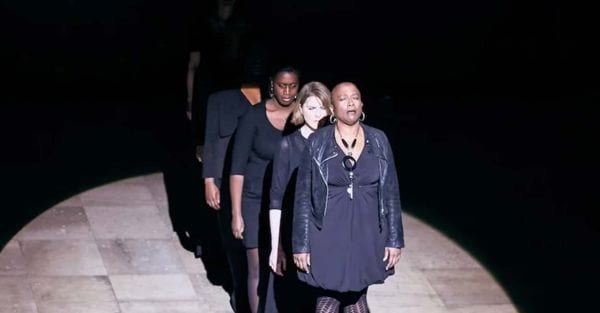
Gabriella Goliath «Elegy ongoing performance project» 2015. Courtesy: Galleria Raffella Cortese, Studio Goliath

Your work has been described as 'divisive'. How do you experience this label and what do you think it says about the historical moment we are living in?

It is not a description I accept. It is worth noting that the Minister for Sport, Arts and Culture, Gayton McKenzie, who attributed it to 'Elegy', has never seen my work. This facile assumption - whereby a work of ritual mourning is dismissed - speaks volumes about the poverty of a politics devoid of accountability and regard for ignored lives, in which the topoi of 'social cohesion' and 'nation-building' end up co-existing and normalising xenophobia, rape culture, feminicide and even genocide.

What role does art play for you when confronted with ongoing, painfully unresolved events?

In a context of irreparable damage and immeasurable loss, in the open wound of the world, art is for me a practice of survival, an affirmation of possibility despite everything. I do not believe that art has a role as such, nor do I share overly positivist views of its 'social functions'.
In a context of white hetero-normative welfare-oriented representation, as a past-present-future project of history, I believe art can perforate, navigate fleetingly, depart and imagine. It is not about inaugurating new social orders or future utopias, but about everyday work that rejects normative violence and dares to think, dream, imagine and represent life, community and the world differently, here and now. If Louise Bourgeois considered art a guarantee of sanity, I see hope not as a guarantee, but as a tender, fragile and potentially transformative offer of possibility.

Beyond your specific case, do you think this situation could set a precedent for other artists working on politically sensitive issues?

Yes. Ingrid Masondo, curator of the exhibition, and I are fully aware of the wider implications of this erasure for the art community in South Africa and around the world. Freedom of expression is guaranteed by our Constitution, after the abuses, censorship and propaganda of apartheid. If the rights to creative freedom - to criticism and dissent - are eroded in this case, through manipulation of power and pressure from groups and financiers, a deeply worrying precedent will be set, which will threaten all artists, curators and creatives in the country. We are not alone in this thinking: numerous public campaigns and letters have called for the intervention of President Cyril Ramaphosa, whose failure to respond has been a disappointment to many.

Last year you participated in the main exhibition at the Venice Biennale. Looking at the two experiences - last year's and this year's - where do you see the boundaries of international artistic legitimacy?

As artists - and, in particular, as artists of colour - I do not believe we should seek legitimacy in art world structures or high-profile platforms like the Biennale. It is up to us to navigate these structures of 'opportunity' with thoughtful care and responsibility. My work was treated with genuine curatorial care in the previous Biennale, by Adriano Pedrosa and Amanda Carneiro, and presenting "Personal Accounts" at the Giardini was an opportunity to do something tender and beautiful.
Having said that, I was also faced with a very complex funding situation, from which I eventually withdrew. These are the contingencies and demands we have to face. We cannot walk a perfect line, but we can (and I think we should) look for paths and ways out of 'lesser violence', in the hope of fostering encounters of possibility within a difficult and burdened art economy.
In my current situation, a boundary of legitimacy has certainly revealed itself, in the controlled conditions of participation, acceptance and success. In crossing this line, in transgressing legitimacy, I find support in the many others who have done the same with courage, care and imagination.

Do you think that today's leading art institutions are really ready to support works that take a stance on current geopolitical conflicts?

Of course it depends on the conflict. I recently exhibited at the PinchukArtCentre, which has a very clear position on the war in Ukraine. Many institutions would take a similar stance on the Russian invasion. On other conflicts, however, the situation changes: geopolitics, vested interests and levels of complicity come into play.
The real question for any art institution is: what am I not prepared to deal with and why? In this complex context, what interests me is the readiness of individuals - particularly blacks, women, queers and decolonial allies - to promote change, cultivate possibilities and push the limits of what is possible in the face of social catastrophe.

Your work is supported and recognised in Italia by Raffaella Cortese. In South Africa, the gallery that represented you broke off the relationship: how did you experience this change and what do you think it means for the current cultural climate in the country?

Galleria Raffaella Cortese is my artistic family in Italia. They have shown me what it means to really believe in the work of an artist: a deeply relational path, based on solidarity and care, which they have consistently demonstrated. Being dropped by the Goodman Gallery at the very moment when I had been assigned the South African National Pavilion was shocking. Shortly afterwards, the Pavilion was cancelled. It was a difficult and worrying time, which made me realise how valuable real support is, such as that of the Raffaella Cortese Gallery, which was among the first to make a public statement of solidarity when the Pavilion was threatened. Alongside them, the community of artists, curators and creative people in South Africa and around the world supported me during this difficult time, with messages of closeness and symbolic gestures, such as leaving flowers on my doorstep. These cancellations reveal rifts not only in the South African art context, but also globally. I am not the only artist to suffer such abandonments or cancellations for controversial content: it is a worrying trend, which we must reject if we want to imagine a different world.

Your work often deals with themes such as violence, mourning and collective memory. Where does this sense of urgency come from and how has it evolved over time?

I often refer to my practice as my life's work. It is lived, inhabited, embodied, but above all it affirms life and possibility, within and despite what I call the impossibility of the representation of women of colour. By this I mean the everyday, often invisible conditions that make their lives subject to violence, contempt and death. Aesthetics - and all that it implies - is not separate from these structures of contempt, but is deeply rooted in them. I do not consider my work 'thematic' in the sense of a documentary or a scene of witnessing a social evil. Rather, it is a relational and interwoven practice: living, breathing and working within and against an order of racial and sexual violence. It is urgent because, for these lives - our lives - it is a matter of survival. My work exceeds me in many ways. It asks a lot of me, often more than I think I can give. But this demand has driven me, not towards a career in art according to the cliché of the 'brilliant white male artist', but into the complicated intertwining of work and life: into relationships, into community, into encounters across differences. And that impulse grew over time, fuelling the urgency to do this life's work, fragile, restorative, loving and (im)possible.

Copyright reserved ©
Loading...

Brand connect

Loading...

Newsletter

Notizie e approfondimenti sugli avvenimenti politici, economici e finanziari.

Iscriviti