Sport

Galbusera, Boggioni and Dell'Orto champions beyond discrimination

From national deaf volleyball team to Paralympic swimming and American women's football, the three athletes talk about their journey at the 10-year anniversary of Alley Oop

by Maria Paola Mosca

6' min read

Translated by AI
Versione italiana

6' min read

Translated by AI
Versione italiana

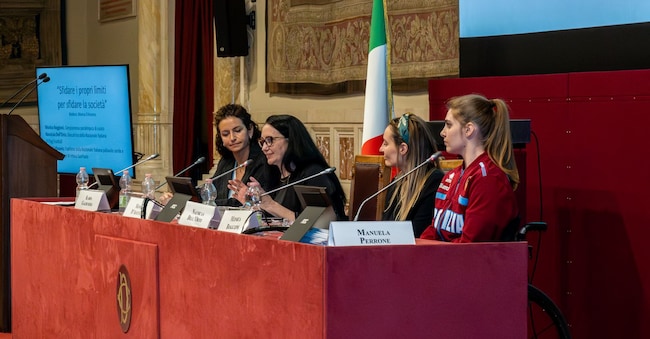
The practice of sport as an engine of inclusion. A concept not to be outlined only in words but to be told through first-hand experience. And on Tuesday 3 March, in Rome, the celebration of Alley Oop's tenth anniversary was also this: testimony from the living voices of those who, by directly experiencing discrimination because they are different, have been able to redefine and are redefining the standards of visibility of diversity in top-level sport.

During the panel moderated by Monica D'Ascenzo, entitled 'Challenging one's limits to challenge society', Paralympic swimming champion Monica Boggioni, flag football player Nausicaa Dell'Orto and the captain of the Italian national volleyball team, Ilaria Galbusera, took turns. Three particularly incisive voices of sportswomen who speak of commitment, vision, determination and results. Capable of conveying to the audience the energy, the constructive anger, the awareness of the value of every effort made in a world not yet designed to include everyone. Three models, three human paths and three different stories of achievement. Who, to the attentive audience in the Sala della Regina in Montecitorio, told the value of teamwork in sport and at work. The confidence in one's own abilities even after major defeats or in the face of those who tell you: you can't. And the satisfaction in being able to call oneself a 'professional athlete'.

Loading...

From individual talent to teamwork

If talent is individual, results are collective in team sports. How can these two dimensions be reconciled and how can a balance be found that is effective for everyone? Ilaria Galbusera - disability manager at Intesa Sanpaolo, as well as captain of the Italian national deaf volleyball team - has no doubts: 'Team sport teaches that talent alone is not enough. It can make a difference in a moment, but it does not build a winning path if it is not embedded in a system of solid relationships. In a team, even more so in a team composed of deaf female athletes, all different in age, deafness and communication choices, trust is not an abstract concept, it is an operational prerequisite. In volleyball, every action depends on the other. If I do not trust my receiving partner, I cannot attack decisively. If there is no harmony, the game breaks down. In deaf volleyball, where communication takes place through glances, gestures and visual signals, trust becomes even more essential. Indeed, it is necessary to be constantly present, attentive, connected. When a team works, each athlete feels part of something bigger and it is there that individual talent turns into collective achievement and the team becomes stronger than ever'.

Trust, shared commitment to the common goal, a lot of preparation and work also in refining mutual understanding between team members to build the mutual trust and respect needed to make another point. Lessons from essentials that can also be transferred to the world of work. If in teams one does not listen to the specific potential of one's colleagues, if one does not find a way to adapt to the challenges of difference, if one does not trust, one cannot be effective. You do not win the game. Of course we need better 'training' conditions for everyone, in sport as in other professions. While there is still a long way to go, whether we are talking about disability or gender difference, Galbusera confirms that things are evolving.

"In recent years, the world of work has taken important steps forward on the issue of inclusion and disability. There has been a shift from a predominantly normative approach to greater cultural awareness. Inclusion is not just a duty, but a strategic value. The real transformation is not yet complete. People often talk about inclusion, but lack a full understanding of the barriers, not only physical, but also cultural and communicative, that can exclude people. Today, inclusion is still the exception, whereas it should become the norm, the everyday.

Intesa Sanpaolo, with its cross-functional group of 80 Disability Manager colleagues, has over the years implemented several concrete initiatives to promote an increasingly inclusive culture, both within and outside the company.

Among the many significant actions, to which I am most attached, are the basic Italian Sign Language (LIS) learning pills and raising awareness of the approach to deaf colleagues, fundamental tools for breaking down communication and cultural barriers. Also important is the creation of a glossary - 'Le parole giuste' (The Right Words) - with the correct words, to encourage respectful and person-centred language, available and downloadable on the Intesa Sanpaolo website. This is not just about training, but a cultural change, with inclusion becoming part of the corporate identity and a lever for collective growth."

When a sport is only for men

Sport can also be discrimination when one is a woman, as in the case of Nausicaa dell'Orto who wanted to play a sport considered only for men. The athlete, who, among other things, is a commentator for the NFL (the top American football league), does not mince her words in telling how the driving force behind her sporting history was the refusal she received when asked to play with boys. Passion and tenacity led her from cheerleading to taking the field with a team, against other opponents. Not only by becoming a player in the national flag football team, but by bringing the sport to Italia.

"I and other girls wanted to play American football and we asked the coach of the men's team to train us. His reply: 'No, you get hurt, you are the weaker sex for a reason'. We didn't listen to him and today women's flag football is an Olympic sport' that will be on the programme of the Los Angeles Olympics in 2028.

Loading...

From what could easily have been the insurmountable boulder that fell in her path, Dell'Orto sparked a bigger movement. Turned the tables on those who told her 'you can't'. Thanks to a coach who was willing to put in the time - 'to protections that were too big for us, with some old jerseys he had in his basement' - it all started in a makeshift camp. "For years we were told that football was a women's sport. My father even told me that it would be a waste of time and that I would only get hurt. Today flag football is an Olympic sport also thanks to those who fought from the beginning to make it possible".

And since it is taken to the biggest stage of world sport, no one, and in particular 'no man, will ever again be able to say that a girl cannot play because we have finally been given the opportunity to compete at the highest level'. In front of everyone's eyes. Team against team. Play after play.

From the sports profession to the profession of the future

If Dell'Orto also tells of defeats, hardships, and discrimination suffered, but with the pride of having succeeded, the look of Monica Boggioni, Paralympic swimming champion, is equally proud. In her speech, she emphasises the role of sports practice on the perception of differences. "I think that sport is also a great tool for cultural growth". This is why in her opinion it is 'very important to invest in the knowledge and transmission of Paralympic sports. Because they make it possible to learn to see disability with other eyes and therefore not as a limitation, but as a set of skills to be rediscovered and adapted. In even broader terms, to understand the value of diversity. It is right to recognise diversity as the only normality that exists and from it derive different needs and requirements that must have the right to be respected'.

Loading...

Sport then becomes an enabler for determining oneself as an individual, an aspect that is particularly crucial for those living in a condition of difference. In fact, the swimmer specifies: 'I think that for people with disabilities, one of the most important issues is the concept of self-determination in society, also in the working environment. For me, swimming has allowed me to achieve a lot and to grow both as an athlete and as a person. Now I can be a professional athlete. Because as of the end of 2022, the law has been passed that equalises Olympic and Paralympic athletes within the military and state corps. After passing the competition and being sworn in, I am fully employed within the State police corps in the Fiamme Oro as a technical agent'.

A change that allows her, among other things, to have a career path even after her competition years and when the time comes to retire from top-level competition.

Offering a broader view on the subject, Boggioni continues: 'This is not only a very positive result for me as an individual person, but I think it has an even more important social and cultural significance because it gives due dignity to all Paralympic athletes. I think it is an example that can be applied to many other areas of our society'.

Copyright reserved ©

Brand connect

Loading...

Newsletter

Notizie e approfondimenti sugli avvenimenti politici, economici e finanziari.

Iscriviti

Tutto mercato WEB