Universe in books

Galileo, notes for changing the cosmos

Scholar Ivan Malara found the edition annotated by Galilei of Ptolemy's Almagest in Florence. Thus the heliocentric theory was ready to enter science. Tale of a discovery

by Ivan Malara

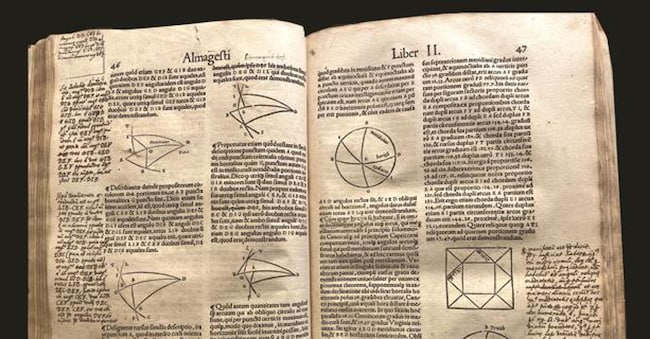
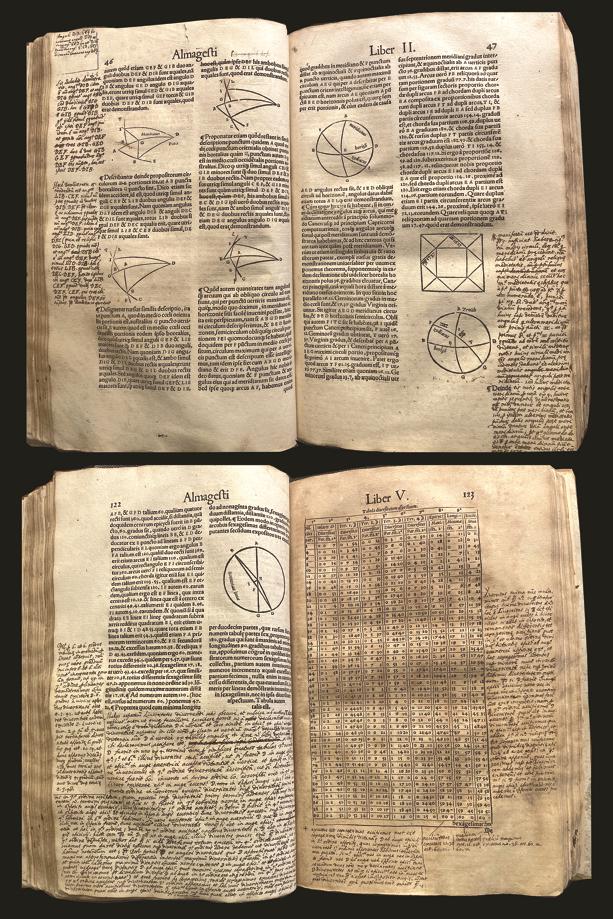
Grafia minuta. Due delle pagine squadernate dell’edizione dell’«Almagesto» di Tolomeo con le fitte annotazioni di Galileo Galilei che commenta i passi del libro stampato a Basilea

4' min read

Translated by AI
Versione italiana

4' min read

Translated by AI
Versione italiana

Archival research does not always repay the efforts of those who undertake it; more often it results in patient waiting, silences, false trails. Sometimes, however, it happens that perseverance, together with a bit of luck, is rewarded by a discovery capable of changing the perspective of a gaze that has become accustomed. This is exactly what happened to me during one such search: among the many volumes I was consulting at the Biblioteca Nazionale Centrale in Florence, a truly unexpected one came to light, complete with conspicuous autograph annotations. Postille that turned out to be Galileo's.

It all started just over three years ago. My work aimed to fill a gap that I considered significant: to clarify what knowledge Galileo had of Ptolemy's Almagest, composed in the mid-second century AD and for over a millennium an indispensable reference text for the study of astronomy. Obviously, Galileo's familiarity with Ptolemy's geocentric system was well known and documented. But what reading had he done of the Almagest, which edition had he used? And, above all, what role did this reading play in his approach to Copernicus' De revolutionibus orbium coelestium (1543), where he proposed a heliocentric view of the universe instead? In the vast critical literature on Galileo, these questions have remained in the background, without receiving the attention they deserve.
Loading...

Grafia minuta.

The hypothesis that guided my research may seem bold, even paradoxical: perhaps one of the decisive factors that led Galileo to embrace Copernicus' doctrine was precisely his mastery of the more specialised aspects of Ptolemy's Almagest. Admittedly, these were two opposing cosmological systems: Copernicus' heliocentric and Ptolemy's geocentric. However, it is also true that they were both formulated in the same mathematical language and made use of largely shared astronomical techniques. Consequently, the Almagest provided Galileo with the grammar he needed to understand De revolutionibus.

To confirm this, the words of Galileo himself are of particular importance.

In controversy with an Aristotelian and fierce anti-Copernican, he invited him to carefully study the Almagest before tackling Copernicus' work. The result, he promised, would be 'marvellous' to say the least: 'you will change your opinion about Copernicus, and you will ascertain how impossible it is to understand him and not agree with his opinion'. Statements of this kind have often been regarded as exercises in refined rhetoric. They have been thought to serve to underline the claudicant knowledge that the proponents of geocentrism had of Ptolemy's text.

While taking their derisive tone into account, I decided to take them seriously and subject them to a precise historical-documentary verification, with the aim of identifying overlooked clues or new information. And to do so, I analysed the so-called De motu antiquiora, a set of texts that Galileo wrote during his Pisan years (1589-1592) and left unpublished.

These texts on the motion of bodies, in fact, reveal the image of a Galileo who was not only an astute reader of the Almagest, but also a profound connoisseur of Ptolemy's sophisticated mathematical demonstrations.

In one passage, he also claims to have written a commentary on the Alexandrian astronomer's work, but we do not know what happened to it. Having ascertained this, the missing piece was still the same: which edition of the Almagest had Galileo studied? It was therefore necessary to widen the search and examine the first printed editions of the Almagest in Florentine libraries, to see if they contained annotations; a task that required time and patience, but which eventually bore fruit. In the Biblioteca Nazionale Centrale's magliabechiano collection, I came across a volume printed in Basel in 1551, which contains Latin translations of most of Ptolemy's then known works, including the Almagest. A very special Almagest, because it is full of numerous postilles that can almost certainly be traced back to Galileo's hand.

The clues in favour of this attribution immediately appeared convincing. First of all, the handwriting and manner of annotation, similar to those in Galileo's early writings. But the most solid confirmation came from the surprise

rendering correspondence between the contents of certain postulates and very specific passages in Galileo's manuscripts on motion, the aforementioned De motu antiquiora, and also in printed works prior to or after Sidereus Nuncius (1610).

In a postilla to the third chapter of the first book of the Almagest, the author of the note criticises a thesis of Ptolemy by appealing to experience, in exactly the same terms as Galileo does in De motu. Another postilla reveals a non-Aristotelian definition of 'heavy' and 'light', identical to that formulated by Galileo in the same writings.

Further clues - from the way of writing some proper names, which betrays an Italian hand, to the criteria of underlining and calling out in the margins - coincide with what we know well about the books certainly glossed by Galileo, many of which are today preserved in the Knights of Malta collection where the annotated Almagest is to be found.

In the coming months, I will publish in the 'Journal for the History of Astronomy' a more extensive and detailed analysis of this discovery, in which the various elements recalled here will be discussed in a systematic manner. At present, the attribution of the postulates to Galileo is supported by the opinion of authoritative experts. If it finds further corroboration from other investigations, we will be faced with a source of great significance: not only for Galileo's intellectual biography, which would be enriched by a hitherto unknown piece of evidence, but also for rethinking from a new perspective the motivations that drove one of the main founders of modern science to support and defend the Copernican system after having carefully studied the Almagest.

Copyright reserved ©
Loading...

Brand connect

Loading...

Newsletter

Notizie e approfondimenti sugli avvenimenti politici, economici e finanziari.

Iscriviti