Economic pressure and relationships with artists
All galleries emphasise their cultural role: helping artists build their careers, organising exhibitions and supporting artistic research. But today, this work requires ever-increasing investment. “A gallery owner always takes a huge risk in the name of supporting culture,” says Massimo De Carlo, “and I believe this role is never recognised for its true value.”
Matthew Noble highlights the disparity between the time needed to build an artistic career and the time required by the market to recognise its economic value.
Federica Schiavo points out that it is primarily small and medium-sized galleries that act as laboratories for research and the development of new generations of artists, albeit with increasingly limited resources.
Collectors have changed too
Galleries report a more selective audience, with longer decision-making processes and fewer impulse purchases. Against a backdrop of greater economic caution, requests for greater flexibility in payment terms are becoming more frequent, which has an impact on cash flow management. For Francesca Simondi , the main issue concerns the generational shift among collectors, whilst Pinksummer highlights the gap between the primary and secondary markets: too great a price difference can deter new buyers. Sara Zanin, whilst agreeing that “collectors are certainly more cautious and selective”, notes that when they find quality, consistency and fair prices, they continue to buy.
According to the majority of the galleries surveyed, the most dynamic price range today is below 30,000 euros, with a frequent reference point of around 15,000 euros. Only Massimo Minini and Consonni/Radziszewski identify the range between 25,000 and 50,000 euros as the most active.
Trade fairs are essential, but the model needs to change
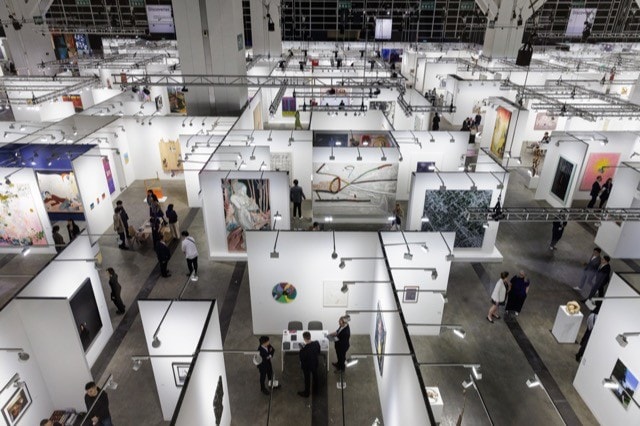
Art fairs continue to be one of the key events in the contemporary art market, but no gallery regards them as a sure-fire investment any more. Participation costs have risen, along with transport, installation and logistics expenses, whilst the financial return has become harder to predict. Yet almost no one is considering giving them up.
Art fairs remain essential not only for making sales, but also for consolidating a gallery’s international standing and for meeting collectors, curators and institutions. For galleries that have provided figures, the proportion of sales generated through art fairs ranges from 40 to 70 per cent of annual turnover, with an average of around 60 per cent.
The change mainly concerns selection: fewer events, chosen with greater care. The common trend is to take part in fewer fairs, selecting them more carefully. Whilst Luca Castiglioni (Milan) believes that art fairs ‘are no longer worthwhile’, for Dario Bonetta of A+B (Brescia) some continue to work, whilst others have gradually lost their effectiveness. RIBOT (Milan) has reduced its participation from seven fairs a year to three because, for a gallery working with young artists, the cost-benefit ratio is no longer favourable. Matèria (Rome), which takes part in an average of four fairs, emphasises that selection is now an essential condition for ensuring financial sustainability, whilst Monitor, whilst considering them necessary, believes it is strategic to reduce their number, at least in the short term.
For P420, however, fairs remain indispensable: the gallery takes part in 12 international events a year, but the selection process is increasingly rigorous and also depends on the quality of the event’s organisation, whose ability to attract collectors, curators and qualified professionals has a direct impact on the return on investment.
Martina Simeti also considers art fairs to be fundamental, but questions their current economic model. Galleries working with emerging artists incur costs similar to those of major international players, despite operating at much lower price points. The risk, she observes, is that the system will end up favouring more commercial programmes at the expense of artistic research. Hence the interest in new formats, such as Paris Internationale and Basel Social Club, which are experimenting with more sustainable models.
This view is shared by Federica Schiavo, who believes that the art fair system seems increasingly geared towards meeting the needs of large galleries, whilst small and medium-sized galleries – which play a leading role in supporting and nurturing young artists – are struggling to cope with ever-rising costs. An art fair, she observes, can no longer be automatically considered profitable, but must be assessed on the basis of overall costs, the quality of the audience, its alignment with the gallery’s programme, and its ability to generate opportunities in the medium term.
Raffaella Cortese adds a further point: today, the relationship between galleries and art fairs is increasingly integrated. Negotiations may begin in the gallery and be finalised at the art fair, or follow the reverse path, as collectors’ decision-making times have lengthened. This is also why the constant rise in costs makes it essential to exercise ever greater care in selecting the markets and events in which to invest.
More than just a venue for sales, the trade fair is becoming a tool for positioning, relationship-building and international development. Its effectiveness is no longer measured solely by the volume of sales generated during the event, but by its ability to build new commercial, institutional and cultural opportunities over time.