
Overhead cranes, new safety regulations in place
A patent is needed. Aisem: time too short, now dialogue with institutions

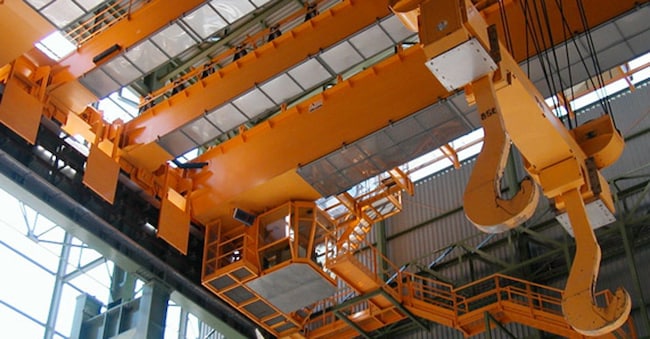
There are at least 150,000 in Italian factories. And for each of these, 3-4 operators are assumed to be involved. A wide universe that of the 'forklift operators', the workers who every day manoeuvre the lifting and moving tools that move the heaviest loads within Italian companies. A group that from 19 May (from 25, according to another interpretation, looking at the publication in the Official Gazette) must necessarily be trained in accordance with last year's State-Regions agreement. Without this training, which takes the form of a 1-1.5-day course, it will not be possible to work in the profession.
Prior to the introduction of the agreement, training on the use of equipment such as overhead cranes was already required by the Consolidated Safety at Work Act (Legislative Decree no. 81/2008), but the choice of training course remained at the discretion of the employer.
Now, on the other hand, the overhead crane has been included in the list of work equipment for which specific, standardised and predefined training is mandatory - both in terms of content and number of hours - as is already the case, for example, for forklifts.
In a note, Aisem, the Italian Association of Lifting, Elevating and Handling Systems federated within Anima Confindustria, emphasised that the time allowed for adaptation was too short compared to the vastness of the audience involved.
"The introduction of the compulsory licence for truck drivers,' comments Aisem president Massimiliano Bariola, 'highlights regulatory and institutional controversies. The distinction between the training previously provided for and the current compulsory requirement, with standards set by interinstitutional agreements, generates uncertainty and interpretative difficulties for companies. It should also be considered that some companies may still be unaware of this novelty, given the short time span between the announcement of the compulsoriness and the entry into force of the rule. Given the large number of operators involved, Aisem had asked the institutions for at least five years to complete the training courses, but this request was not granted. It is therefore necessary for the competent authorities to work together to ensure more adequate timeframes and effective training support tools, in order to reconcile safety and production continuity'.


