Towards the conference

Lega: Garavaglia secures the signatures needed to stand as a candidate; he will challenge Salvini in a secret ballot

Among those who have signed in support are Attilio Fontana, Governor of Lombardy, and Massimiliano Romeo, leader of the parliamentary group in the Senate

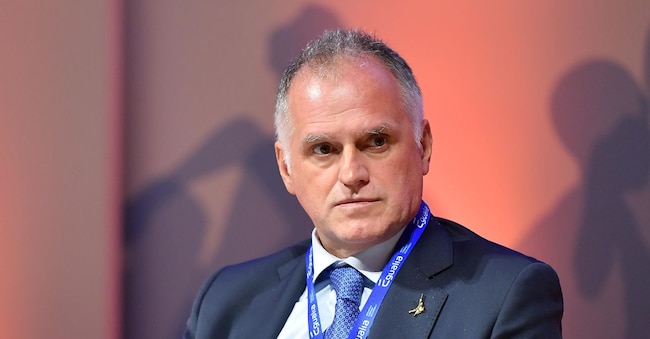
Il Presidente della Commissione Finanze e Tesoro del Senato Massimo Garavaglia in occasione dell'Osservatorio Nomisma su Il Sistema dei farmaci generici in Italia 2024 presso lÃ??auditorium dellÃ??Ara PacisRoma, 17 ottobre 2024.  ANSA/FABIO CIMAGLIA ANSA

5' min read

Translated by AI
Versione italiana

5' min read

Translated by AI
Versione italiana

Massimo Garavaglia is officially a candidate at the Lega’s extraordinary congress. The Carroccio senator has achieved his goal, having collected and submitted this morning the 80 signatures required to stand as a candidate, including that of the Governor of Lombardy Attilio Fontana and regional councillors Massimo Sertori and Claudia Terzi, as well as that of the Senate group leader Massimiliano Romeo. The signatures in support of his candidacy came largely from Lombardy – over fifty – followed by around ten from Veneto, and others from Piedmont and Trentino.

The deadline for submitting candidacies (as well as motions and proposals to amend the constitution) for the League’s extraordinary congress, scheduled for 24 and 25 October in Milan, was at 1.00 pm. For the former Minister for Tourism in the Draghi government and current chair of the Finance and Treasury Committee at the Senate – who is very close to Giancarlo Giorgetti – gathering the signatures was no easy task. He only managed to meet the target at the very last minute. Amid rumours of pressure from Salvini’s ‘Praetorian Guard’ to ensure delegates did not sign in support of the challenger – or withdrew any support they had already given – and the fear among more than a few that publicly taking a stand might jeopardise their own re-election bid.

Loading...

Toccalini: 70 per cent of signatures in Lombardy for Salvini; the campaign continues

“In Lombardy, we collected 120 signatures out of a possible 170 for Matteo Salvini, so Lombardy ends up with 70 per cent of the party’s grassroots membership choosing to continue on the path alongside Matteo Salvini,” announced Lega MP Luca Toccalini, secretary of the Lega Youth Wing, in the Chamber of Deputies. “Contrary to what has been reported in the press in recent weeks,” he added, “the figures are very clear. There are some very significant and exceptional cases, such as Bergamo, where 12 out of 20 delegates signed in support of Matteo Salvini; so this, too, somewhat undermines the narrative of the last few days.”

Garavaglia’s candidacy

Garavaglia, from Lombardy, who has decided to stand in order to bring to light the internal tensions that have been rocking the party for months, is preparing to challenge Salvini’s national-sovereignist line in the name of a ‘Bossian’-style federalism and a stronger stance on liberal economic policies (‘‘At times we have veered towards statism,’ he stated in an interview with *La Repubblica*, ‘which our electorate – made up of workers and small and medium-sized enterprises – has not always appreciated’). This stance is shared by the Governor of Lombardy, Attilio Fontana, and the Senate group leader, Massimiliano Romeo (who lead the ‘northern faction’ within the League), but also by two other heavyweights: the former Doge Luca Zaia and the governor of Friuli-Venezia Giulia Massimiliano Fedriga, who, however, have not endorsed any candidates and have not yet taken sides.

Although, in the run-up to the party conference, both have contributed – with the group leader in the Chamber of Deputies Riccardo Molinari (aligned with Salvini) – to the drafting of a Northern-led motion focusing on autonomy and federalism, as well as reviving the proposal to extend the single Special Economic Zone (SEZ) to the northern regions, to remove limits on consecutive terms for all local elected offices, and to establish SEZs in the industrial areas of the North. A motion ultimately signed by all the Northern League governors in the North. Not only the ‘Salvinian’ Alberto Stefani (Veneto) but also the ‘dissidents’ Attilio Fontana (Lombardy) and Maurizio Fugatti (Autonomous Province of Trento). And by the regional secretaries of the North, including Massimiliano Romeo (Lombardy)

Molinari: Governors’ stance on the Northern Italy motion is a sign that carries more weight than the controversy

‘This document serves to reaffirm that addressing the Northern Question is the League’s primary mission. In fact, without the League, we would not be on the verge of differentiated autonomy; we would not have secured the infrastructure investments we had been waiting for for years, thanks to Salvini; we would not have the fiscal federalism frameworks; and the government would never have considered extending the Special Economic Zones (SEZs) to the North,” said Riccardo Molinari, the Lega’s parliamentary group leader in the Chamber of Deputies, regarding the motion on the North – of which he is the lead signatory – which will be put before the Lega’s congress this weekend. “The involvement of all the regional Lega parties in the North and the governors in drafting the text is a sign that is worth more than a thousand controversies reported in the newspapers over recent months,” he added.

Motions to revive the ‘Northern Question’

The motion, of which Riccardo Molinari is the lead signatory, bears the telling title ‘The Northern Question: the driving force behind change in the country’. It effectively drives a wedge between the two camps in the name of the federalist cause that unites all the Northern League governors in the North (Fontana, Fedriga, Fugatti, Stefani and the former governor Zaia), setting as a priority for the Government’s political action “the full implementation of differentiated autonomy and fiscal federalism, whilst also assessing institutional pathways both for the creation of macro-regions and for a return to the full revitalisation of the provinces”. And, as a long-term goal, ‘to begin proposing a constitutional reform that could transform Italia into a true federal state, providing the regions with greater devolution of legislative powers and fiscal autonomy, and moving beyond the system of equal bicameralism by granting the Chamber of Deputies exclusive jurisdiction over matters of national interest, whilst a Senate of the Regions should deal with matters falling within the concurrent jurisdiction of the State and the Regions’.

In addition to supporting ‘the removal of term limits for all local elected offices’ (governors and mayors) ‘in border areas and in the industrial and logistics hubs of the North’. And to promote the establishment of “Special Economic Zones” in border areas and in the manufacturing and logistics hubs of the North, which require simplification of taxation, bureaucracy and infrastructure to support their ability to compete on international markets.

Secret ballot at the congress

The presence of two contenders automatically means a secret ballot. At the April 2025 congress in Florence, Salvini had no challengers and was re-elected by acclamation. In Milan, the 700 delegates (400 of whom are elected) are the same as those in Florence. And so the ‘Capitano’s’ victory is taken for granted by everyone. But the secrecy of the ballot box could hold a few surprises, with dissent perhaps expressed through blank ballots. In any case, it would be the margin between the first and second-placed candidates that would matter most. Those closest to Garavaglia are hoping for a result close to 30 per cent – a scenario that suggests the secretary might assign a prominent role to his challenger. For example, within the political secretariat announced by Salvini.

The new symbol

Once again, there will be the electoral symbol that is due to be voted on by the extraordinary congress on Saturday 24 October. The phrase ‘Salvini premier’ will be removed: a change that is effectively mandatory under the new electoral law, which requires the coalition’s prime ministerial candidate to be named on the ballot paper. But the redesign could go further, because, as Salvini has stated, ‘the new symbol will make it very clear who we are and where we want to go’.

Copyright reserved ©
Loading...
Loading...

Brand connect

Loading...

Newsletter

Notizie e approfondimenti sugli avvenimenti politici, economici e finanziari.

Iscriviti