
Garous Abdolmalekian and the resistance of Iranian poetry
War, love and loneliness in the verses of the intellectual who won the International Ceppo Prize

3' min read
3' min read
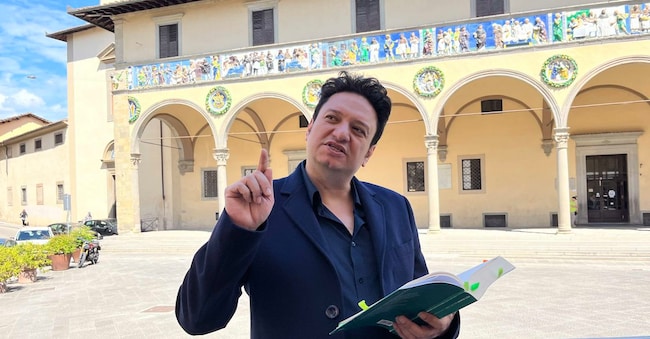
The interpretation of news events dictated by the media and the repressive climate tend to condition, to reduce to a series of stereotypes, the perception we have today of a culturally stratified country like Iran, of that Persia which still venerates the role of the poet within daily practices as the bearer of expressive freedom. If the West proves to be almost penalised by its own rationalism, enchanted by 'the word that squares from every side / our formless soul', following a fitting image by Garous Abdolmalekian, in front of a ripe orange the scientist analyses and describes, while the poet grasps the fruit to squeeze it, to smell its perfume and drink its juice. This is the function of poetic language according to the lecture that Abdolmalekian gave between Florence and Pistoia when he was awarded the sixty-ninth International Ceppo Prize. The poet would thus be a sentinel, capable in spite of himself of perceiving society's toxic signals before others, like 'a canary in a mine'.
The Resistance of Poetry
.This is the title of the chapter dedicated to Abdolmalekian that concludes the volume "Iranian Poets from 1921 to Today" (Mondadori, 2024, pp. 444, euro 24), edited by Faezeh Maradari with translations by him and Francesco Occhetto. Rising in the wake of the third generation of New Poetry, her literary experience stands out as one of the most representative of the currents of civil commitment following the 1979 Revolution and the following conflict between Iran and Iraq (1980-88), which she experienced first-hand during her early childhood: "The bomb fell on the school / we wanted to shout for help / we wanted to call our children by name / but even the letters of the alphabet were on fire" (from "Trilogy of the Middle East", 2018). Concise, direct and devoid of rhetoric, his pen moves from an intimate perspective to intensify and vibrate when he deals with the human condition and, in particular, with popular protests against the regime and Israel's recent missile offence with US placet: "The war is burning / and the firefighters / they don't know how to put out the murder".
War, love, loneliness
President Trump has often simplified complex global issues into binary slogans and narratives ('friend/foe', 'strong/weak'), whereas Abdolmalekian proposes a verse that digs, seeking ambiguity and, above all, empathy. The poetic word resists the amplification of the ego on screens, the debasement of the other from itself to a threat, and reacts by setting up an alternative form of relationship; that of understanding. His writing succeeds in 'thinking with the imagination', as the mysterious aspect of each image is the very body of thought, inventing vivid atmospheres through an objective, concrete and comprehensible imaginal world. Paraphrasing the Hegelian drift concept of the 'hidden found', or 'hidden manifest', the poet discovers a treasure and then unearths it, so that the reader may find a richer treasure than the one hidden by the writer.
Wandering in the Dark
."Poetry is a fire in the ground" that the reader can only access through a gesture of discovery, revolutionary at the juncture of accepting others' vision of reality. "The attention to recent and past history is never separated from the instances of singing to bring the lives of others to fulfilment," comments Paolo Fabrizio Iacuzzi, president of the prize. "Abdolmalekian's dissent against marginalisation and abuse is never separated from the epic quality of his voice, capable of reactivating the great tradition of Persian poetry. In Iran, manuscripts have always been endangered due to social-political changes and turmoil, so the dissemination of poetry was very limited; however, its melodic function allowed it to be memorised and passed down from one generation to the next, grafting itself into the collective memory through oral transmission: "In my land / Where do the songs migrate? / Where do the ballads hide? / Where do the poems go?"

