
Gas, half of the national storage in Lombardy
In the region, the Hydrocarbons Fund distributes approximately 200,000 euro annually to the mining territories, plus 876,000 euro for the municipalities with reserves

Key points
Lombardy, a region of gas reserves, hosts the largest number of storage concessions: 6 of the 15 national ones, covering 301 square kilometres, are in fact here in Bordolano, Brugherio, Cornegliano, Ripalta, Sergnano and Settala. Emilia-Romagna has another 5, covering 388 square kilometres, followed by Abruzzo with 2 and Basilicata, Molise and Veneto with 1 each. This is certified by the latest official Bulletin of hydrocarbons and geo-resources, published by the Ministry of the Environment and Energy Security and updated to 28 February 2026. A slow-moving photograph, but one that for Lombardy bears witness to both the history of geological exploitation in the region and its fundamental role in the development of gas production in Italia.
It all began in the municipality of Cavenago D'Adda, in the province of Lodi: here Agip drilled Caviaga 1, "the first gas well in Italia," says Innocenzo Titone, president of Apve (Eni's Pioneers and Veterans Association). "The Caviaga field," he continues, "is a large natural gas field, the first of considerable size in Western Europe with reserves of 12 billion cubic metres and sufficient pressure to allow it to be transported over long distances. The first discovery in Caviaga dates back to 1944, at a depth of 1,300 metres. Other discoveries followed at Ripalta Cremasca in 1948, at Cortemaggiore in 1949, between Piacenza and Cremona, and at Bordolano, also in the Cremona area, in 1951. These drillings made it possible to start with the distribution of gas to the industries of the Po Valley, an engine to revive the post-war economy'.
Gas reserves
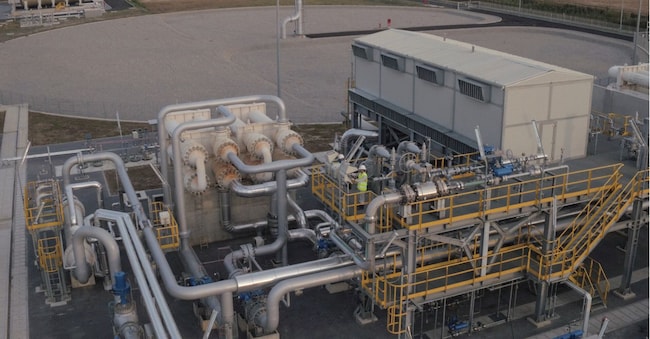
Italy's pioneering gas epic, which later moved to Emilia-Romagna and the Ravenna Sea, left Lombardy with a predisposition for the evolution of production: the storage of gas reserves. "Storage represents the reuse of depleted fields," Titone further explains. 'Many old fields are still used to store gas reserves,' he adds. 'Not all of them are suitable. Lombardy has reservoirs formed from sandstone, a porous and permeable rock that allows it to receive and return gas at its best, as well as guaranteeing a longer life for the reservoir. Many are exhausted and therefore available. Also thanks to this, Lombardy has reinvented itself'.
Looking at the map, one can see how many storage concessions coincide with or adjoin territories linked to mining concessions, especially those that have been terminated. "Lombardy certainly plays a role in national energy security," notes Giorgio Maione, the Lombardy Region's councillor for the Environment and Climate, on the subject of gas storage in the region. "If we think of the current geopolitical situations, certainly having a certain storage capacity can be useful for our companies,' he emphasises. 'This is also thanks to the State-Region Agreement, thanks to which the gas storage facilities have been implemented over time with the implementation of a micro-seismic monitoring network to guarantee the monitoring of local seismicity and any effects due to gas pumping and delivery activities over time. Significant sites are active with a total capacity of about 9.7 billion cubic metres of gas. The majority of the Italian reserves, which have a storage capacity of 18 billion cubic metres (one sixth of the European one) guaranteed by the 13 active sites. In Lombardy, as mentioned, there are 6 of them: Settala, Brugherio, Sergnano, Ripalta, Bordolano under Stogit, a Snam subsidiary, and the Cornegliano site of Ital Gas Storage.
Production
Again according to data from the Ministry of the Environment, in Italy there are 83 concessions for the cultivation, i.e. production, of hydrocarbons on land, and Lombardy is fourth in terms of absolute number of concessions with 8 (some in condominium with neighbouring regions): Cascina Castello, Casteggio, Caviaga, Mirandola (for which a request for total renunciation has been filed), Pontetidone, Settala, Vescovato, Villafortuna-Trecate. It is behind Emilia-Romagna's 33, Marche's 14 and Basilicata's 11, and is fifth in terms of surface area with 201 square kilometres, behind Basilicata (1,072 square kilometres), Emilia-Romagna (742 square kilometres), Marche (402 square kilometres) and Tuscany (308 square kilometres). Out of 36 mining concessions that have been terminated pending mining restoration in Italy, 9 are in Lombardy (national record): Bagnolo Mella, Canonica, Cignone, Cortemaggiore, Gaggiano, Ovanengo, Pessano, San Gervasio, Soresina.


