Quotations at Ttf

Gas under 25 euro: European prices never so low in February since 2021

Record stocks, rising temperatures and increased use of renewables are easing market tensions. But risks on the horizon have not disappeared completely

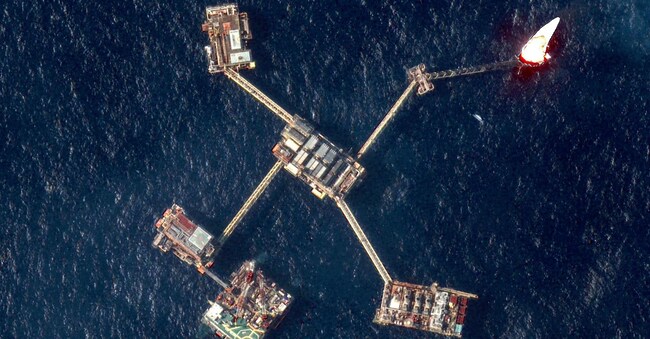
by Sissi Bellomo

Una piattaforma per l’estrazione del gas. Maxar Technologies/Handout via REUTERS

2' min read

2' min read

Spring has come early on the European gas market, where the price continues to fall. Even the 25 euro per Megawatt threshold gave way at the Ttf, the reference hub for the Old Continent, where a low of 24.5 euro was reached on Wednesday 14.

Fuel had not traded at such a low price for eight months. And to find similar valuations in the winter period one has to go further back in time, to 2021, when the war in Ukraine had not yet started and Russian gas was supplying us in large quantities, with low costs.

Loading...

The great energy crisis, which peaked in 2022, had sent gas prices soaring to values above EUR 340/MW.

The emergency now seems far away, although betting on a further sharp reduction in prices risks being a gamble given that much of Europe's needs today are met by liquefied gas (structurally more expensive than that delivered by pipeline) and given the uncertainties that still remain on the horizon. These include the expiry at the end of the year of the contract for the transit of Gazprom's supplies to Ukraine, which have not yet been cleared.

In Italy, for instance, Russian gas still arrives (precisely via Ukraine), albeit to a much smaller extent than before and under contracts that cannot be easily terminated. Austria - which does not have a sea border and cannot directly import LNG - has even increased its dependence on Moscow, to a staggering 98% in December: a figure that has raised a scandal in Vienna, prompting the Energy Ministry to study solutions to allow Omv to escape its legal obligations with Gazprom.

Accelerating the fall of gas prices in Europe is the weather: the weather has been fairly mild this winter, except for short periods of intense cold. Spring will soon really arrive. And stocks continue to be very high: EU storages are still 67% full according to the latest Gie data (referring to 12 February), an all-time record for this time of year. The seasonal average over the last ten years indicates a filling of 49%.

It is not only the climate that is relieving the demand for gas. European consumption has also shrunk, partly structurally. Among the causes is the slowdown in industry (especially in the most energy-intensive sectors) there is also the advance of clean sources (including nuclear and hydro, which have recovered after a disastrous 2022).

Europe derived a record share of electricity from renewables in 2023: as much as 44% according to Ember. In contrast, generation from gas plummeted by 15% (to 452 TWh, 17% of the mix), 'the largest annual reduction since at least 1990', comments the analyst firm.

After a long time, however, there is a turnaround on the demand side: in January, notes Greg Molnar, analyst at the IEA, there was even a double-digit percentage increase compared to a year earlier, around 12% (although the comparison is with very low levels). It has been much colder this year than in January 2023, Molnar explains. But there has also been a 4% rebound in power plant consumption. Moreover, thanks to the lower prices, 'we continue to see industrial consumption rebound as well'.


Copyright reserved ©

Brand connect

Loading...

Newsletter

Notizie e approfondimenti sugli avvenimenti politici, economici e finanziari.

Iscriviti