Middle East

Gaza, the fourth winter of war: hundreds of thousands of displaced people in the cold

Yet another flood in Gaza, which submerged over 70,000 tents, occurred on the very day that, just a few dozen kilometres away, Israeli President Isaac Herzog informed the leader of the Yashar party, Gadi Eisenkot, of his intention to task him with forming the new government

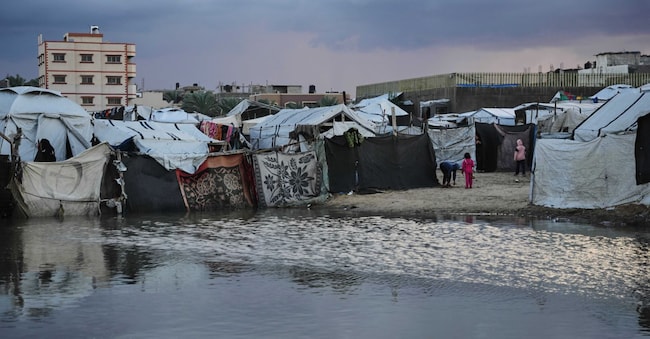
Bambini palestinesi sfollati camminano in un campo tendato inondato dalla pioggia dopo un forte acquazzone a Deir al-Balah, nella Striscia di Gaza centrale, sabato 7 novembre 2026. (Foto AP/Abdel Kareem Hana)      Associated Press/ LaPresse Solo Italia e Spagna APN

3' min read

Translated by AI
Versione italiana

3' min read

Translated by AI
Versione italiana

From our correspondent

“Imagine having to choose between staying in a flooded tent or seeking shelter in a building that could collapse on top of you at any moment.” As Dr Raed Sabba tells us from Gaza about the hardships of the past few hours, we can hear the incessant rain falling.

Loading...

Yet another flood in Gaza, which submerged over 70,000 tents, occurred on the very day that, just a few dozen kilometres away, Israeli President Isaac Herzog informed the leader of the Yashar party, Gadi Eisenkot, of his intention to task him with forming the new government. President Herzog has invited Eisenkot to the presidential residence, where, at 5.00 pm tomorrow, he will officially entrust him with the task of forming the government.

The next Israeli government will have to decide the future of the Gaza Strip and find a practical solution for the disarmament of Hamas. But that is not all. It will have to find a way to alleviate a very serious humanitarian crisis. The heavy rains that fell on the Gaza Strip yesterday have caused severe disruption. Many buildings, already damaged by the war, have partially collapsed. There are reports of people injured as a result of walls and roofs giving way.

Piove a Gaza, migliaia di tende allagate: "Questa non è vita"

This is the fourth winter of the war. In Gaza, hundreds of thousands of displaced people are living in tents and makeshift shelters, often without waterproofing, heating or sanitation facilities. Water seeps in everywhere, soaking mattresses, blankets and clothes. In some camps, it reaches a depth of 40 centimetres. Entire families spend their nights in the cold and damp. The risk of respiratory illnesses is rising, particularly for malnourished children and the elderly. For newborns, there is the added danger of hypothermia.

Then there is the threat of contaminated water. Drinking water is also in short supply. As if that were not enough, this already dire situation is compounded by overcrowded hospitals where medicines are in short supply.

The peace plan announced by Donald Trump a year ago appears to have crystallised into a low-intensity conflict. It is difficult to speak of a ceasefire when, according to figures reported by medical sources in Gaza, bombings and gunfire have claimed over 1,500 lives in twelve months, the vast majority of whom were civilians.

A Gaza campi profughi allagati, un palestinese sfollato: "Non abbiamo più un posto dove dormire"

Meanwhile, things are heating up in Israel. The path to forming a governing majority remains complicated and fraught with obstacles.

It was Avigdor Lieberman, leader of the right-wing, Russian-speaking and secular party Israel Beitenu, who once again set the boundaries yesterday. Lieberman ruled out a minority government supported from outside by the Arab parties, but left the door open to an agreement with the ultra-Orthodox, who have long been his historic adversaries. The leader of Israel Beitenu even said he was willing to compromise on universal conscription, hitherto one of his non-negotiable principles.

Eisenkot, for his part, insists that all Israeli citizens must undertake military or civilian service. This is one of the most difficult issues in the negotiations. After three years of war, discontent is growing amongst those who have fought – particularly amongst centre and left-wing voters – over exemptions.

Loading...
Gaza, piogge torrenziali sulla Striscia: inondante le tende degli sfollati

Amid this turbulent climate, the outgoing Prime Minister Benjamin Netanyahu, who was defeated in the elections, has once again called for a government of national unity. ‘If Likud and its allies are suddenly interested in unity and a broad-based coalition government, they are more than welcome to publicly announce the breakdown of their alliance with the extremists, their acceptance of Gadi Eisenkot’s four principles, and their willingness to join a government led by Prime Minister Eisenkot,’ replied Yashar, Eisenkot’s party, almost immediately. A statement that sounds like a provocation.

Meanwhile, in Gaza, it continued to rain last night. Dr Sabba concludes: ‘Perhaps what hurts the most is seeing how this suffering is gradually coming to be regarded as normal, as if it were now acceptable for children to spend yet another winter surrounded by water, cold and fear, whilst the world continues to issue statements of concern.’

Copyright reserved ©
Loading...

Brand connect

Loading...

Newsletter

Notizie e approfondimenti sugli avvenimenti politici, economici e finanziari.

Iscriviti