
Glimpses and frames of dust and light
The writer tells how she took over a cinema in a Hungarian village. A magnificent reflection on the love of the big screen and the cinema

4' min read
Key points
- John Berger's exergue
- Everyone has their own epic memory linked to a projection
4' min read
Sometimes books have imaginative, evocative, somewhat clever, mélo or deviant names.
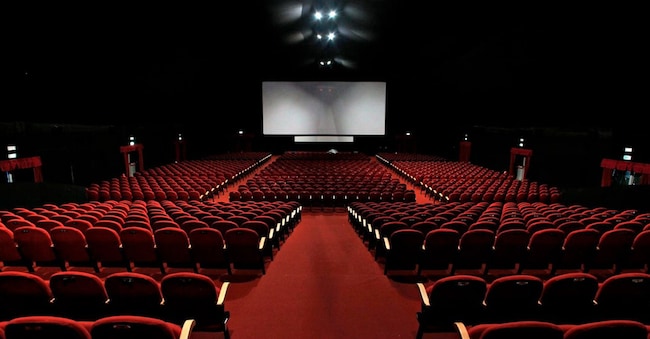
Of Light and Dust by Esther Kinsky, on the other hand, has a perfect correspondence between content, title and cover, created with a landscape of primary colours - red, green, yellow -, which the German author herself seeks out as she delves into Hungary. She is hungry for a plain in which to lose herself, similar to her father's childhood heimat, so flat that she can already see the train carriages on the horizon hours before their arrival. Instead, he finds an abandoned cinema, the Mozi, in a small village and decides to put it back together with a couple of co-stars, 'electrocuted' by mutual passion inside a cinema. In this region, where lacks and absences prevail, the author's gaze generates a new setting, full, in the warm season, of sunflowers, corn, acacias and many poppies. Of Light and Dust speaks above all of the frames with which we delimit our gaze and of an adventure that inevitably drags along a reflection on the love of the big screen and the "humanity" of the cinema, a place in which "all gazes" are turned "in the same direction", the one "established by the projectionist, invisible to the audience". Kinsky does not make cinephilia a truncated warning, a 'wise old man's' advice, he only shows a stubborn and gentle attachment to the hall as a mythical place. He accompanies the reader, does not instigate him, does not berate him: 'watching is a skill that is learned.... A skill of which one slowly becomes aware'.
John Berger's exergue
It is no coincidence that the es of the second chapter is a phrase from John Berger, the king of the gaze. The cinema is, in fact, training, which becomes an addiction, or rather, a nostalgia, the kind one feels when thinking of loved ones. Or an 'other-world', on which we climb even when we are out of the theatre, a mental room, where the memories of the projected images and the memory of our body are activated with respect to the screen: front row, back, right, left. Kinsky had also spoken about memory and perception in a book about the earthquake in Friuli in 1976 (Rombo, Iperborea, 2023) with acumen and without rhetoric, identifying the collective trauma. In the last work, the underground cordon that holds everything together is childhood: there is the homage to her father, who occasionally took her and her brothers to 'a cinema near the station, where they showed a short film, a movie and a newsreel on a continuous loop'. Here the first collective experience takes place, which has little to do with cinephilia. It is more of a sensorial and choral affair: the possibility of joining 'the meagre audience at any time, looking for a seat by the faint glow of the mask's torch and sitting down'. The hidden beauty of being able to spend the whole day there, as a refuge and den to shelter from the weather, or a few hours waiting for the train, amidst the clouds of nicotine floating in the hall, where a stale smell lingers.
Everyone has their own epic memory linked to a projection
.Everyone has their own epic memory linked to a screening. For me, it was the evening viewing ofA Prophet by Jacques Audiard in the old (now closed) hundreds-seat theatre hall in Grado. Until the very last, I was the only spectator in the vast audience and I prayed fervently to be alone. But two minutes before the start, a couple and a gentleman arrived. Gradually I got used to fighting the idea of their presence as an intrusion and sharing the suspense in physical postures. Eventually, we left silently and quickly so as not to cross glances and comments. Each of us, however, knows that the other three were for two hours 'film brothers'. For Kinsky, the cinematic madeleine is 'the heavy rough felt curtain at the entrance, with the lower corners of leather or imitation leather crawling on the linoleum floor, the mask with the curled hair and the tired face, who was always worrying about finding us a row where there was no one'. The writer's father often left his children at the cinema, as if he were a nanny, and went to do chores, turning the cinema into a place of care, regardless of the content of the film. At the end, nobody commented, but the writer was always left with the suspicion that the father wanted to leave his children a message through the screen. As in the film in which a train was seen crossing an immense plain, similar to that experienced by the father as a child. Kinsky learnt to experience the gaze as a camera: 'Winter Morning as the first film: a montage of different perspectives and orientations... Passing from one window to another of the house to see the outside transformed into glimpses ... and complete with the story, glimpses that outside, having renounced their own frame, became points of reference thanks to which the 'I' looking on determines its own position'. The cinema is an element of destabilisation, a point of confrontation. The infamous debates after the screening are none other than this, training in the other's point of view. 'Every village a film, I thought. Every window a cinema'.
© REPRODUCTION RESERVED
Esther Kinsky


