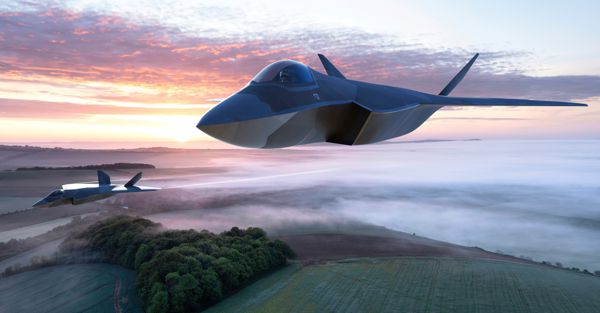
Gcap, on 13 December the agreement on sixth-generation fighters with Great Britain and Japan. Hypothesis of enlargement to Saudi Arabia
For Italy, the new aircraft are destined, as reiterated by the government also in parliament, to replace the Eurofighter fleet as of 2035

4' min read
Key points
4' min read
The road to 2035, when the sixth-generation fighter-bomber, which will replace the Eurofighter, will enter service, marks yet another milestone. The project is being carried out by Italy, the UK and Japan (but could welcome other countries in the future). Earlier this week, Roberto Cingolani, CEO of Leonardo - the lead company for Italy, together with Bae Systems (UK) and Mitsubishi Heavy Industries (Japan) - anticipated that the agreement for the Gcap (Global Combat Air Program) will be signed on 13 December.
The programme
.The Gcap programme consists of a sixth-generation combat aircraft system, integrated with unmanned cooperative systems, satellites and other military assets. The project envisages that all elements of the system are connected by an 'intelligent' network, based on a dedicated cloud architecture, artificial intelligence and next-generation datalinks. For Italy, the new aircraft are destined, as reiterated by the government also in parliament, to replace the Eurofighter fleet starting in 2035, with an operational life extended into the last decades of the century. The project has a leading role for the government. "The Global Combat Air Program is an initiative of strategic importance in both political and industrial terms," stressed Prime Minister Giorgia Meloni, in a video message to the Pontignano Conference, organised by the British Embassy in Italy and the British Council.
Crosetto: Gcap programme goes the way of Elon Musk
Italy's participation in the sixth-generation Gcap fighter programme, stressed Defence Minister Guido Crosetto, speaking during question time at the Senate, 'will give us access to a technological elite of absolute excellence in the world. It can be a turning point in the aerospace field that goes in that line indicated by Elon Musk, which can overcome even the human element in flight'. "It is an ambitious programme," the minister added, "which will not compete" with the F35 programme. "I think this cooperation between countries is important both technologically and economically, and the fact that other countries want to join in is an indication of the confidence that this programme is inspiring in the world." As for the F35, he added, 'it is a programme that has not only brought significant benefits to Defence - it is a choice relevant to the Armed Forces of administrations preceding mine, which I agree with, however, because in the end it is a unique deterrence tool in the world - but it has also ensured a significant social spin-off'. (
Leonardo: 'JV for Gcap development coming soon'
Speaking a few days after Cingolani's statements at a hearing before the Senate Foreign Affairs and Defence Committee, Leonardo's chief Gcap officer, Guglielmo Maviglia, provided some details on what the next steps will be. After the go-ahead from Italy, the UK, and Japan, which 'will make it possible to officially launch the activities of the agency responsible for managing the programme on behalf of the three nations,' the lead companies, he explained, 'aim to sign a joint venture agreement shortly to create the new company that will lead the design and development of the Gcap. The two entities will work together, agency and joint venture, and will be staffed by personnel from all three nations to maximise collaboration and sharing, ensuring effectiveness, efficiency and timeliness in programme management'.
Tajani: I think the Gcap will expand to Saudi Arabia
The programme was initially initiated between Italy, the UK and Sweden, who signed a Memorandum of Understanding in December 2020. Sweden later abandoned the project, while Japan decided to join it. The same could happen for other countries. "I think that the Gcap agreement with Great Britain and Japan on combat aircraft will now be extended to Saudi Arabia," said Deputy Prime Minister and Foreign Minister Antonio Tajani on 27 November, speaking at the Forza Italia conference 'European Defence: Challenges and Opportunities' in the Chamber of Deputies. Asked about the timing of the enlargement to the new partner, Tajani replied: 'We are working'.