
Geberit grows in the Italian market and invests in Gaeta and Villadose
The Swiss bathroom group celebrates its 150th birthday and expects sales to hold steady in our country, thanks in part to incentives
by Giovanna Mancini
 Aggiungi Il Sole 24 Ore
ai preferiti su Google
2' min read
2' min read
Founded as a cottage industry in the small town of Rapperswil on Lake Zurich, the Swiss Geberit Group is today an international giant in the bathroom sector, with more than CHF 3 billion in turnover, 10,000 employees worldwide, 26 production facilities, four of them outside Europe in three main product lines: sanitary ware, drainage and supply systems, and ceramics.
Italy third largest market for the group
.Listed since 1999, the group has experienced great and rapid growth over the past 25 years and is now celebrating its 150th anniversary with a series of initiatives centred on Italy, in particular during the April design week in Milan. Italy is after all the third most important market for the group (with about 7% of total turnover), after Germany, which accounts for about one third, and Switzerland, which generates about 15% of revenues. And it is one of the few that also grew in 2023 (+1.9% compared to 2022), a year that was not easy for the market as a whole and which saw Geberit's turnover fall by 9.1%, although with positive margins of 30% of revenues.
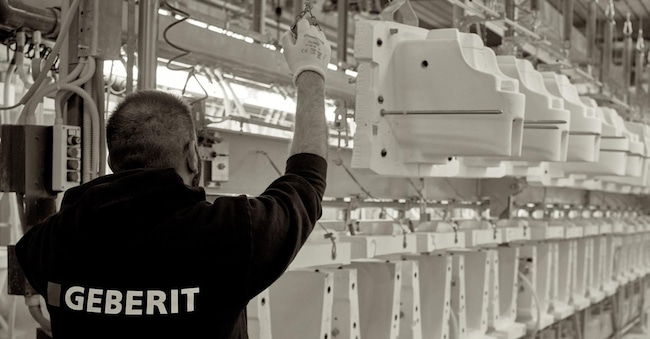
Not only that: our country is also strategic from a manufacturing point of view, with two production plants and around 600 employees, of which around 150 in Villaodse, where it concentrates the production of waste pipes for the European market, and 350 in Gaeta (Latina), a production site for ceramics taken over following the acquisition in 2015 of the Sanitec group, which includes a dozen prestigious brands, including the Italian Pozzi Ginori. Geberit also has a sales subsidiary in Lugano.
Investments in Gaeta and Villadose
"The Gaeta plant has an extremely high level of know-how," explains Giorgio Castiglioni, General Manager of Geberit Marketing and Distribution. "It is one of the group's top five factories, specialising however on a niche product. Villadose, on the other hand, is strategic not only for its production, but also because it is located in a favourable area in terms of logistics and infrastructure'. The investments on the Italian factories, therefore, continue: in the last 7-8 years, about 40-50 million Euro have been invested on Gaeta alone.
The Italian market is expected to remain positive again this year, albeit without the peaks of recent years, thanks also to the continuation, albeit partial, of the building incentives that have certainly helped to support sales in Italy over the past year.

