Cars

Geely: its strategies, technologies and upcoming models

The Chinese company, which has strong roots in Europe, unveils its expansion strategies at the Paris Motor Show

5' min read

Translated by AI
Versione italiana

5' min read

Translated by AI
Versione italiana

Ten major Chinese car manufacturers at the same motor show: this has never happened before in Paris. In the halls at Porte de Versailles, Chinese brands are occupying spaces that, until a few years ago, belonged to the big European names, and some are talking of a sudden invasion. But those in the industry who say this are telling a convenient story, not the true one. The case of Geely illustrates this better than any other.

Twenty years in Europe: those who saw it coming looked the other way

“Perhaps many of you are only just becoming familiar with our brand,” began Aiden He, Geely’s European CEO, at a press conference, “but our ties with Europe go back a long way.” That is indeed the case. It may well be that consumers are only just discovering the Geely brand. The European industry cannot say the same: it has signed agreements with Geely, sold companies and shared factories. The group, which is celebrating its 40th anniversary this year, has been in Europe for twenty years: first came the acquisition of the manufacturer of London’s black cabs, then in 2010 the purchase of Volvo Cars, followed by Lotus; a substantial stake in Mercedes-Benz and the 50-50 joint venture for smart; engines developed with Renault under the Horse project. And now the Ford plant in Valencia, where two Geely electric SUVs will roll off the production line from 2028. Added to this are research and development centres in Sweden and Germany and a design centre in Milan.
Loading...

Geely, whose group also includes Lynk & Co and Zeekr, entered the Italian market in July 2025, but the groundwork had been laid some time before. It is now present in 27 European markets with over 450 sales and service outlets, and in September alone it sold 6,700 cars on the continent, with monthly sales having almost quintupled since March. “The competition we’re looking at isn’t just Chinese brands,” explains He. “We’re looking at manufacturers who’ve been here for some time and produce locally. We must learn with humility, stay and consolidate our position. Then grow, step by step.”

Geely, after all, has already chosen its path, which, once fully operational, will not consist solely of imports from the East. “If you really want to establish a presence in Europe, localisation is essential,” says He. “It’s not just a question of tariffs: if you want to sell in significant volumes, manufacturing in Europe is essential.” It’s a question of responsiveness and delivery times. Moreover, the title of the press conference, “In Europe. More For Europe”, reveals the intention: to put down roots in the European industrial fabric.
A growing range

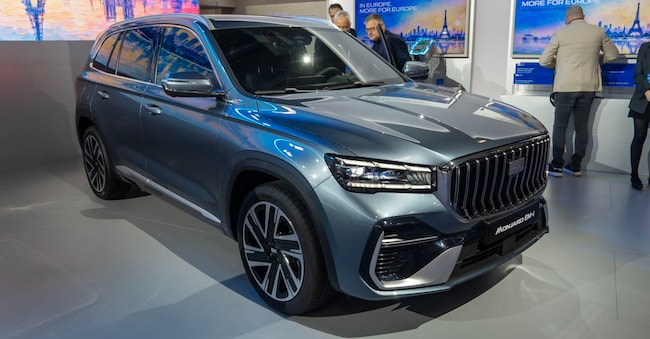
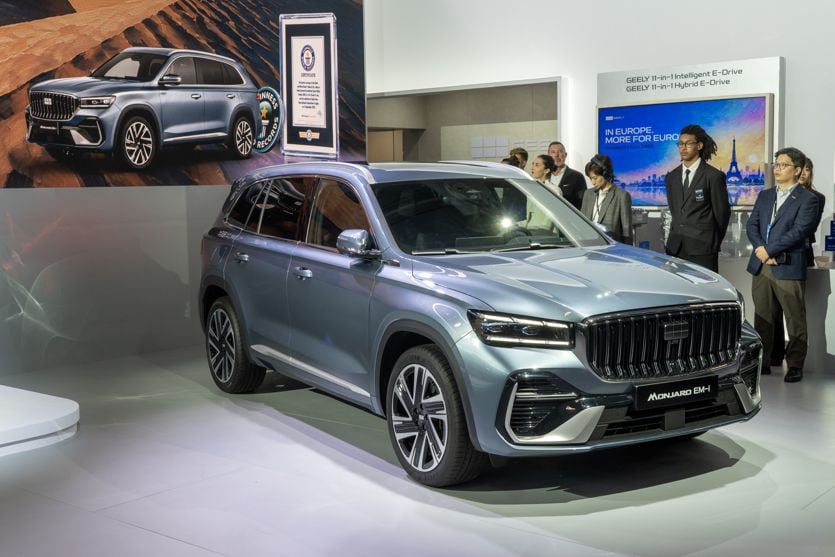
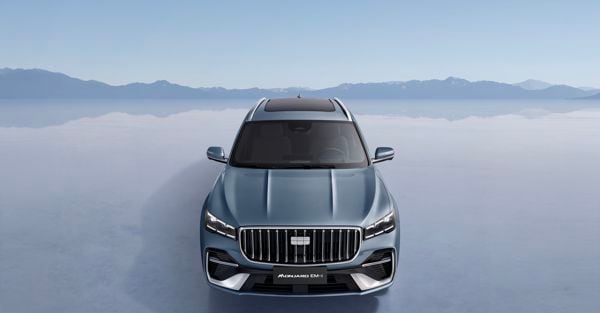
In Paris, Gelly showcased the latest additions to its range, which is now becoming more comprehensive. The most significant new addition is the Monjaro EM-i, the flagship plug-in hybrid SUV, making its European debut: 4.80 metres long, delivering up to 246 kW and 667 Nm in the all-wheel-drive version, 0–100 in 5.8 seconds, 116 km in electric mode and over 900 km of total range, with a power extender mode for those who still prefer electric driving. It will arrive in early 2027.
Then came the final twist, the ‘One More Thing’ announced by He at the end of the conference: Project KO11, a high-performance plug-in hybrid off-roader that takes on the most sophisticated Western 4x4s, expected in Europe by the end of 2027. Also on display in Paris were the E5, the electric SUV already on the market which is, however, changing its name (it was previously called the EX5) and now features higher-capacity batteries (from €39,900), and the Starray EM-i, a plug-in hybrid SUV with a 136 km electric range, starting at 35,900 euros.

And under the Zeekr brand comes the colossal 9X, a hyper-powerful and hyper-equipped luxury SUV (complete with a retractable OLED TV for passengers), weighing in at over 3 tonnes, due to arrive in January at around 120,000 euros. A stylistic statement designed to show that the Geely Group sets no limits, even at the top end of the market, and which offers a glimpse of what the design and features of a more modestly positioned 8X might look like in the future.

The E2: the real test of the market

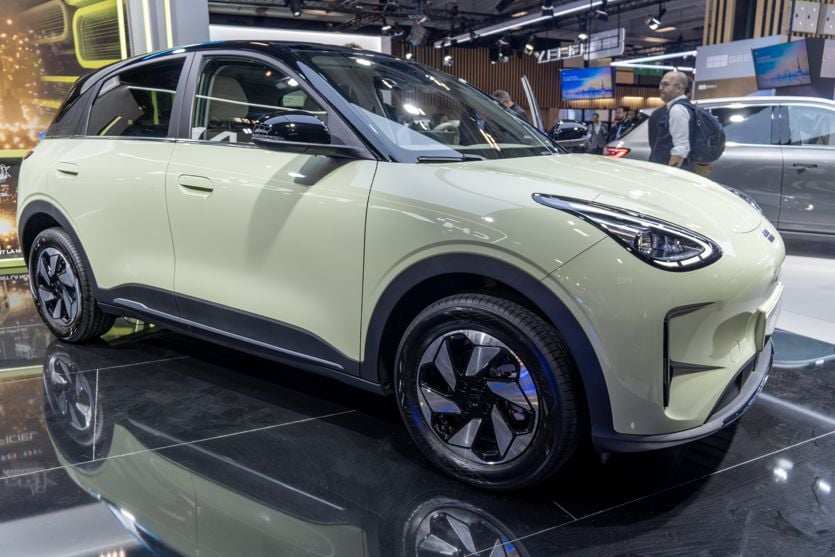
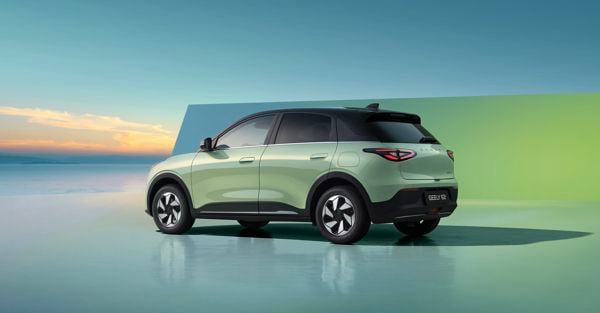
But the most dangerous model for European manufacturers is the smallest one. The E2, due to be launched shortly, was the best-selling car in China last season, with over 800,000 units sold in less than two years: it is set to arrive in Italian showrooms in a matter of weeks, with the first deliveries scheduled for November. This marks Geely’s first direct assault on the heart of the European market – the small car segment – albeit in a fully electric version, with an entry-level price comparable to that of a petrol or diesel model: 20,900 euros.

It is not the same car as the one sold in China. For the European market, it has been thoroughly revised: new electronics, sensors and software have enabled it to achieve a 5-star Euro NCAP rating under the new, stricter 2026 protocol; the suspension has been retuned to suit European tastes; there are even a few more physical buttons. “In China, people use the screen more; here, we need buttons,” admits He. “The five-star rating on such a small car shows that the brand can be trusted,” adds Marco Santucci, who heads Geely in Italia. In short, the narrative often put forward by European manufacturers – that Chinese-made cars are unsafe – should probably be viewed more critically and with the necessary caveats.

How does the E2 perform on the road?

If we had to choose an adjective to describe the E2, we’d say ‘desirable’. We drove it through Parisian traffic, and the first thing that strikes you is its handling, which is truly European: not too soft, you can feel the bumps without them being uncomfortable, and the handling remains precise at all times. The rear-wheel drive with a multi-link rear suspension – a rarity in this segment – helps. It’s agile in traffic, with a turning circle of 9.9 metres. The only criticism: the steering is perhaps a little too power-assisted, but the power-steering response can be adjusted via the menu.

Loading...

The dimensions can be misleading. On the outside, it’s 4.13 metres long; on the inside, thanks to the long wheelbase and flat rear floor, there’s plenty of room for five people, both in terms of width and legroom. The boot is generous for its class, and there’s also a 70-litre storage compartment in the bonnet, which is ideal for cables and a few extra bits and pieces. The equipment is on a par with the next segment up: heated seats, 360-degree cameras, the Flyme Auto system with a large central display, and high-quality finishes – though the inevitable use of plastics is a slight drawback. The styling isn’t aggressive, nor is the car itself: the E2, whilst offering the typical acceleration of an electric vehicle at low revs, prioritises comfort over performance. In town, we achieved a consumption of around 13 kWh/100 km, a good figure, albeit not a record-breaking one.

There are three versions: the Pro, priced at 20,900 euros, with a 35 kWh battery and a WLTP range of 252 km; the Max and Ultra, priced at €22,900 and €24,900 respectively, with a 47 kWh battery, 116 CV and a range of 345 km. European city cars, electric or otherwise, have been warned. And the E2 has everything it takes to win over Italian cities, especially amongst those who have a garage or a parking space where they can recharge.

Copyright reserved ©
Loading...

Brand connect

Loading...

Newsletter

Notizie e approfondimenti sugli avvenimenti politici, economici e finanziari.

Iscriviti