Digital Economy

Gemini 2.0, Mariner and Deep Research Google's search assistant arrives

From today, the Gemini 2.0 Flash experimental model will be available to everyone. New function called Deep Research also presented

5' min read

5' min read

Gemini 2.0 arrives and promises to help us even more in our lives, work, 'thanks to new advances in multimodality, such as native output of images and audio, and the native use of tools, it will allow us to build new AI agents that will bring us closer to our vision of a universal assistant,' says Sundar Pichai, CEO of Alphabet (Google) presenting the new version of the AI model. IlSole24Ore participated, with some 70 other international journalists, in the presentation of the model and other experimental features.

Gemini 2.0

.

"Today we are putting version 2.0 in the hands of trusted developers and testers. And we are working quickly to get it into our products, primarily Gemini (voice assistance, ed.) and Search," Pichai continues. "Starting today, the Gemini 2.0 Flash experimental model will be available to all Gemini users. We are also launching a new feature called Deep Research, which uses advanced reasoning and long context capabilities to act as a research assistant, exploring complex topics and compiling reports on behalf of the user. It is available from today in Gemini Advanced,' the manager summarises.

Loading...

Many are working on so-called reasoning: a few days ago, OpenAi launched the final version of the Gpt 01 model centred on these capabilities for solving complex problems.

There is also news in the area of search, which Google promises to revolutionise in 2024, in response to the advance of alternative search engines equipped with AI (Bing, Chatgpt) and its loss of market share.

Alphabet is introducing Gemini 2.0's advanced reasoning capabilities into its search engine's AI Tabs, "to address more complex topics and multi-step queries, including advanced mathematical equations, multimodal queries and coding. We started a limited test phase this week and will roll it out more widely early next year'. As is known, Google's AI is not yet in search in Europe, but the absence will be short-lived: 'over the next year we will continue to bring AI overviews to other countries and languages,' says Pichai.
Today's latest announcement concerns a chip: Gemini is built on custom hardware such as Trillium, Google's sixth-generation TPUs. "TPUs powered 100 per cent of Gemini 2.0's training and inference, and today Trillium is available for customers to build on," says Pichai. Google, like other big tech, is in short working on dedicated AI chips available on the market, competing with the leader that is Nvidia.

Experimental projects: agents

.

Google also presented the developments of experimental projects, which fall under the umbrella of 'AI agents'. Systems that do actions on behalf of the user, with a certain level of autonomy. According to various experts and a recent Gartner report, this is probably where the future of AI lies: not just content production but complete actions, to improve worker productivity and help us better in our daily lives. This is an area that has yet to be built, with ample risks of which Google says it is aware. Hence the decision to keep these projects still experimental, with a limited number of testers.

The presentation showed a video of a person with smart glasses walking around the city of London. He goggles a lock with a keypad and asks Gemini to remind him of the code. He frames a bus and wants to know where it goes. He walks around the city and asks about monuments and other things by voice. These are things that in part and in a more limited way can already be done with the AI assistants built into iPhone and Samsung smartphones. OpenAI has some of these functions on Chatgpt and is in the process of extending them to allow full AI interaction via the mobile phone camera ("can you explain the formulas you see on this piece of paper?").

Google wanted to show it was no different and in addition added full integration between these functions and Google Search, Lens and Maps, and the ability to store up to ten minutes of user sessions. The experimental project is called Project Astra.

What is projetc Mariner?

Another is Project Mariner: an AI agent that sits on our browser and does actions for us. An example shown in the presentation: you ask it to browse certain companies' sites and collect contact data and it does it automatically, then gives you the information. Microsoft and Anthropic are also working on agents integrated in the operating system or in applications, as is Salesforce. After all, generative AI is still famous for errors and hallucinations. If you give it a power to act on our behalf, disasters are just around the corner. It would also know too much about us: there are also privacy issues. To a question of ours on the risks of agents during the presentation, Google responded by mentioning precisely these issues and its commitment to protecting users' personal data.

Until companies are sure about the possible risks, however, they will tend to keep these functions limited. Mariner is also for the time being a test, not open to the public.

Ditto for Jules, an agent for programmers, as shown by Google with these advertisements. It integrates directly into a GitHub workflow. It can tackle a problem, develop a plan and execute it, all under the direction and supervision of a developer. "It's part of our long-term goal to build artificial intelligence agents that are useful in all areas, including coding."

And now Gemini 2.0 for gaming.

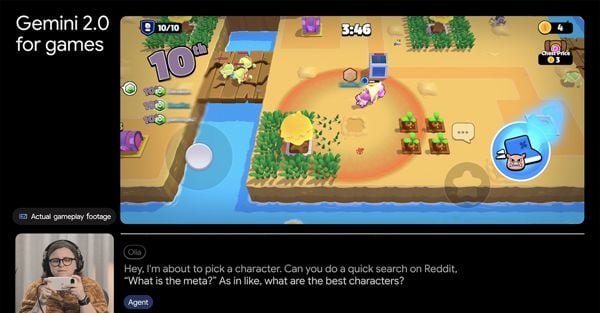
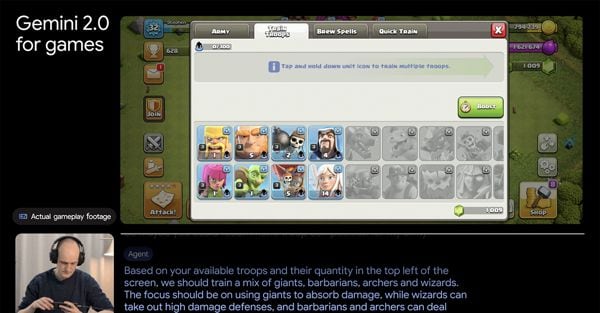
Video games, even. "We built agents with Gemini 2.0 that can help you navigate the virtual world of video games. They can reason about the game based solely on the action on the screen and offer suggestions on what to do, via real-time conversation,' Google announces.

We have seen him in action: he is like an expert user advising on the right strategies, how to overcome certain problems in games, how to win a game.

"We are working with leading game developers, such as Supercell, to explore how these agents work, testing their ability to interpret rules and challenges in a wide range of games, from strategy titles such as 'Clash of Clans' to farming simulators such as 'Hay Day'.

In addition to acting as virtual gaming companions, these agents can also tap into Google Search to connect with the wealth of gaming knowledge on the web'.

The last step, the physical world.

"In addition to exploring agential capabilities in the virtual world, we are experimenting with agents that can help in the physical world, applying the spatial reasoning capabilities of Gemini 2.0 to robotics. Although it is still early days, we are excited about the potential of agents that can help in the physical environment,' Google announced.

It is early days, yes. But the prospects are numerous and disruptive.

Copyright reserved ©
Loading...

Brand connect

Loading...

Newsletter

Notizie e approfondimenti sugli avvenimenti politici, economici e finanziari.

Iscriviti