
Gender equality, inclusion, modernity: the challenge of the rector of the Milan State University
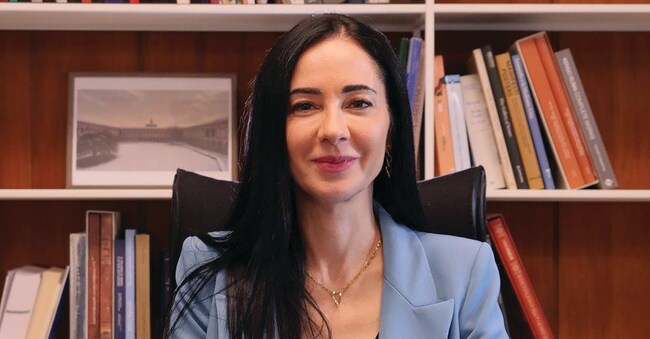
Marina Brambilla. The first woman at the helm of the Milanese university, the professor recounts the path that led her to the top and anticipates (in part) the programme for the next six years

6' min read
6' min read
She has built her own path and internalised the importance of not giving up on her goals since she was a young girl, perhaps unconsciously or perhaps not: Marina Brambilla, 51, the first woman to lead the Università Statale di Milano, has not forgotten the image of the disgruntled mother who was forced to give up her job to raise her and her brother and, step by step, has made it to the top of a major university without precluding herself from building a family.
On the first floor of the magnificent Ca' Granda, home of the university - which celebrates a century of history this year - she recounts the journey as a Germanist that began with her studies at IULM ("I chose to graduate there in Foreign Languages and Literatures also with the idea of being able to make a profession out of it: There was a specialisation in interpreting and translation'), continued with a doctorate in Pavia in cotutela with the University of Hildesheim, then with the arrival at Statale as a researcher and with teaching on the degree course in Linguistic and Cultural Mediation. From there, new chapters opened up that led her, step by step, to beat her contender in last April's election for the university's leadership (which will last until 2030), which she won with an overwhelming result on the ballot: 1,652 preferences (65% of the total) against the 645 (25% of the total) obtained by her colleague Professor Luca Solari, full professor of Business Organisation; there were 265 blank ballots, 10%.
The vision and aptitude for governing a complex machine like the Statale - the largest university in Lombardy with 64,000 students and 4,000 employees - come from afar, first and foremost from the example of his father, the personnel director of a large metalworking company: the experience of those who deal with human resources was at home, before his eyes. The time of the doctorate was 'very formative', explains the rector (formally at the helm since 1 October), both for the long stay in Germany - in contact with another culture and another reality - and for the thesis work, 'philological and archival: the family of Hans Egon Holthusen, a very important figure in German culture, had donated to the university a correspondence that had to be studied, catalogued, ordered, placing letters that were difficult to decipher (because they were written in Gothic characters) one after the other and then transferring them onto digitised documents. It was an exciting excavation into the language and at the same time a team effort with German colleagues, not only professors and researchers but also archivists and librarians'.
It was during her doctorate that Marina Brambilla met her future husband, also a university lecturer, by whom she would have a son who would follow her, to the letter, on her path: 'At 36, I was ready from a scientific point of view to apply for associate competitions, I wanted to do so even though my son was nine months old. Bari, Salerno, Aosta... I took him with me on all these tests: I nursed him. It's a phase of life when it's very difficult to separate mother and child, yet I needed to move forward in my career'.
The qualification as an associate came in Salerno, the one as an ordinary four years later, in 2014, 'with the method that judges publications, does not involve an in-person competition but an evaluation of the curriculum, scientific papers, and activities carried out. I got in here (in Milan, ndr) but habilitations are always conferred by national commissions'. At the time, exactly ten years ago, Marina Brambilla had no idea that she would become rector, even though, from the very beginning, she combined her interest in teaching and research with that in administrative and organisational activities ("I remember that in the early years I was already a member of the board of the Sesto library") and in 2012, under the rector Gianluca Vago, she was given the delegation for the Erasmus programme, then the delegation for student orientation and finally the task of designing the University Language Centre. Steps that foreshadow the leap forward, in 2018, to the role of pro-rector dedicated to student services: "Over the past six years, alongside the rector Elio Franzini, I have been able to work on the whole wide game of the right to study, residences, housing. Which, in a city with prohibitive costs for university students like Milan, has meant "increasing the number of beds from 779 to around 1,200, a commitment made with both the Region and the Municipality, as well as with a direct effort by the university that we intend to continue. Over the past few years we have increased the number of scholarships (which also benefit those with merit requirements) by 500, reaching 5 thousand scholarship holders a year, with the possibility of taking advantage of the meal; we have extended the no tax area from 14 thousand euro in 2018 to 30 thousand euro: this means that for the coming academic year half of the students, having an Isee up to 30 thousand euro, will not pay taxes. I would also like to say that we have maintained the 500 euro merit-based tax break regardless of income: it is right to break down economic barriers, but there is a time when all students are equal'.


