
Desalinating water with solar energy. Genius Watter aims for 100 million in 5 years
Six plants and four under construction in Africa for the Padua-based company founded in 2018. The goal is to reach 200, also in Italy, making the dimensional leap with the help of funds

4' min read
4' min read
Ten million investments in the next 18 months, to reach 100 million in five years. Ambitious are the plans of Genius Watter, a company created in Carmignano di Brenta (Padua) in 2018 by Dario Traverso, the CEO, and his father Franco, the president, already active in the field of photovoltaics - first with Helios Technology founded in 1981 to build solar cells and panels, then with Silfab since 2007, which in 2010 gave birth to Silfab Solar Inc., which today has 1,200 employees in Canada and the USA and produces modules and panels for the North American market.
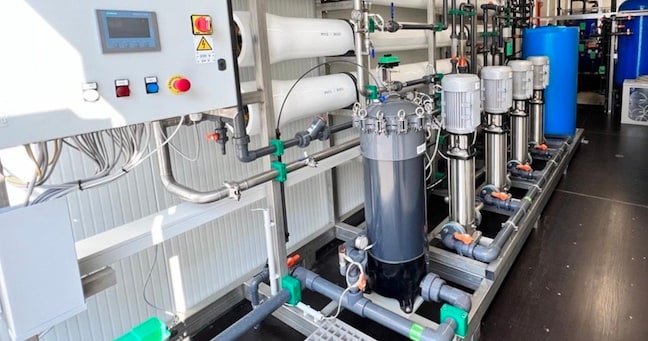
Genius Watter specialises in reverse osmosis desalination of water using solar energy, without batteries. The patented system is able to provide drinking water in areas with no connection to the electricity grid, from brackish groundwater or seawater. A solution with various applications, currently implemented in Africa, in different sectors: humanitarian, civil, industrial, agricultural, tourism.
"It all started after a trip to Cape Verde where we experienced an obvious problem of the archipelago: water was scarce, with brackish underground aquifers due to marine intrusion and lack of rainfall. My father had a patented technology, which then evolved, which we put to use in response to a need: access to clean water. An issue that affects one in three people globally and is destined to worsen,' says Dario Traverso, studies in economics and international trade in London and Shanghai and entrepreneurial experience abroad.
In Somalia with the UN
.Genius Watter built two plants in Somalia, one in Xingalool and one in cooperation with the United Nations in 2022 to bring 50,000 litres per day of drinking water to Caynabo, a major town in Somaliland. "People were drinking from open wells with low quality water. For us, it is an iconic, transformative project for the community. When I went to visit the plant in December 2023, the elderly people thanked me,' Traverso continues: 'With the UN we are working on a new project in Somalia: a plant is being built in another village, a larger one. With a public-private partnership (PPP) formula: an instrument that makes it possible to attract private capital for public utility projects, with the involvement of an institution such as the UN, which donated the plant, and the commitment of the private sector, which must have the capacity to make the projects sustainable. In this case we, with a local partner. Here the service contract, established by the water authority, is for 20 years'.
From plant to service
.Other installations include Foton in Cape Verde, an urban water factory project, and Karafuu in Zanzibar: a clean water supply for an eco-hotel. "We currently have a total of six installations in operation: two in Somalia, three in Cape Verde, and one in Zanzibar. We have another four under construction and others under development, again in these countries," explains Traverso, also outlining the business model, which is based on three pillars: "Technology, with plants pre-assembled in Italy and then connected on site, enclosed in containers for easy mobility. Maintenance, remotely monitored and managed by a local team to whom we transfer our know-how, training skills in the countries where we operate. Thecommitmentpoint: as a company we do not sell systems but provide the service of water, according to a 'servitisation' model whereby we take charge of the design, installation, testing, management, co-financing and then ensure the supply at better prices than other systems, such as transport by truck, for contracts of 10-15 years, like a PPA but of water'.


