
Genoa, first bio LNG refuelling on Gnv ferry
The operation took place on the new Virgo ship thanks to a barge provided by Axpo Italia
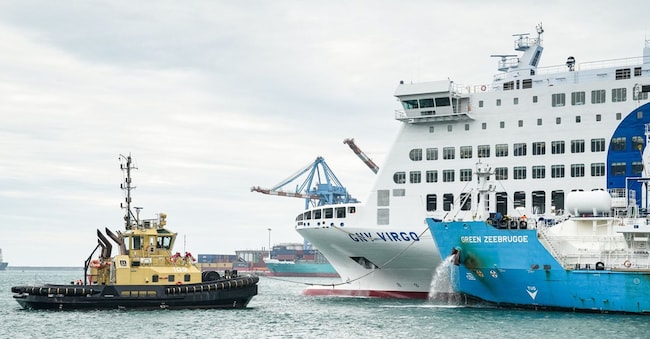
First LNG refuelling (in this case bio) carried out on a Gnv passenger ferry and first operation of this type completed in the port of Genoa. The two firsts were achieved yesterday thanks to the bunkering operation carried out on the Gnv Virgo, a new unit of the shipping company controlled by the Msc group, and made possible by the use of the Green Zeebrugge lighters, provided by Axpo Italia. And, of course, with the support of the Western Ligurian Sea Port Authority and the Harbour Master's Office.
"The introduction of LNG in our daily operations," said Matteo Catani, Gnv's CEO, "not only drastically reduces polluting emissions, but also allows us to gain concrete experience with the technologies that will drive the future of European maritime transport, confirming our commitment to increasingly sustainable and competitive shipping.
On the occasion of this first refuelling, he stressed, 'the fuel used is not simply fossil Gnl, but bio-Gnl, obtained from biogas of organic origin. The adoption of this fuel marks a significant step in the company's environmental strategy: it is no longer just a matter of reducing emissions, but of adopting an energy model that allows us to concretely approach near-zero impact levels'.
Thanks to this refuelling, emphasise Gnv, the unit will be able to make the first Genoa-Palermo voyage, round trip, with zero net greenhouse gas emissions, demonstrating that near-zero-impact maritime operations are already technically possible today, provided that alternative fuels such as bio LNG are available.
"We are working," added Catani, "so that the use of bio LNG can become a structural solution for our operations, although we are aware that, today, the availability of this fuel remains limited and requires significant investment, as well as the development of a supply chain capable of ensuring stable supplies on a large scale. Costs are still high and the amount of product on the market is not sufficient to cover a growing demand. It is a complex path, which needs the commitment and cooperation of all the actors involved in the supply chain'.


