
Gentiloni: 'Soviet Pnrr plans? I know Giorgetti's jokes. Not implementing them is a problem"
In his speech at the Rimini Meeting, European Commissioner Paolo Gentiloni defends the NRP and stresses the importance of reducing Italy's public debt to ensure the country's economic stability

3' min read
3' min read
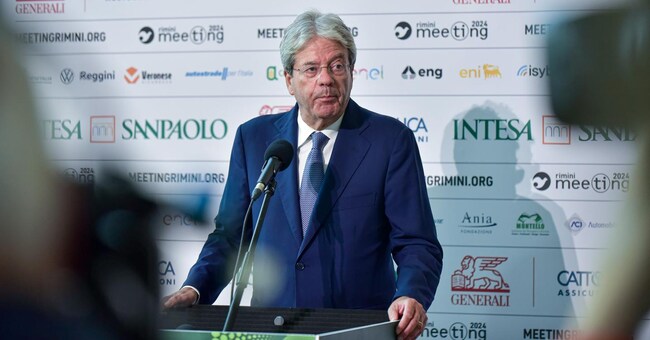
"That the Pnrr is made of Soviet interventions seems to me a joke, after all I am familiar with the Minister Giorgetti and his jokes". This is how the European commissioner for the Economy, Paolo Gentiloni , on the sidelines of the Rimini Meeting, responds to those who ask him what he thinks of today's statements by the Minister for the Economy, according to whom the training projects contained in the Recovery and Resilience Plan are reminiscent of the five-year plans of the Soviet Union. It is, Gentiloni explains, 'a very important thing for Italy, it is 190 billion euro bond; it was the crossing of the Rubicon by the European Union. And you know that Italy is the main beneficiary'. Then, he notes, 'of course, if we were not able to spend this money, to implement these investments, then there would be a problem of bureaucracy, but on our part, not on the part of those who imagined the projects, i.e. the Italian governments and those who authorised them, i.e. the European Commission'. And 'as for me,' he concludes, 'I still have two or three months to complete my European mandate; let me be European Commissioner. We'll talk about the rest when these two or three months are up'.
EU pact gives impetus to work in the medium to long term
"I think that the new stability pact actually has the impetus to work on the medium and long term: we are talking about a four or even seven-year plan that the different countries have to present to the Commission in the next few weeks, which is now. So I think it is a long-term perspective'. This was said by the European Commissioner for the Economy, Paolo Gentiloni, in a press point at the Meeting. 'The cooperation with Minister Giorgetti has always been excellent. I can say that we worked together very well and that Giorgetti played an important role in the definition of the new stability pact, representing Italy and supporting the new stability pact on behalf of Italy'.
Good growth but Italy is exposed on debt
In recent periods, "Italy has had good levels of growth, I would not get into great lucubrations about the difference between growth in Italy and growth in France, because they are really very similar, one thing is certain, and that is that we in particular have more than other countries to keep together the need to push growth and the need to control public debt". This was said by the European Commissioner for the Economy, Paolo Gentiloni, in a press point at the Meeting. "So," he observed, "if there is one point on which Italy is particularly exposed, it is that of a public debt that after the Greek one is the highest in the European Union and, unlike the Greek one, has not yet taken, as it must over the next ten years, a sure path of gradual reduction.
It took a pandemic to make the Eurobond
."The Eurobonds, which have been talked about with a smile on our lips for 20 years, we have done it, of course it took a pandemic. I do not know to what extent we will be able to make progress without these crises," said the European Commissioner for the Economy, Paolo Gentiloni, at the Rimini meeting. For Gentiloni, the issue facing the next EU Commission is 'how to be as ambitious as we have been in the last five years', in which the EU has given 'strong responses' to crises, for example by demonstrating 'extraordinary' European unity in the war in Ukraine. The paradox, for Gentiloni, is that the good results of the last few years 'have shone a spotlight on the EU' and now one wonders where Europe is on Gaza, why it is failing to promote economic growth with common measures, why it is stalling on the fight against climate change or the defence of rights.
Very important Fed chairman on rate cut
"It is very important how" Federal Reserve Chairman Jerome Powell "opened the Jackson Hole meeting this morning. He said that the time has come to adjust monetary policy" in the United States. "He did not say how or when, but it is clear that when the Fed chairman gives a clear signal that he is going in the direction of cutting interest rates in the United States, in an economy that, all things considered, has very significant levels of growth, and it is decided that it is time to change monetary policy, it means that the challenge of fighting inflation in a large part of the world has in fact been won. This was said by the European Commissioner for the Economy, Paolo Gentiloni, in a press point at the Meeting. This, he noted, 'does not mean that we have reached the 2% target, but it does mean that realistically, as in our forecasts, we will get there in a year or so'.

