
Gentle remorse of a land crushed by turbo-capital
Francesco Sossai recounts the Veneto through the story of two penniless men, showing a grotesque and spoilt world, but in its own way human

4' min read
Key points
- The protagonists: Carlobianchi and Doriano
- Between Berlusconi and Del Vecchio
- The path of Francesco Sossai
- The foreign press
4' min read
Le città di pianura by Francesco Sossai (from 25 September in cinemas) is a dishevelled film, as are its protagonists, two fifty-something bumblers who pick up an architecture student and involve him in their wanderings in the Veneto plain. And, perhaps, it is precisely this eccentric edge that gives the story a particular grace, originality and humanity that we rarely see on the big screen: the poetics of nothingness, when the everyday has been stripped of its poetry. It begins in an unspecified Veneto, violated by the turbo-capitalism of Zanzottian memory, which has transformed the land into a warehouse, the villages into places without history, the ritual of drinking into a ceremony of oblivion. Sossai transfigures these elements into a comedy of the absurd, grotesque and melancholic.
The protagonists: Carlobianchi and Doriano
The 36-year-old director from Belluno, in order to narrate the epic of a lost world, surprises two friends, Carlobianchi (Sergio Romano), known as Charliewhite, and Doriano (Pierpaolo Capovilla), in their car in the middle of the night, sunk in an alcoholic sleep, impervious to any protesting horns from the cars they block the road to. Caressed by the red and then green light of the traffic lights, they could well be the victims of a crime scene. The camera meanwhile looks around, catching glimpses of a generically homologated ugliness.
Between Berlusconi and Del Vecchio
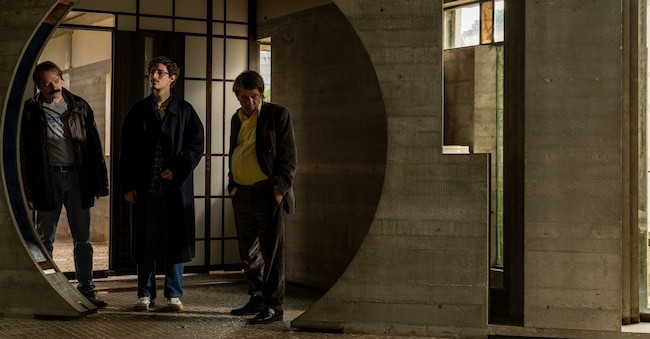
Then one's thoughts turn to those films that dare a caustic start: You meet Toni Erdmann by Maren Ade, which begins on rubbish cans, or Sieranevada by Cristi Puiu, which has its beginning on cars parked on the street. When the couple wakes up, they decide to have one last drink, waiting for the return of their friend Genie (Andrea Pennacchi), the Godot of their lives. Genio is a mysterious figure who appears when Cavalier Fadiga (Roberto Citran), the owner of an eyewear factory, steps out of his helicopter to reward a retiring worker. Fadiga looks like a cross between Berlusconi and Del Vecchio, he is affable and surgical, and learns the names of the employee's relatives to prove that the company is one big family. For the two friends, Venice is the only shore in the spasmodic search for the last 'shadow' of wine: here they stumble upon a girl's graduation celebration and join in the hope of a toast. It is at this juncture that Carlobianchi and Doriano meet Giulio (Filippo Scotti), a student as shy and out of his depth as the two 50-year-olds. For this reason, perhaps, it is natural for him to amalgamate with the two flatheads. The story is a small affair, but it is told through gentle wit and secret irony. For Sossai's film, one feels like coming up with unlikely juxtapositions, such as Po Valley westerns with a late 20th century aesthetic, or thinking of the director as a Kaurismakian Olmi.
The path of Francesco Sossai
Sossai grew up in the Belluno Dolomites and knows the province's sweetness and squalor. He macerated his Veneto in an unfinished detachment, after his Roman studies in English and German literature and his diploma in directing at the German Academy of Film and Television in Berlin. In 2021, he made Altri cannibali, in black and white, with the faces found in the bars, shops and streets of his places, to which the camera remains attached, searching for an escape route that does not exist. After all, Carlobianchi and Doriano also escape, through two actors who wonderfully steer an impossible, aimless course. Both are 'true strays', even though they belong to the world of show business, or perhaps because of it. Sergio Romano is a man of the theatre, while Pierpaolo Capovilla is a musician and was a singer in a counter-current formation in the 1990s. In Le città di pianura there are Mazzacuratian echoes (see Citran) of that indomitable Veneto that is a kingdom with its own mechanisms and dialect, even if Sossai's shows the scars of what came later, when everything had already been scrapped. Sossai looks at the defeat through the eyes of a defeated generation, which grew up with the myth of omnipotence, the miracle of the North East and stumbled into the crisis of 2008. The director films his heroes with love, as if he wanted to compensate them for the abrupt fall from the merry-go-round. Nothing saves Carlobianchi and Doriano, not even the beauty they never see: Venice is only the sign of a "cicchetteria", the lagoon a mere strip that laps against the quay on which the unlikely couple, enlarged into a trio, walk, yearning to visit Carlo Scarpa's Brion Tomb, which he designed himself.
Foreign Press
In competition in a Certain regard at Cannes, Le città di pianura was elected Film of the Critics by the syndicate, described as 'tender and exhilarating' by 'Le Figaro', 'Enchanting' by 'Variety'. Perhaps the screenplay, written by Sossai himself and Adriano Candiago, at times suffers from an excess of hyperbole in terms of jokes and 'dirty' images, but those who know certain provinces, and especially those in the Veneto region crushed by profit, unfortunately know that what we see in the film is not so far removed from reality. 'Le Monde' wrote that Cassavetes' characters come alive in Sossai's film and, not by chance, the latter had written 'The whole world is dying of sadness. We are the enemy'. More than sadness, there is a delicate, fresh and new regret in Sossai's film.


