
Geopolitical risk for businesses: Luiss relaunches its observatory to measure it
Focus on the need to understand the shifting balance of power in the international arena and its impact on economic systems

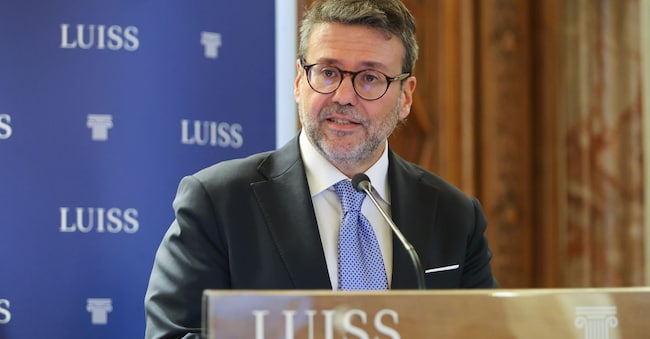
In an ever-changing global landscape, the Italian manufacturing sector faces increasingly complex challenges. Analysing the risks associated with shifts in the international balance of power has become essential and, from the choice of markets to that of supply chains, now constitutes a structural factor in corporate decision-making processes. It was precisely with the aim of learning how to interpret these changes that the idea for the event ‘Sistema Italia and Geopolitical Risk: Challenges and Opportunities’ was conceived, organised by the ‘Franco Fontana’ Strategic Change Research Centre at Luiss in collaboration with Intesa Sanpaolo. The event took place at the Luiss campus on Viale Pola in Rome.
New balances
At the start of the proceedings, Paolo Boccardelli, Rector of Luiss, emphasised the speed and depth of the transformations affecting the global geopolitical balance, impacting markets, technologies, energy and value chains, and ‘altering the interdependencies that characterise the global economy’.
According to Boccardelli, in order to meet these challenges, Italia must capitalise on its ‘ability to manage complexity by investing in human capital. From the digital transition to the demographic winter, the real challenge of strategic autonomy hinges on skills: it is by training and nurturing our talent that we will be able to ensure the resilience, economic security and competitiveness of the Italia economy’.
The Geopolitical Risk Observatory
In this historical period, therefore, the monitoring and qualitative and quantitative analysis of risk have become essential. This is the remit of Luiss’s Geopolitical Risk Observatory (GRO), established within the ‘Franco Fontana’ research centre to support businesses in understanding global geopolitical dynamics and their impact on economic systems. Indeed, as Giampiero Massolo, director of the GRO, explained, ‘we are not experiencing a temporary crisis, but a structural systemic change’. The world order that “for thirty years has guaranteed Italian businesses shared rules and open markets is crumbling” and for this reason “geopolitics can no longer be a mere backdrop, but must become a permanent area of expertise for businesses”, concluded Massolo.
In this context, a key tool is the GRO’s Geopolitical Risk Index, for which Carlo Gallo is responsible. Gallo explained that the index, which now covers 65 countries and is updated fortnightly, has been structured around three causal levels: ‘As well as considering the structural level – that is, the variables and characteristics of each country that change slowly over time – we also take into account the current state of the various countries and the predictive dimension, in which we assess the intentions and potential for action of geopolitical actors.’

