
Geopolitics and the environment at the centre of the Urban Land Institute conference
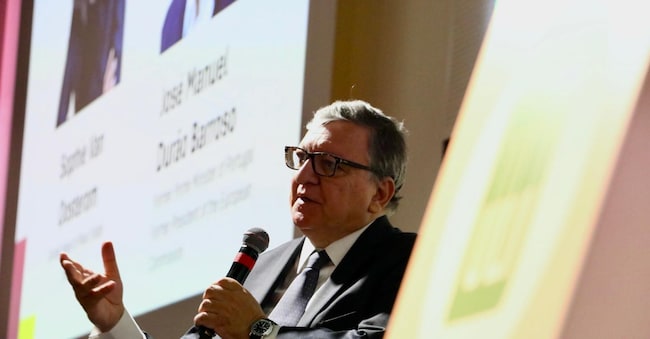
The highlight day of the conference opened with an analysis of global trends by José Barroso, former President of the European Commission, and Janet Henry, chief global economist at Hsbc

5' min read
5' min read
The great challenge of the decarbonisation of the building stock, the new geopolitical risks connected to real estate dynamics, macroeconomic trends and the focus on responsible investment, sector trends at national level and the picture of Milan, Europe's fourth largest investment market. These are some of the topics discussed on 12 June, the main day of the annual conference of Urban Land Institute (Uli) Europe, at the Allianz MiCo in Milan (10-13 June).
Giving the welcome was Lisette van Doorn, ceo of Uli Europe, who, as outgoing president Lars Huber also reminded the audience, emphasised the need to initiate real long-term transformative action to decarbonise Europe's building stock. He did so by recalling the tools that ULI is making available to the sector, including 'Preserve', which will enable the integration of climate transition into the financial models underpinning investment decisions and should accelerate the large-scale adoption of ULI's Transition Risk Assessment Guidelines, launched in 2023. In parallel, he recalled the birth of the new task force formed by the seven leading industry associations - from Epra (European Public Real Estate Association) to Green (Global Real Estate Engagement Network), from Inrev (European Association for Investors in Non-Listed Real Estate Vehicles) to Wbcsd (World Business Council for Sustainable Development) - to develop a common carbon pricing strategy for the real estate sector.
The geopolitical focus
.It was José Manuel Durão Barroso, former Prime Minister of Portugal and former President of the European Commission, who gave the opening speech on the impact of geopolitics on real estate dynamics. "Today there is great attention to geopolitical risk because our situation is very polarised, fragmented, volatile and dangerous, and it is essential to take this into account when deciding on the model of society and economy we want to have," Barroso began. 'I believe that after Russia's invasion of Ukraine the world will not be the same as before. This is not just a European conflict, but a global one, considering who is providing material support to Russia - Iran and North Korea - and noting that China itself has never been so close to Russia. The world is completely changing, also in geo-economic terms: as far as supply chains are concerned, the focus is on resilience instead of efficiency, and the issue of national or supranational security is back on the agenda'. On the one hand the United States, "with its increasingly protectionist positions and investments with the goal of self-sufficiency - see The Inflation Reduction Act (Ira)", on the other "an increasingly aggressive Russia", and not far behind China, "which is drawing the greatest blessings, in terms of manufacturing and industry, from photovoltaic panels to cars, from the green transition launched by Europe with the Green Deal".
"Europe's problem at the moment is the lack of growth. We are at the gates of the greatest scientific and technological revolution, that of generative artificial intelligence,' Barroso emphasises, 'an opportunity that countries like the United States and China are seizing and investing in, and in which Europe is lagging behind.
Macroeconomic and industry trends
.Next, Janet Henry, Chief Global Economist at Hsbc, outlined for the audience an in-depth analysis of the economic currents affecting real estate. From cutting rates - predicting that the Bank of England will cut them in August and the Fed in September - to the markets' view of the US election, which is currently betting on a Trump victory. From immigration driving labour force growth in both the US and the UK (with a massive prevalence of non-Europeans) to the focus on China's property market, with the thrust of a new rescue package unveiled by the authorities that will allow state-owned enterprises to buy unsold homes.
The panel discussion Responsible Investing, Esg and Fiduciary Duty, attended by Anna Cartwright, Partner at Jones Day; Guilan Decrop, Head of Europe at Norges; Nathalie Palladitcheff, rean estate exectutive and board member, and Hala El Akl, Vice President of Sustainable Investing and Operations at Oxford Properties Management France (SAS), it emerged that climate risk is a financial risk and that, in order to align investment returns with ESG returns, a tool must be found to objectively and comprehensively measure what is being done in terms of the green transition of buildings and reflect this in portfolio valuations. Simple metrics are needed: cost, time, calculation of carbon emissions over the building's life cycle. And perhaps we need to move beyond the acronym ESG, whose three aspects now tend to be naturally incorporated into investment decisions, but which as an acronym in itself, especially in some parts of the world such as the United States, is becoming divisive. The goal to be clear is to achieve zero net emissions.
Brand connect


Newsletter RealEstate+
La newsletter premium dedicata al mondo del mercato immobiliare con inchieste esclusive, notizie, analisi ed approfondimenti
Abbonati