The vote

Germany: a nightmare run-up to the election for Merz and the CDU: trailing in Berlin and hanging in the balance in Mecklenburg

In the latest polls ahead of Sunday’s election, the Christian Democrats are on 20 per cent in the capital, one percentage point behind Die Linke, with Alternative für Deutschland close behind on 18 per cent. In the Baltic state, the Chancellor’s party risks being excluded

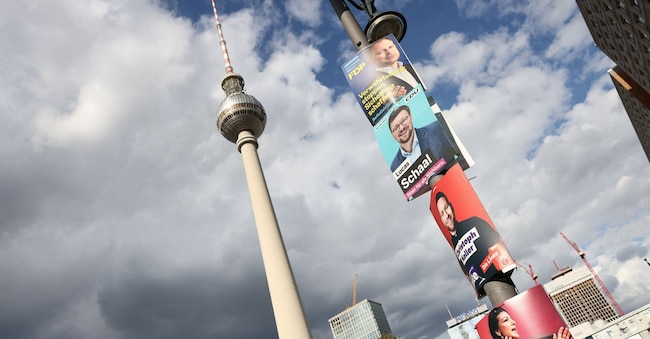
Manifesti elettorali in vista delle elezioni regionali di Berlino (REUTERS) REUTERS

3' min read

Translated by AI
Versione italiana

3' min read

Translated by AI
Versione italiana

The latest polls ahead of the vote on Sunday 20 September are looking very much like a nightmare for Friedrich Merz and the Christian Democrats. In the race for mayor of Berlin, the CDU stands at 20 per cent, one percentage point behind Die Linke, with Alternative für Deutschland close behind at 18 per cent. In Mecklenburg-Western Pomerania, the Chancellor’s party has fallen as low as 6 per cent. Just one percentage point separates it from the threshold below which it would be barred from the regional parliament.

Mistakes...

On Sunday evening, the executive committee of the Union of Conservatives (CDU-CSU) will be following the vote count in real time, ready to pass judgement on Merz. When he took office, not even a year and a half ago, no one could have imagined that the elections in the capital and in the small Baltic state would become a decisive turning point.

Loading...

In the meantime, however, there has been a series of missteps, which have sent support for Merz (below 15 per cent) and his party plummeting to an all-time low. Nationwide, the CDU has fallen to around 20 per cent of voting intentions, down from the 28.5 per cent it secured in the February 2025 elections – a result that was already one of its worst ever.

And then came the disaster in Saxony-Anhalt on 6 September, with the AfD securing 44 per cent of the vote and falling just three seats short of an absolute majority in the regional parliament, whilst the CDU saw its share of the vote halved to below 18 per cent. The crisis within the party thus reached a breaking point.

The decline of the Conservatives has been accompanied by the rise of the far right, which has gained ten percentage points since the Bundestag election, reaching 30 per cent.

The crackdown on immigration, with the sharp fall in arrivals and asylum applications, has not altered the trend; indeed, it has probably not even been noticed by Germans, particularly those living deep within the bubble of Germany’s Islamisation.

Not even the economic recovery – which could see GDP grow by 1 per cent this year (barring any issues with Trump or the Hormuz crisis) – has made much of an impression on voters. The upturn is being driven by public spending on defence and infrastructure, whilst ordinary people are struggling with utility bills, petrol and, in Berlin in particular, exorbitant rents.

The stance Merz has adopted as an international leader on Ukraine and European defence, however, does not seem to have won over the electorate, who – at least in part – are instead rejecting the reform of military service, with the prospect of a return to compulsory conscription.

...the arguments and the gaffes

On the contrary, the clashes within the coalition with the SPD were certainly felt, and were reminiscent of the disputes within the previous majority, which collapsed prematurely. Merz’s gaffes have even gone viral, as he has gradually accused Germans of relying too heavily on social security benefits, working too little and taking too much sick leave. And then there were the social reforms – not draconian but at times convoluted, such as the requirement for a doctor’s certificate from the very first day of illness – and unpopular ones, such as the abolition of early retirement. Following the collapse in Saxony-Anhalt, the majority is now having second thoughts about these measures.

For the SPD, it’s all about Mecklenburg

Things aren’t going much better for the government’s coalition partners. In national opinion polls, the SPD is languishing at a meagre 12–13 per cent. In Berlin, it is watching the race from a distance. The only ray of hope comes from Mecklenburg, where it has edged ahead of the AfD, standing at 37 per cent of voting intentions. The credit, however, goes entirely to the outgoing Minister-President, Manuela Schwesig, who, amongst other things, is challenging the pension cuts.

Loading...

And so, with just two days to go before what has become a decisive moment, the Government has announced its most popular measures: a cut in fuel excise duties and a future cap on pump prices. The package approved on Friday is worth 2.5 billion. Who knows if it will win votes.

Copyright reserved ©
Loading...

Brand connect

Loading...

Newsletter

Notizie e approfondimenti sugli avvenimenti politici, economici e finanziari.

Iscriviti