
Germani: ‘Autonomy under strain, school administrative offices overwhelmed by the NRRP and regulatory requirements’
To save schools: lifting the ban on staff mobility for ATA staff and DSGA staff in management roles, and an end to internal disputes over disciplinary proceedings.

Increase staffing levels in school administrative offices or return certain powers relating to staff matters to the Ministry; reduce the size of School Councils to a maximum of seven members by establishing a Collegiate Management Board; include DSGAs in the management category, thereby allowing them to transfer to other public administrations.
Anquap’s priorities
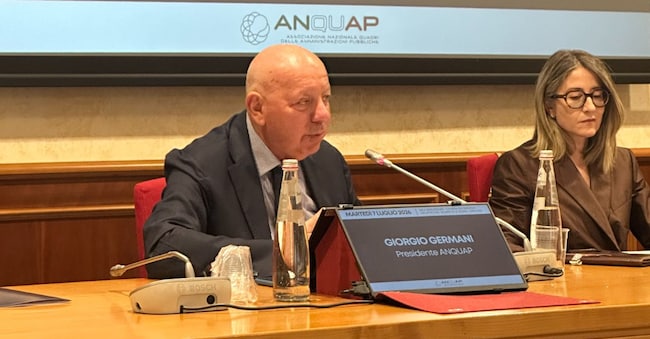
These are some of the key proposals put forward by Giorgio Germani, National President of ANQUAP, at the conference marking the Association’s 25th anniversary, which took place this morning in Rome at the Palazzo dei Gruppi Parlamentari in the Chamber of Deputies. The policy manifesto also addresses the simplification of the Accounting Regulations in relation to the Public Contracts Code, the new merit-based recruitment of ATA staff with the inclusion of technical assistants in the first cycle, and the transfer of disciplinary proceedings to the Regional Education Offices. Other demands include the extension of meal vouchers, a training card for ATA staff, and guaranteed triennial competitive examinations for SGA Directors.
“It’s one or the other: either the operational conditions are put in place so that schools can carry out the functions assigned to them, or the Ministry takes back some of the objectively repetitive and systemic functions relating mainly to teaching and ATA staff,” said President Giorgio Germani. “The administrative offices, already burdened by extraordinary tasks such as the implementation of the PNRR and PON/PN, are struggling to cope even with day-to-day operations due to the excessive transfer of administrative duties without a corresponding increase in staffing levels and technical expertise.”
Governance
On the subject of governance and internal management, Germani highlights the need to move beyond the current regulatory framework: ‘We are dealing with legislation dating back to the 1970s, which is no longer suited to the organisational reality of autonomous educational institutions. The main issues concern the excessive size of the School Council and the lack of operational relevance of the Executive Committee. A rebalancing of decision-making roles is needed. On disciplinary matters too, there must be a clear distinction between those who initiate action and those who make the decisions.”
Salaries and the exodus from schools
Germani then addressed the issue of pay and the exodus of staff from schools: ‘If the fear is that staff are leaving schools, then political bodies must recognise that working in school administrative offices, laboratories and general services is no longer as attractive as other public sector jobs. If we do not wish to lose experience and professional expertise, staff must be duly recognised for the tasks they perform, both legally and in terms of pay. The 2019–2021 National Collective Labour Agreement (CCNL), rather than representing a step forward, has marked an unreasonable step backwards, compounded by unresolved issues such as the replacement of absent DSGAs, a task currently entrusted to colleagues in unsustainable and poorly paid interim roles. The management allowance remains wholly inadequate even following the signing of the 2025/2027 National Collective Labour Agreement.’ Germani called for these proposals to be accepted and implemented because, he remarked, ‘they would enable educational and teaching objectives to be achieved and would facilitate the expansion of the educational provision, striking a balance between the governance and management of schools and improving the working conditions and wellbeing of school staff’.
Brand connect


Newsletter Scuola+
La newsletter premium dedicata al mondo della scuola con approfondimenti normativi, analisi e guide operative
Abbonati