
Gian Mario Villalta for 'Una scontrosa grazia' in Trieste
In 'Poesie', published by Garzanti, the poet recomposes more than forty years in verse into an organism that presents itself as a stratified, self-conscious memory of its own making

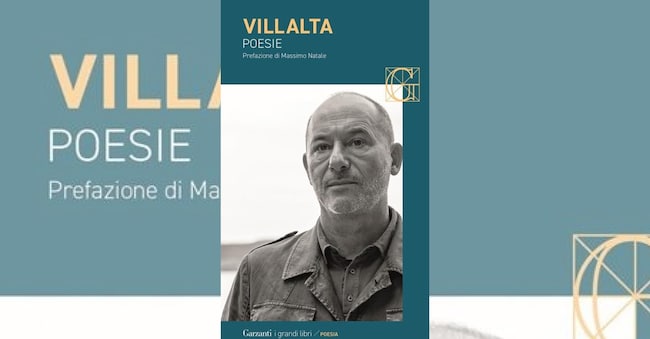
The 'Una scontrosa grazia' review continues to welcome Italian poetry to Trieste. Artistic director Alessandro Canzian, assisted by Federico Rossignoli, Carlo Selan, Mario Famularo and Marijana Šutić, over the course of a decade has selected about a hundred intellectuals with their most significant publications and, to celebrate the milestone, the writer Gian Mario Villalta closes the 2025 edition. "In order not to get lost in what language I live in / I had to cross, cross / the only granted vertical": in "Poesie" (Garzanti, 2025, pp. 736, euro 24) Villalta recomposes more than forty years in verse in an organism that presents itself as a stratified and self-conscious memory of his own realisation. Specifically, the verses from "L'erba in tasca" are the paradigm of a founding tension between two existential cores that runs through the entire work, between belonging and fleeing with respect to a time and a space, between self-image and the need to disavow oneself. Right from his earliest works - such as "Traccia", "Limbo" and, indeed, "L'erba in tasca" - Villalta asserts himself as a poet of loss, but not in the elegiac sense of a nostalgia to be resolved: rather, his poetry enshrines the trauma of the end of Friulian peasant civilisation as a linguistic wound.
Saying beyond the debacle
"body de lengua-mare da 'na recia / a chelàltra, sul tavolin dadrìo dove che 'l vent / te sliga i oss, e nissun vede, dadrìo dapartut / de quel che son / mi e no-mi...". The dialect, already in "Altro che storie!" and in "Vose de vose", reveals itself to be a semantic and sonorous laboratory in which the possibility of saying again after the collapse is measured, from a "black lump in the throat" to a "cluster of voices" - "grasp de vose" - that seeks the truth of the spoken word where uniformed Italian stiffens. It is a "translengua", an unstable threshold, an experience of the limit that leads to irrevocable change. Villalta cautiously recounts a world that empties itself of the past while relying on its roots and, at the same time, resisting the risk of wrapping it in false memories. The poet questions his own sensitive perception, defusing the easy narratives that one often indulges in to avoid the fractures of awareness; thus, the path that leads to "Vanity of the Mind" (2011) is an acknowledgement, as Massimo Natale notes in the preface: poetry measures itself against reality and by events, burning all rhetoric of idyll and all temptation of authenticity.
A test of truth
In the "Revoltà" and "Kindergarten" sections, the vernacular literally turns against its author, becoming the residue of an identity in the process of dissolution, but still capable of vividly restoring the phonic memory of an even ferocious experience: "It was not so much the tremor, after the blow, when he entered death with a jolt that went up the arm to the shoulder. It was the instant before, when the power of his limbs humbled, that yielding, his head relaxed, as if he already knew'. And Villalta does not deny it, but rather subjects it to a test of truth: if it can no longer adhere to reality, to the present, then at least an internalised echo remains. With "Telepathy" (2016) and "Where are the years" (2022), the lyrical discourse definitively opens up to the relationship and loss becomes a possible communion, as the self learns to graze an "us" through the signs of time on the hands of others: "I am with you, as much as I can, I am fine, / if I remain what I have always been: you make time deeper, / the present more present".
Sharing the loss
The dialogue with Zanzotto, Celan, Giacomini and Montale, continuously acknowledged and re-motivated, goes beyond literary homage to act as a critical genealogy. Villalta inherits their linguistic experience on a par with an awareness of failure: he knows, with Zanzotto, "that no sarà pi posto, no pi temp, no tera, / par 'na parola che la à radiss", and for this very reason he attempts to refound writing on proximity, on the perception of the body, on listening beyond the self. From the analogical and mournful impasto of his early works to the dialogical lucidity of his recent trials, in the end, his trust shines through; not in the lyric self, but in the word that can still make itself an encounter. In this sense, "Poesie" is not a work of closure so much as of passage: a summa in which Villalta continues to question himself - on "what in the days remains with you / or becomes someone's page, something that passes through you / when it wants to, and never the same".
Gian Mario Villalta, "Poesie", Garzanti, 2025, pp. 736, euro 24

