The interview

Giansanti (Confagricoltura): challenge Europe on CAP and trade agreements

The president: 'On 18 December we will be 10,000 in the square in Brussels. The right figure for agricultural funds? Half a trillion euro'
by Micaela Cappellini

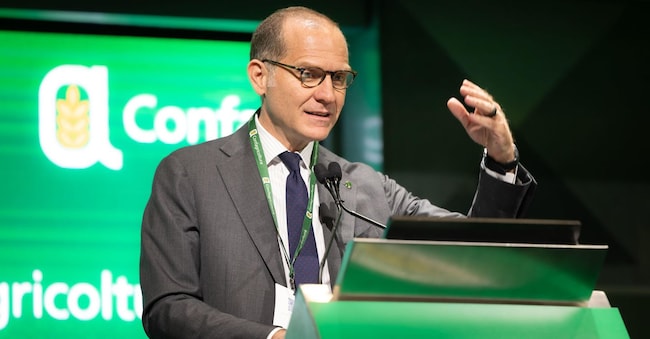
Massimiliano Giansanti, Presidente Confagricoltura. (Ansa)

3' min read

Translated by AI
Versione italiana

3' min read

Translated by AI
Versione italiana

The resources proposed by the EU Commission for the next CAP? Insufficient. Protection of the European market from competition from non-EU products? Ineffective. There are many accusations that the agricultural world makes against Europe. That is why on 18 December farmers will take to the streets of Brussels with tractors: 'There will be 10,000 of us,' promises the president of Confagricoltura, Massimiliano Giansanti. For more than a year now he has also been president of Copa Cogeca - the association that brings together the main European farmers' organisations - and at the Commission von der Leyen is ready to launch the challenge not only from the square in Brussels, but also from the stage of Confagricoltura's winter assembly to be held next Wednesday in Rome.

President, what should the next CAP look like?

Loading...

We need a common agricultural policy that focuses on productivity, competitiveness and innovation, whereas sustainability can be implemented in many ways, not necessarily with ecoschemes. Resources must be directed to professional farmers: even today in Italy 50% of the farms that receive the CAP do not have a VAT number, I cannot understand how it is possible to put a professional farmer on the same level as someone who does it on Saturdays and Sundays. To do all this we need more resources, certainly not a 20 per cent cut like the one proposed by the EU Commission.

How much should the ceiling of the new CAP amount to then?

With the EU Commissioner for Agriculture, Christophe Hansen, we discussed a figure that should not be less than half a trillion euros (500 billion, ed.), i.e. the current CAP budget plus at least 10 per cent inflation recovery.

This week the Agriculture Committee of the European Parliament rejected the safeguard clauses of the free trade agreement between the EU and Mercosur, as they were intended for the agricultural part. I guess you are satisfied...

I would say yes, this is a strong signal of attention from the European Parliament with respect to an agreement that cannot be paid for by farmers alone. The vote in the European Parliament will not be easy, anything can happen, what is certain is that there is all room to correct the agreement, if President von der Leyen so wishes. And we want a Europe that protects its farmers in a global market because, after all, that is what everyone is doing today: President Trump did it with tariffs, President Lula does it by pushing the production capacity of Brazilian farmers.

How should Brussels protect its market?

While it is true that Europe is an export-oriented continent, it is equally true that Europe today cannot become the open market for all, without limitations. For example, agreements do not always focus on reciprocity of standards. To this we must add that controls are rarely carried out in Europe: in a recent meeting with the EU Commissioner for Health and Animal Welfare, Olivér Várhelyi, we realised that almost all products arriving outside Europe are not subject to controls at European ports.

At the assembly for the 80th anniversary of Confagricoltura Parma, together with Paolo Barilla, you said that large-scale distribution should also be included in the vertical supply chain model, alongside the agricultural part and the processing industry

I believe in the centrality of supply chains. Today, the market demands of us that the big champions play on the field. On the one hand, therefore, we must work to aggregate, moving from the logic of fractioning and dwarfism to the logic of the giant. On the other hand, we must imagine models that also involve large-scale distribution.

In Parma you also said that we should not only focus on PDOs, but also on brands. This is a thesis that you don't hear often, among actors in the agricultural world...

The great project carried out years ago for the valorisation of denominations has been an extraordinary work and must continue. But we must also be honest with ourselves. Today, Italy is a European leader in terms of the number of denominations, but how many of these have a contractual force on the market? Not all of them. This is why we must also work with the country's great brands, to build increasingly strong and competitive supply chains, also abroad.

Has the Meloni government done enough for agriculture?

Certainly the resources made available will be remembered in history as significant. But asking for more from the institutions does not mean questioning their work. And we have asked the government, in the budget law, to increase resources on Agriculture 4.0, to cut the welfare wedge, and to rationalise energy costs.

Copyright reserved ©
Loading...

Brand connect

Loading...

Newsletter

Notizie e approfondimenti sugli avvenimenti politici, economici e finanziari.

Iscriviti