Australia

Gina Rinehart loses €400 million 'Hope Downs' lawsuit

The Supreme Court grants Wright Prospecting royalty rights to Hancock Prospecting, and Rio Tinto, which retain ownership of the iron ore mining cluster in the Pilbara. Children's claims dismissed

by Enrico Bronzo

aggiornato alle ore 13:15

Aggiungi Il Sole 24 Ore
ai preferiti su Google
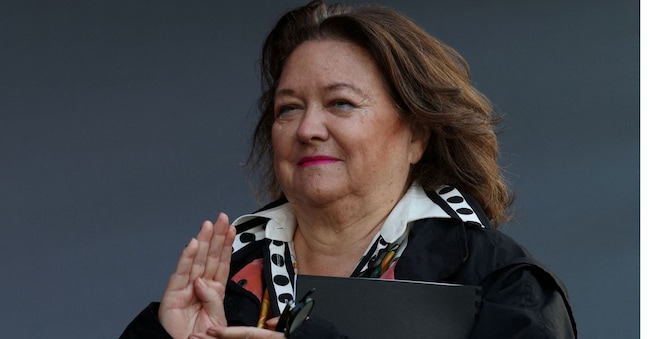
Gina Rinehart, presidente esecutivo della Hancock Prospecting, fa un gesto durante l’omaggio al tramonto “Lest We Forget” alla vigilia dell’ANZAC Day alla Sydney Opera House di Sydney, in Australia, il 24 aprile 2025. REUTERS/Hollie Adams  REUTERS

4' min read

Translated by AI
Versione italiana

4' min read

Translated by AI
Versione italiana

Hancock Prospecting Ltd., the privately held company of billionaire Georgina Hope's Gina Rinehart, has partially lost a decade-long legal battle with Wright Prospecting Ltd. over royalties, but will retain full ownership of a major iron ore mining cluster in Australia as ruled by Judge Jennifer Smith.

The West Australian Supreme Court, in Perth, has issued a ruling rejecting Hancock's argument that Wright Prospecting had no royalty rights to certain iron ore deposits, including the huge Hope Downs mine it shares with. It turned out that Wright Prospecting was entitled to hundreds of millions of dollars in royalties, past and future.

Loading...

Wright Prospecting claimed to be entitled to its half of the 2.5% royalties that the Hanwright company, formed by partners Wright and Hancock (Gina's father), had secured from Hamersley Iron, a subsidiary of Rio Tinto, in the early 1960s.

"All amounts owed in respect of royalties and interest to Wright Prospecting or Rhodes are a shared responsibility with our partner Rio Tinto, which has an additional royalty contribution in this regard," Hancock Prospecting said in a statement following the ruling.

Rio Tinto did not immediately respond to a request for comment.

The complex lawsuit was filed more than a decade ago by Wright Prospecting, which claimed to be entitled to royalties from the Hopes Down project and questioned Hancock's ownership rights.

Hope Downs and its tenements constitute one of the largest iron ore mining centres in the Pilbara region of Western Australia, and the proceeds have catapulted Rinehart to billionaire status, while Chinese industrialisation has led to a boom in demand for this ingredient for steelmaking.

Wright Prospecting is a private company owned by the descendants of prospector Peter Wright, a business partner of Rinehart's father, Lang Hancock. Many decades ago, the two men founded a company claiming rights to the iron ore-rich Pilbara region.

A spokesperson for Wright Prospecting said they welcome the decision and will carefully review the lengthy ruling before determining next steps.

Wright's descendants argued that, under that partnership, both Wright Prospecting and Hancock Prospecting were entitled to an equal share of those assets.

Royalties also awarded to Dfd Rhodes, a company owned by the descendants of a gold miner, Don Rhodes, was awarded royalties by Judge Smith. Dfd Rhodes had claimed that a 1969 agreement entitled it to a share of 1.25% royalties on Hope Downs. Judge Smith 'rejected Rhodes's contractual claims relating to royalties and supported in part her claim of equity relating to past and future royalties'.

Trial lasted 51 hearings

More than 4,000 documents relating to events mainly from 1967 to 2005 were submitted as evidence during the trial; 51 hearings were held,

"At the heart of the issues raised by the parties in the proceedings were a series of formal agreements made decades ago between men who were friends or colleagues who for a number of years had engaged in harmonious and cooperative arrangements to explore, discover and prospect for iron ore in the East Pilbara," Western Australian Supreme Court Justice Jennifer Smith said in the ruling on Wednesday.

Comments at the end of the 'Greater Hope Downs'

judgment

Rinehart's children, John Hancock and Bianca Rinehart, were also parties in proceedings to obtain a share in the property. Their request was rejected. The decision is likely to be appealed.

Gina Rinehart's company welcomed the ruling: in a statement it said that the court rejected the unfounded property claims of (two of her children) John (Hancock), Bianca (Rinehart) and Wright Prospecting Pty Ltd (Wppl) in their entirety.

In a statement, Wright Prospecting welcomed the ruling.

Speaking outside the courthouse, Dfd Rhodes CEO Matt Keady told reporters that the decision was 'a victory' for the company and that although profits could be described as 'substantial', there would probably be further litigation.

The 'Greater Hope Downs' mining hub

The Hope Downs mine in the Pilbara region of Western Australia comprisesfour large open-pit mines (Hope 1 North, Hope 1 South, Hope 4 and Baby Hope).

The mines are jointly owned by the Hancock Group and Rio Tinto, and the complex is named after Hope Hancock, Gina Rinehart's mother.

On Rio Tinto's website it says that Greater Hope Downs is a major iron ore mining centre in the Pilbara region of Western Australia, operated as a joint venture between ourselves and Hancock Prospecting.

The complex includes Hope Downs 1, located about 100 km north-west of Newman, Hope Downs 4, located 50 km north-west of Newman, and the Hope Downs 2 project, soon to be built.

Located on the traditional territories of the Banjima and Nyiyaparli peoples, these mines occupy a strategic position near Newman, taking advantage of the Hamersley Range, which hosts about 80 per cent of Australia's proven iron ore reserves.

Wright Prospecting

's requests

Wright Prospecting acknowledged that Hancock Prospecting excluded the Hope Downs land from their partnership, as permitted by a 1987 agreement, but that the same agreement provided that they should still receive royalties from that property.

As for the remainder of the Hope Downs mining lands, formerly known as the East Angelas, Wright Prospecting argues that they have always remained an asset of the partnership and that therefore it should receive an equity stake in these lands, potentially worth several billion dollars.

How much will Wright Prospecting and Dfd Rhodes get. It is only possible to estimate this because the actual royalty amounts will be determined in a separate process at a later date.

"Bringing Hope Downs to life required substantial investment in exploration, evaluation and development, obtaining thousands of government approvals, securing funding for major projects and a joint venture partner," Hancock Prospecting executive director Jay Newby said in a note.

The calculation of royalty amounts

The royalty claims amount, as reconstructed by Reuters, to AUD$4 million (€2.5 million at the exchange rate of 15 April 2026) per year for Rhodes and about AUD$14 million per year (€8.5 million) for Wright Prospecting, for a total of €11 million per year.

Bearing in mind that the disputed agreements, reading the operative part, go from 1983 to 1989, by default and in the most cautious manner possible and without taking revaluation into account, we are in any case talking about at least around 400 million euros plus revaluation.

Copyright reserved ©
Loading...

Brand connect

Loading...

Newsletter

Notizie e approfondimenti sugli avvenimenti politici, economici e finanziari.

Iscriviti