The intimate portrait

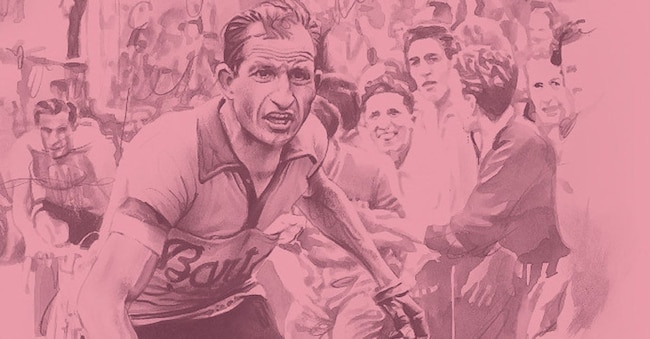
Gino Bartali: the faith and selflessness behind the cycling champion

The little-known story of the Tuscan champion who, in addition to his sporting victories, risked his life to save hundreds of Jews during the war, driven by a deep faith

by Dario Ceccarelli

5' min read

Translated by AI
Versione italiana

5' min read

Translated by AI
Versione italiana

“Good deeds are done, but not spoken of. If you’re good at sport, medals are pinned to your jersey, and then they’ll shine in some museum. Those earned through doing good are pinned to the soul and will shine elsewhere…”

Words that go straight to the heart – those of Gino Bartali, a great champion who needs no introduction. He was a leading figure in the heroic era of cycling, that of the post-war period, when the Tuscan rider engaged in a fierce rivalry with Fausto Coppi in one of the most extraordinary rivalries in the history of sport – and beyond.

Loading...

Memorable pages that still resonate in the collective memory today, in an increasingly fast-paced and globalised world, a world light-years away from the Italia that was emerging from the ruins of war.

But here we do not wish to discuss great rivalries or extraordinary feats. And of that legendary duo, who have captured the hearts of cycling fans, we are more interested in the one who, overshadowed by the other’s immense legendary status, has remained somewhat in the shadows of the collective narrative. We are talking, in fact, of Gino Bartali, who was not only a formidable champion, capable of winning two Tour de France titles, three Giro d’Italia titles and much more, but also a man of surprising humanity and selflessness.

Qualities which, due to his deeply reserved nature, remained hidden for years, overshadowed by the common perception of him as a perpetually grumpy, never-satisfied man who endlessly repeated, “It’s all wrong, it all needs to be redone.” A mask, a role in a play. So much so that when, in 2013, the Israeli organisation Yad Vashem awarded him the title of Righteous Among the Nations, “for distinguishing himself in extremely dangerous operations aimed at rescuing no fewer than 800 Jews”, many were stunned. Is that possible? Really? But why did he always keep it hidden?

As Sergio Meda explains so well in his book (Un uomo perbene, lo spirito carmelitano e francescano di Gino Bartali), it was only after the champion’s death that the true extent of his contribution to the Resistance during the period 1943–44 came to light. One of the few people aware of his role was his son Andrea, who was, however, bound not to disclose it until his father’s death.

Andrea asked, “Why did you tell me all this if I’m not allowed to tell anyone?”

Gino replied, “I want to be remembered for my sporting achievements, not as a war hero. There are others who are heroes. I simply stuck to what I knew best: cycling.”

Bartali’s Courage

It is quite striking, in an age like ours where appearances reign supreme and tolerance is not the foremost of virtues, to read such stark yet profoundly human words once again. In the book, which brings to light new and valuable testimonies, Gino’s courage is rightly highlighted. Carrying false identity papers in the frame of his bicycle – documents designed to allow the persecuted to move about more freely – was extremely dangerous. People were shot for far less. And even though Bartali used his long training sessions as a pretext, travelling from Florence to Assisi and back in a single day, in an Italia ravaged by war, meant exposing himself to grave risks. Some forty such journeys are recorded. And the Fascists, already hostile towards him because he was a member of Catholic Action rather than the Fascist Party, kept him under close watch. On one occasion, whilst travelling to the Vatican in Rome, Bartali was stopped at a Nazi checkpoint, though without any consequences. On another occasion, in July 1944, he was taken as a suspect to Villa Triste in Florence, where the Fascists imprisoned and tortured their opponents. “You’re in cahoots with the priests and sending weapons to the Vatican!” a Fascist major accused him. “I only bring sugar and flour,” replied Bartali, who was saved thanks to an officer who knew him well and was a fan of his.

The many stories and accounts shared by Meda, a veteran journalist, help us to better understand the figure of Gino Bartali. Who, as well as being ‘a pot of beans constantly boiling’ (as his mother Giulia used to say), was truly a decent man, sometimes moody, but never arrogant. A man who never made a fuss of his status as a champion. He hated hypocrites and slackers, with whom he often had to put up. He was naive, in the sense that he trusted his friends, which caused him several financial troubles. His faith, nurtured by his visits to Assisi, was sincere but not bigoted. “His,” recalls his son Andrea, “was a very practical form of religiosity, observant but also secular, in the sense that for him the Gospel was truly a way of life and not simply a book to be read.”

As well as being a journey into his spirituality, the book is also a journey into the figure of the champion, at a time when cycling was the most popular sport. A journey recounting the strengths and weaknesses of a ‘Toscanaccio’ (rough-and-ready Tuscan), from which the nickname ‘Ginettaccio’ was derived, along with a cascade of other nicknames such as ‘Iron Man’, ‘The Timeless One’, ‘The Devout One’ and so on. Meda, with tact but also legitimate journalistic curiosity, also writes about his private life, his parents’ affection, the painful loss of his brother Giulio, and his tender love for his wife Adriana, his lifelong companion.

Then there is Bartali the cyclist, who never gives up, who drives Coppi round the bend, but whom he will eventually come to love as well. Two champions who not only divided Italia but also brought it back together when, together, they won in France. Of course, there is the 1948 Tour, when Bartali, with his victory, is said to have averted a possible civil war following the assassination attempt on Togliatti. True? False?

Certainly Alcide De Gasperi, the leader of the Christian Democrats, asked him to lend a hand by diverting the attention of the most belligerent elements through his victories. But Palmiro Togliatti, leader of the Italian Communist Party, also warned his followers from his hospital bed, writing: “No adventures, comrades”. Be that as it may, Bartali, who made up a deficit of over twenty minutes, achieved an exceptional feat by winning the Tour again ten years after his first victory in 1938.

There are plenty of anecdotes, and we’ll leave you to discover them for yourselves. In particular, those about Bartali’s extraordinary stamina – he was the envy of his rivals because he had a constitution of steel and a heart that beat like a metronome. He could eat anything and digest it all. He never stopped, not even in his old age, when he followed the Giro d’Italia driving a white Golf to advertise a famous drink or some other product. People adored him and, when he got out of the car, they wouldn’t let him leave. Wearing his cycling cap, he signed thousands of autographs and postcards. He wanted to leave, but in the meantime he kept talking.

Gino, however, left this world on 5 May 2000. It was a Friday, and when he passed away in the early afternoon, he was wearing the white habit of the Discalced Carmelites. “He went to heaven to embrace Coppi,” wrote the newspapers, which, for once at least, got it right.

Sergio Meda

A Man of Integrity: The Carmelite and Franciscan Spirit of Gino Bartali

Edizioni Francescane Italiane, 184 pages, €15

Copyright reserved ©
Loading...

Brand connect

Loading...

Newsletter

Notizie e approfondimenti sugli avvenimenti politici, economici e finanziari.

Iscriviti