
Gioia Tauro, a mega container ship powered by the port’s electricity grid
First cold-ironing operation for a cargo ship at the Calabrian port. President Piacenza: “A historic milestone for the national port system”

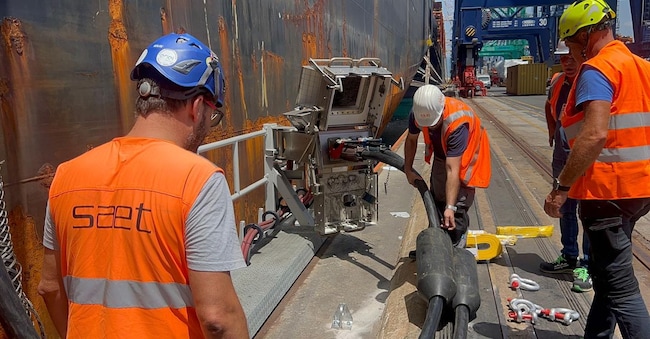
The port of Gioia Tauro is firmly committed to the energy transition: a mega container ship was powered entirely by the quay’s electricity supply via the cold ironing system, which allows moored ships to keep all their on-board systems running without having to use their own engines, as is usually the case, thereby significantly reducing pollutant emissions.
With this operation, the Calabrian port ranks among the first European ports to have brought into operation one of the strategic infrastructure projects envisaged by the European Union’s policies for the decarbonisation of maritime transport. The star of the first test operation, which was successfully completed, was the cargo ship MSC Mirja, with a capacity of over 19,000 TEU (20-foot containers).
After mooring, the technical staff connected the vessel to the mobile socket of the cold ironing system via the power cables. Once the technical checks and operations to ensure the interface with the electrical substation had been completed, the vessel switched off its auxiliary engines and was powered exclusively by the shore power supply, with a total power output of approximately seven megawatts.
“Today, the port of Gioia Tauro,” says Paolo Piacenza, president of the Port System Authority for the Southern Tyrrhenian and Ionian Seas, “is taking a step that marks a historic moment, not only for our port but for the entire national port system. A mega container ship has switched off its engines whilst berthed, drawing power exclusively from the quay’s electricity supply. We are not talking about infrastructure that has simply been completed, but about a fully operational system serving shipping companies. ‘This achievement demonstrates how sustainability can translate into tangible innovation and competitiveness.’ Gioia Tauro, he concludes, is ‘investing in technologies that reduce environmental impact and enhance the port’s appeal, making it increasingly efficient, sustainable and integrated with major international logistics networks’.


