
Duties, Giorgetti: 'The Stability Pact must be suspended for business aid'
The Minister of Economy at Cernobbio: European rules include a general safeguard clause in addition to national ones
by Gianni Trovati
 Aggiungi Il Sole 24 Ore
ai preferiti su Google
3' min read
3' min read
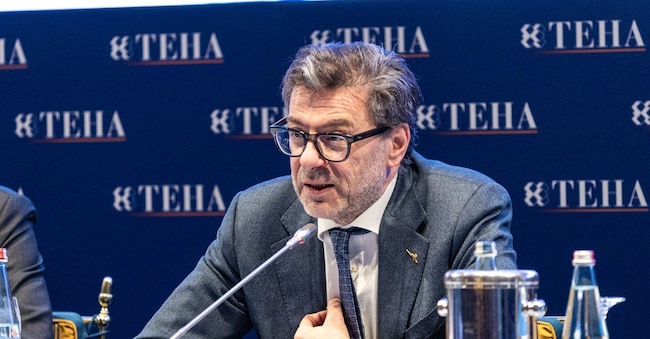
In order to put all countries in a position to activate public aid to the sectors most affected by Trump's trade war, it is necessary to reactivate the general suspension of the Stability Pact as in the days of Covid. In his speech at the Ambrosetti Forum in Cernobbio, Economy Minister Giancarlo Giorgetti arrives after a long discussion to launch what he calls a 'provocation'. But he does so in a clear and direct manner, a sign that it is not just a provocation.
Aid to Business
In the directive that reformed EU economic governance, Giorgetti explained at Villa d'Este, "there is Article 26," i.e., the one that provides for national safeguard clauses such as the one indicated by the EU commission to increase the countries' military spending, "but there is also Article 25," i.e., the general escape clause that allows all member states to "deviate from the net expenditure path established by the Council, in the event of a serious negative trend in the eurozone or the Union as a whole. "In recent days people have started to evoke aid for companies," explains the Minister for the Economy, pointing out the links of a "serious and pragmatic" reflection, as he repeatedly claims, but "aid for companies is an economic-financial intervention at the expense of the State, which must be allowed by EU rules. And if the serious economic risk situation is recognised in Europe,' the accounts holder closes the ring, 'remembering that in the current economic governance there is also Article 25 in addition to Article 26 is the logical consequence'.
"Prudent and realistic" approach
.Of course, this does not mean in Giorgetti's view a new 'free-for-all' like the one that at the start of the Covid season expanded the budget spaces in a boundless way, allowing the Conte-2 government to cancel the safeguard clauses on VAT but also to initiate interventions that then degenerated over time such as the Superbonus. Not least because, at least for the moment, the overall impact of the tariff battle promises to be incomparably less than that of the virus. The other debt and the consequent 'reduced space in the Italian budget' remain for Giorgetti 'a fact' and a constraint that 'I cannot and will not ignore'. On the contrary, the head of accounts is keen to 'vindicate' the 'prudent and realistic' approach to accounts that 'I intend to defend even in the new phase we are facing', after the recognition arrived from Fitch on Friday evening with the confirmation of the BBB rating with a positive outlook. The risk to be countered, however, is that of yet another asymmetrical approach in Europe, in which those with more budgetary margins can deploy instruments and resources incomparable to those available to others. The extraordinary spending plan on arms and infrastructure just launched by Berlin is an effective testimony to this.
Cold-blooded, damaging counterclaims
.In addition to being, at least for now, much more measured than at the time of Covid, the possible aid to the sectors most affected by the rain of US duties is not the only tool in a strategy that, according to Giorgetti, must aim at 'de-escalation', because 'we must not press the panic button'. The button has been pressed in recent days by the stock exchanges, which 'sometimes act rationally', while policy must 'keep a cool head, carefully assess the impacts and 'avoid starting with a policy of counter-duties that could simply be harmful'.
European or Italian answer?
.As often happens to him, then, Giorgetti enters in a non-obvious way into the battle that even in these hours opposes the leghist supporters of bilateral negotiations between Italy and the US and those who instead, like Foreign Minister Antonio Tajani, support the need for a united EU response. The "rational approach" promoted by Giorgetti starts from the consideration that Trump's strategy "is based on commercial and utilitarian criteria" and not political ones, with the consequence that some "countries ruled by socialist, not to say communist, governments have been treated much better than liberal-democratic states". On these assumptions, the Italian account holder argues that action must be taken in the knowledge that trade policy 'is essentially a European competence' but is not the only front on which to act. So far there has been little discussion of it, but just as crucial is the tax front because 'the Trump administration has declared that the first pillar of OECD international taxation is definitively dead, and that therefore the US intends to rediscuss on different grounds the system of taxation of American companies working in other countries'. Here, Europe is 'lagging behind' because the EU Digital Tax only exists in theoretical debates that have been going on for many years, while in the Official Journals we only read about the taxation of individual countries such as Italy in addition to France and Spain.

