
Giorgetti: ‘Pragmatic sovereignty lies in fiscal prudence. GDP is set to be close to +1 per cent by the end of the year’
The Minister for the Economy has defended the Government’s achievements: “We’ve kept the ship afloat, and that was no mean feat”

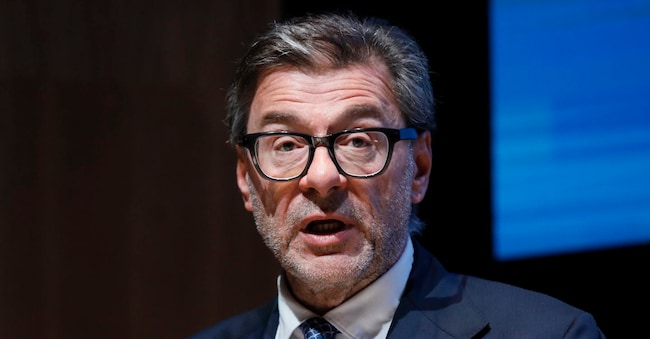
“Prudence regarding debt is a form of pragmatic sovereignty”. In his closing address at the Ambrosetti Forum in Cernobbio, which was politically marked by the verbal battle between Roberto Vannacci and Mario Monti, the Minister for the Economy Giancarlo Giorgetti coined this term to indicate an alternative path to both the ‘show-off’ brand of sovereignty and pro-European orthodoxy. The crux of pragmatic sovereignty, as outlined by the author, lies in its concrete outcomes, starting with the renewed international confidence that allows Italia to face the ‘storm looming over the bond market’ with relative confidence, with yields rising due to the swelling of debt (led by the US) coinciding with yet another resurgence of inflation.
Staying true to a style that has been established over the years, Giorgetti maintains a measured caution even in his choice of words, whilst still taking pride in the results achieved by the Government. “We’ve managed to stay afloat, and that was no mean feat,” he explains, adding that, barring any surprises, this year’s growth should be “close to +1%”. After all, this result was achieved almost entirely in the first six months of the year, when the indicator showed actual growth of +0.8 per cent; to this must be added the effect of three extra working days compared with last year, bringing the total to between +0.9 per cent and +0.95 per cent. In short, it would take very little for the results of the second half of the year to push the figure above the round number.
Nor was this a foregone conclusion in the run-up to the announcement, as evidenced by the +0.6 per cent figure cautiously cited by the Government in its latest public finance document, in line with international forecasts. But obviously, a few decimal points are not enough to resolve the structural problem of low growth, which Italia shares with ‘old Europe’, as the Minister for the Economy himself points out.
After all, the country pays tariffs for wars in terms of ‘double the power’, due to its exposure to imports of energy raw materials. And it has to tackle domestic issues as well as European ones. Among the first issues, Giorgetti once again highlights the shortfall in private investment, which, in his view, points to responsibilities lying outside the Government. On this point, the Minister for the Economy is clear: “Why do Italian pension funds invest all over the world except in Italia?”, he asks. The answer to this rhetorical question cannot lie in a ‘lack of opportunities for returns on patient capital in Italia’, given that money from ‘pension funds all over the world’ is flowing into the country.
The minister is keeping his cards close to his chest regarding the budget, as discussions have yet to get into full swing. Among the priorities, of course, is making the country more attractive to young people, to counter a demographic decline that looks set to have an increasingly significant impact on productivity and GDP. On this point, wages are a key lever; however, “businesses have a vital role to play”, Giorgetti emphasises: managers and entrepreneurs at Villa d’Este applaud this statement, but it remains to be seen how it will be put into practice.


