
Giorgetti: signs of slowdown due to exogenous causes, we will revise GDP estimates
Economy Minister: urgent suspension of Ets until energy prices realigned

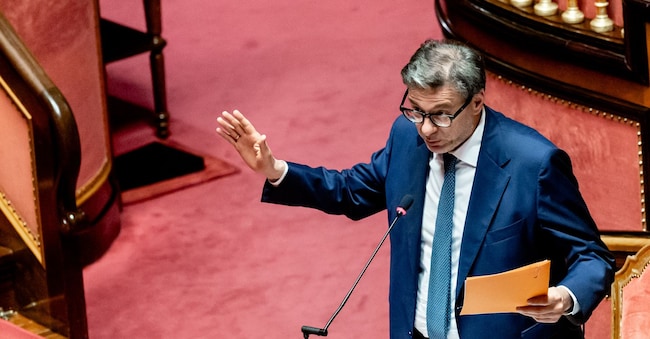
The government will have to revise its growth forecasts in light of the international situation. This was stated by Economy Minister Giancarlo Giorgetti in the Senate: 'The signs of a slowdown in the growth outlook are to a large extent attributable to exogenous factors,' Giorgetti emphasised. 'The government is preparing to revise its forecasts with the escalation of tensions in the Middle East. The government is therefore preparing to revise its macroeconomic forecasts in the same direction as the main international bodies' and national forecasters. Before the energy crisis, the minister emphasised, there were 'signs of improvement' in the growth outlook.
"We monitor truce, ready to intervene"
'Faced with the current crisis context, the government has adopted measures aimed at structurally reducing the cost of energy and emergency provisions to contain fuel costs,' said the Minister of the Economy. 'The government is responding to the current crisis with a prudent but decisive approach and intends to progressively calibrate the measures according to the persistence and volatility of price dynamics.
For Giorgetti, 'these emergency measures go hand in hand with measures to support incomes and the production system. The evolution of the international context will be constantly monitored in the light of the truce reached yesterday, and the government is ready to intervene on both the demand and supply sides, aware that measures on the supply side require more time to produce effects
"On public accounts we are as prudent as ever'
'When in doubt, we are as prudent as ever'. This was the economy minister's response to those who asked him whether the government would be able to achieve the deficit target of 3% of GDP with the crisis in the Middle East, on the sidelines of question time in the Senate. Shortly before, he had said that "as regards the exit from the excessive deficit procedure, the Istat accounts from the beginning of March indicate a general government deficit-to-GDP ratio of 3.1 (actually 3.07) in 2025. We are waiting for Eurostat's assessments, in the third ten days of April, which is extremely relevant for the decisions to be taken. In fact, the scenarios vary considerably, depending on whether or not the preconditions for an exit from the excessive deficit procedure exist. For an exit from the European procedure, a deficit-to-GDP ratio below 3 per cent is required.
"Stop stability pact if prolonged financial stress"
The incumbent of Via XX Settembre explained to the audience: 'It must be made clear from the outset that, should the international crisis not evolve positively, the measures adopted by individual states will necessarily have to be part of a European strategy, which we are urging and promoting'.

