
Giorgetti: 'On taxes on billionaires decision of states, move forward with taxes on multinationals'
The economics minister: 'It is clear that the decision of how to tax, how much and when is up to the nation states, it cannot be recalled, neither in the G20 nor in the UN. This is a precise limitation that many countries have put in place, and from which we do not intend to derogate".

3' min read
3' min read
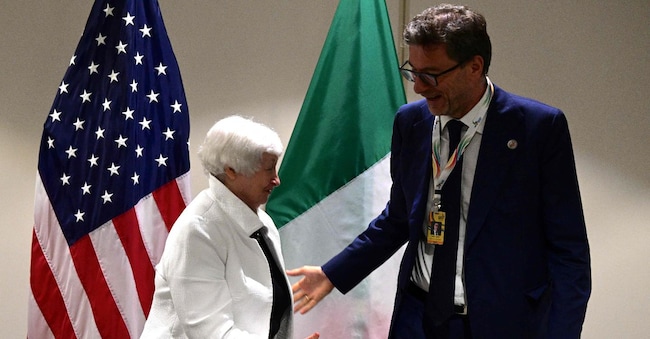
On the tax for the super-rich, 'we are in favour, but we need to discuss well with respect to a principle that must not be questioned: ownership'. Minister Giancarlo Giorgetti said this on the sidelines of the G20 in Rio de Janeiro. 'It is clear,' he said, 'that the decision of how to tax, how much and when is up to the nation states, it cannot be recalled, neither at the G20 nor at the UN. This is a precise limitation that many countries have put in place, and from which we do not intend to deviate'.
Advancing with taxes on multinationals
"If we go after the global minimum tax" on the super-rich "first we should do the one on large multinationals and unfortunately pillar one of the multilateral agreement is dramatically in the pits, blocked by India, China and resoundingly also by Australia and therefore the Americans do not give the green light," the Finance Minister added. "If India, China, and the United States are missing, it seems clear to me that the tax base is missing. So, we have been insisting, with diminishing hope, on the implementation of the first pillar on the taxation of large multinationals'.
Our priority is on the Mattei plan in Africa
"Italy has the Mattei Plan. We have also reiterated with the World Bank, the concentration of our strategic interest is on Africa, because among the many needs and the many needs at a global level, we have a specific interest in focusing development on Africa, in a coordinated manner, as part of our Mattei plan," Giorgetti stressed. "So with the World Bank we have spoken precisely about this," he noted. "There is a willingness to focus attention on those three or four countries on which to intervene.
On Russian assets we are at a crossroads
.The dossier on the extra-profits of immobilised Russian assets, 'as the central banks have rightly pointed out to us, is a very slippery slope, where there is a clear political consensus, but where you have to be very careful about what you do, both from a legal point of view in the strict sense, and from a reputational point of view in a broader sense,' the minister explains. 'I believe we are close to a solution that can save these dimensions. Again, there are two options on the table at European level. The work of the Italian presidency of the G7 has led to the penalty kick, but at this point we need to understand whether in Europe we can move at the level of unanimity, and this would allow the 27 countries to change the regulation, and make this system perpetual, or at least defined until the end of the war. Or instead,' he points out, 'if we have to be content with the continuous renewal, as is done with the sanctions periodically (every six months, every year or every two), which achieves the same purpose, but which for the US is not totally satisfactory because it does not offer this kind of definitive assurance that they require before Congress. So we are in this situation. A lot will depend on Hungary's attitude, and we will see in September-October, given the particular hurry to define the framework before the US elections'.
Panetta: good Italian G7 solution on Russian assets
"The solution on extra-profits on immobilised Russian assets that was found under the Italian presidency is much more reasonable than previous proposals. It is a solution that does not violate international law, and it extracts resources needed by Ukraine, which is why it has found the agreement of the seven countries," Bank of Italy Governor Fabio Panetta pointed out on the sidelines of the G20 in Rio. "It is a solution that extracts resources from immobilised Russian assets, especially in Europe, but at the same time does not create a precedent in the violation of international law."

