Human Rights Festival

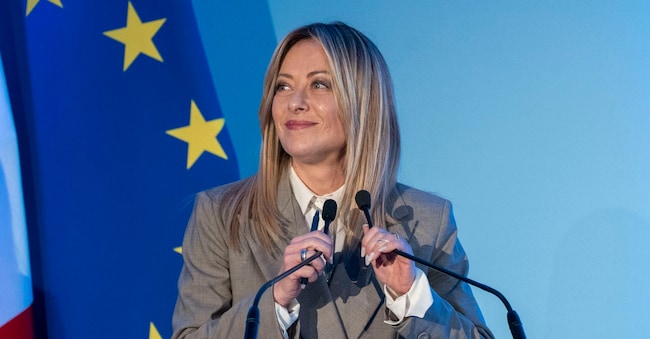
Giorgia Meloni 'a two-faced leader'

Two documentaries feature Italia at the Fifdh in Geneva: one on the ambiguity of the premier's political discourse, the other on the camalli of Genoa and their battle that has gone from trade union to political and intersectional

by Lara Ricci

Giorgia Meloni, Presidente del Consiglio dei MInistri (Imagoeconomica) 7146

5' min read

Translated by AI
Versione italiana

5' min read

Translated by AI
Versione italiana

Sold out at the Fifdh (Festival du film et forum international sur les droits humains) in Geneva for the world premiere of Le cas Meloni, the Meloni Case, by Anna Bonalume and Jeremy Frey, a French documentary analysing the rise to the presidency of the Italian Council of Ministers of the representative of a party with its origins in neo-fascist movements, for the first time since the post-war period.

A film that will soon be broadcast on French public television, while on the French-German channel Arte another documentary dedicated to the Prime Minister is available these days: Giorgia Meloni et le clan des Goélands, by Barbara Conforti.

Loading...

The subject is of great interest in France - where another woman, Marine Le Pen, at the head of an extreme right-wing party, the Rassemblement National (successor to the Front National), has twice reached the second round of the presidential elections (three times if we add that of her father, Jean Marie, in 2002) - and also to the Geneva audience, judging by the large, packed hall that also attended the debate that followed the documentary, in which the progressive acceptance, normalisation, of neo-fascist logic and discourse in Europe, where the independence of the judiciary and the media, as well as freedom of demonstration, are increasingly threatened, was discussed.

Anna Bonalume, journalist and university lecturer in philosophy, decided to return to the country of her birth to retrace the history, and above all the narrative, of the 'Meloni phenomenon' and to underline its ambiguity.

Therefore, she does not start from Garbatella, a working-class Roman neighbourhood of which Meloni likes to declare herself a native - even the leader's official website reports that she was born in Garbatella - but from the neighbourhood where she was actually born, a middle-class neighbourhood in the north of Rome, as middle-class as her family, linked to the world of show business, was.

Using period footage in which the future prime minister declared that Mussolini had been a good politician, and with the help of experts such as historian and sociologist Marc Lazar or journalists Luciana Castellina, Myrta Merlino and Giovanni Zagni, the documentary reconstructs her militancy in neo-fascist movements and the very rapid rise that led her, ten years after co-founding Fratelli d'Italia, to the top of Italia politics.

Describing her as a 'two-faced Janus', Bonaluce and Frey highlight the premier's ability to hold a double discourse, to change it when necessary, or to act contrary to what she has publicly stated.

For example on Europe: always Eurosceptic, in the face of international allies it has supported Ukraine, NATO and has not, at least in appearance and until the film was made, last year, weakened the EU.

That EU from which Italia, as a result of the previous government's negotiations, received EUR 200 billion, a sum that is said to be at the origin of the economic stability that the current government flaunts, Zagni points out.

Or the discourse on women: on the one hand she has been able to treasure her being a woman, and the efforts and achievements of feminist movements, and on the other, she has made it known that she wanted to be called 'the president of the Council', as if she were a man, and has taken decisions that - Castellina emphasises - progressively erode women's rights, for example by opening the doors of the consultatories to 'Pro Life' associations, an ambiguous move for someone who had promised she would not touch the law on abortion, as well as when 'from a couch of a public television programme', Castellina stresses, 'she spoke of a "Holocaust" regarding six million aborted fetuses' (from 1978, the year Law 194 on abortion was introduced, ndr).

Or, again, the documentary Le Cas Meloni stigmatises the prime minister's discourse on migrants: when she was not in power she called for a naval blockade, a military action to bar the way for migrants, while since she has been in government what she has done is build two migrant centres in Albania costing 800 million euros, 'public money thrown away because various Italian courts have ruled that asylum seekers cannot be detained there'.

The writer Antonio Scurati, interviewed, observes that, like Mussolini, Meloni has been able to put the leader's body centre stage, with gesticulation, mimicry, and tones that take over from the contents of the speech, which remain 'squashed', producing 'an almost physical vibration, a simplified and direct communication that reduces intellectual effort and creates a bond with the people'.

Meloni would be a tightrope walker, in short, according to Bonalume and Frey, a tightrope walker capable of exploiting the tradition of commedia dell'arte, of showing herself to be an ally of Musk, Trump and Vance and at the same time of Europe, despite the tariffs.

A balancer capable of unprecedented political stability, but dangerous, because - they observe - the premierate reform he seeks to bring about would weaken democracy, as would the other moves to concentrate power in the hands of the premier.

Italia was the protagonist at Fifdh with another film, albeit out of competition, Portuali: Perla Sardella's fine documentary on the camalli di Genova. A rough film, which opens by filming at length the bargaining of a group of trade unionists who decide to leave the CGIL and join the grassroots trade union union union, with references to Article 18, the redundancy fund, labour laws and technicalities etc.

References that are unlikely to be understood by a foreign audience, but which help to emphasise the concreteness and meticulousness of trade union work, thus managing to avoid rhetoric and spectacularization and to restore an epic sense to a battle that, starting from the demand for fair work, correctly paid, where the health of workers is protected, has gone from trade union struggle to political struggle, with the refusal to ship weapons destined for countries at war (it all began in 2019, at the height of the conflict in Yemen): "We do not want to be a cog in the war," they assert. "For us, loading weapons onto the Saudi Bahri company's ships is no different from the soldier loading ammunition."

'Law 185 of 1990 prohibits the trafficking of arms destined for countries at war on Italia territory, and Article 11 of the Constitution states that Italy repudiates war' - the trade unionists who found themselves in court accused of criminal conspiracy (the investigation was later dismissed) defended themselves.

A battle also joined by the students, who marched together with the camels repeating the slogan 'The dockworkers taught us, blocking weapons is not a crime'.

An ethical battle that also intersects with that of gender: Bruno Rossi, one of the most senior trade unionists, is in fact the father of Martina Rossi, the student from Genoa who died on 3 August 2011, falling from the sixth floor of a hotel in Palma de Mallorca following an attempted rape that they tried to pass off as suicide.

A powerful documentary, Sardella's, capable of drawing attention to the importance of trade union and political battles, but also to the intersectionality of the struggle.

Copyright reserved ©
  • Lara Ricci

    Lara Riccivicecaposervizio curatrice delle pagine di letteratura e poesia

    Luogo: Milano e Ginevra

    Lingue parlate: Inglese e francese correntemente, tedesco scolastico

    Argomenti: Letteratura, poesia, scienza, diritti umani

    Premi: Voltolino, Piazzano, Laigueglia, Quasimodo

Loading...

Brand connect

Loading...

Newsletter

Notizie e approfondimenti sugli avvenimenti politici, economici e finanziari.

Iscriviti