
Giorgio Armani reinvents itself through innovation and the art of tailoring with a focus on materials
Miuccia Prada and Raf Simons streamline and simplify; at Tod’s, Matteo Tamburini reaffirms the simplicity of excellence; Thom Browne’s eccentric rigour

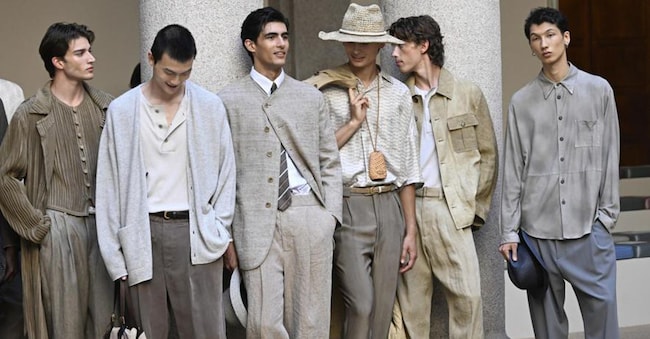
The men’s fashion calendar in Milan was rather sparse this season, featuring the Spring/Summer 2027 collection. There were few shows, but all were significant, striking a good balance between established names and new designers.
As is traditional, the show Giorgio Armani brings the event to a close. Leo Dell’Orco continues to honour Giorgio’s legacy without being constrained by it. There is a nonchalance, a lightness and a pace all of its own in the new Armani, without coming across as unnecessarily disruptive; on the contrary, one senses, updated and reworked, echoes of King Giorgio’s finest work from the 1990s – the influence of which endures and reigns supreme here and now. In this collection, a sense of Mediterranean exoticism blends skilfully with the brand’s signature soft tailoring, and the result is nuanced, enveloping and effortless, even if the overly long show dilutes the message rather than bringing it into sharper focus.
There is probably nothing particularly new about embellishing clothes with ethnic accents, but what sets this collection apart is its tireless attention to materials, tactility and surface textures. Everything is rough, three-dimensional, as if weathered by the scorching sun: a far cry from the anonymous flatness and the cold, AI-like fashion that is so common these days. Also on the catwalk were a few looks from the womens’ pre-collection, designed by Silvana Armani: a lovely addition that emphasises the organic nature and cohesion of the Armani world.
In an age of overstimulation, choosing just one thing is a radical stance. Miuccia Prada and Raf Simons are convinced of this, speaking of clarity, lucidity and discernment: the exact opposite of the postmodernist mix that is all the rage everywhere, the origins of which, paradoxically, are to be found precisely in certain particularly striking corners of Prada thought, both recent and distant. Changing one’s mind, after all, is a sign of intelligence. ‘There is too much of everything, a proliferation of messages that is confusing,’ declare the creative directors, practically in unison. ‘That is why we have decided to focus on what is universal, absolute and timeless.’
Rejection, as a deliberate and repeated act, translates on the catwalk into a brutally youth-oriented proposal: by constantly stripping things away, sizes become ever smaller, bodies lose mass and age is frozen at adolescence. The clothes, on the other hand, are reinterpreted, rematerialised and reused archetypes: five-pocket trousers and denim jackets – worn as shirts – in every possible material; bomber jackets and blazers; V-neck or crew-neck jumpers.

