
Giorgio's entrepreneurial vision and Armani's future challenges

3' min read
3' min read
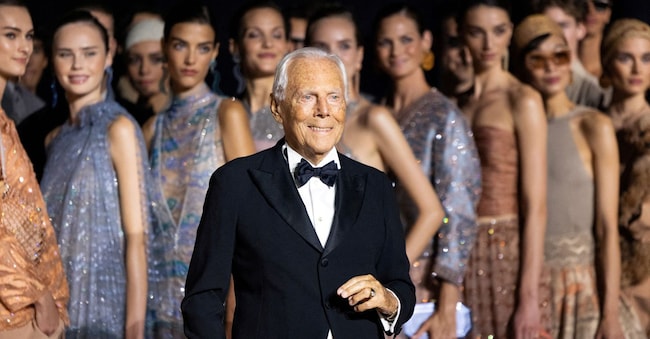
Giorgio Armani was the king of fashion and the impact he had on taste and the way we understand elegance was enormous. As familyandtrends has already had occasion to mention, Giorgio Armani was, also, a great entrepreneur who created a magnificent enterprise to which he decided to give continuity by thinking about who and how he should continue it.
Giorgio Armani is the only major Made in Italy company of the 1980s that has remained strong and independent from the large international groups. This is because entrepreneur Giorgio Armani has been able to adapt the company to the evolution of competition and consumers while remaining faithful to its history and distinctive traits. Understanding this evolution gives insight into the entrepreneur's greatness.
Made in Italy was born with the first Pitti organised by Giovanni Battista Giorgini in 1951, it was about offering clothes, shoes and accessories to a niche of rich customers to make them feel elegant and fashionable. The work was 'simple': the demand was sophisticated customers who were well acquainted with the characteristics of the products they were buying, and 'modular' in the sense that the customer bought the garment and then supplemented it with others to achieve his or her own taste in dressing and appearance. Over time, the number of consumers of elegance and fashion around the world has grown by leaps and bounds due to the combined effect of the increase in the number of people, their income and the desire to use an increasing proportion of them for their own style. However, consumers have also become much less knowledgeable about elegance and taste, and have demanded a place where they can buy elegance and taste certified by the seller's brand, given the impossibility of defining them themselves. In this competitive environment, it was necessary to integrate style production with distribution, communication, branding. Furthermore, it became key to know well the various segments of this large style and appearance market so as to propose the attractive brand for the right segment by intercepting demand where it is and with an evolved distribution.
Those who did not adapt, like almost all the fashion designers of the 1980s, disappeared or were bought by some large international group. In 1981, Giorgio Armani, in order to adapt his company to the changed competitive environment and grasping the growing importance of distribution, launched the first Emporio Armani, stating: "[it is] a container of garments, accessories and ideas, destined for a transversal, cosmopolitan and metropolitan public". From there was born the Giorgio Armani of today with its 2.3 billion turnover and unique positioning; very different from the French model of Kering and LVMH. In the words of the entrepreneur Armani: "These French groups want to do everything, I don't understand it... It's a bit ridiculous... Why should I be dominated by one of these gigantic structures that lack personality?"
Giorgio Armani has also been a great entrepreneur in planning his own succession, avoiding the typical mistake of wanting to replicate the founder with a clone of him; in fact, he told the Financial Times, 'Without me? I don't think this can be replicated', and in his book For Love, 'The scenario now is very different from when I started, so I imagine multiple coordinated functions for those who will come after me, much more efficient'. The founders are unique beings who synthesise the owner, the entrepreneur and the manager and cannot be cloned. The subdivision of the future ownership of Giorgio Armani spa into different categories of shares with multiple voting rights and rights to the appointment of a certain number of directors, chairman and managing director reveals a reasoned organisation of ownership and entrepreneurial leadership. The presence of certain categories of shares with veto rights on the appointment of the men's and women's style managers suggests that a managerial structure has been devised to evolve the figure of the stylist-entrepreneur-founder.


