
Giovanni Pintori, a perpetual motion with the flavour of the future
His production went far beyond mere advertising to become art and new humanism
4' min read
4' min read
On the occasion of Olivetti's 50th anniversary, a book was published, Olivetti 1908-1958 with cover, marvellous, by Giovanni Pintori, curatorship, inapputable, by Giorgio Soavi, and layout, harmonious, by Max Huber. This small, great example of virtuous triangulation would suffice to justify (and finally!) the superb exhibition that the m.a.x. museum in Chiasso is dedicating to Giovanni Pintori (until 16 February 2025),a sardus pater of Italian graphic art (Gavino Sanna dixit) and a figure, alas, still little known, although his greatness (and graphic freshness, which still endures) would deserve it. Hence, the initiative to (ex)take Pintori first to Switzerland - where graphic art has always found, conveniently, a home - and then (re)take him to Nuoro, from where he left in the 1930s (the exhibition will be at the Man, skilfully guided by Chiara Gatti, co-curator of the two exhibitions with Nicoletta Ossanna Cavadini), in June 2025 (and at the Man, with the help of the then director Cristiana Collu, there had already been Pintori's first exhibition), is most laudable and timely.
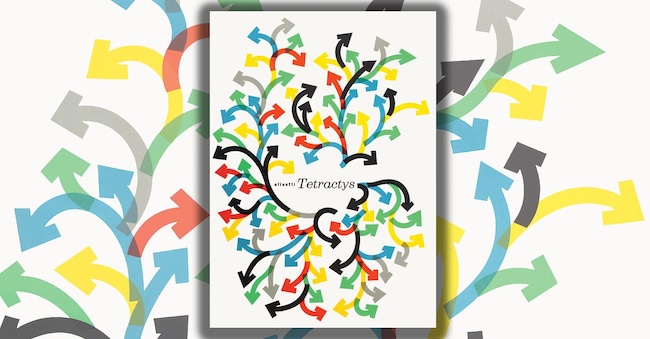
But these trajectories, which, with the fulcrum of Ivrea, intersect the threads of Pintori's existence, really do disappear, like mere pretexts, in the face of the succession of pieces dotting the walls of the rooms and the display cases of the museum and which reaffirm, in a manner that is in some ways "unprecedented", or simply unexpected, even for connoisseurs, the quality of Pintori's artistic, non-graphic expression. A small personal parenthesis: for years, behind my desk in the office at Via Monte Rosa 91 in Milan, I had attached a poster of the 'Tetractys' (1956) - one of the most famous creations, not by chance the emblem of the exhibition -: I had it practically in front of my eyes every day, and yet, to see the sketches and the finished realisation here again, one is still astounded. The language, the style, of Pintori, his 'severe tension between reserve and inspiration' (subtitle of a fundamental book by Massimiliano Musina; Fausto Lupetti editore, published on the occasion of the centenary of his birth, in 2012), emerge with moving force. Like, and this is the only other masterpiece that I mention for the almost insolent quality of its execution, the 'Numbers' poster (1949): here the original painting allows us to grasp to the millimetre, literally, Pintori's love and devotion for the typographic quality of numbers and letters (and what beautiful reproductions elsewhere of the Rosetta Stone, protagonists of some advertising campaigns and metaphors of the power of words and writing). It is a matter of entering a world, the Olivettian and the Pintorian, in which the impulse towards the communication of a product (they were still typewriters or calculators to be sold) was far outweighed by the power of the message. Which always revolved around the meaning of modernity, its use, its bearing: and Olivetti was an absolute example in this. Those were years in which industry was really marking the entrance into modernity and the hands of Ivrea, an almost unrepeatable example, were always pointing straight to the future. Pintori used arrows and trajectories, balls and letters, numbers or, in a later and even more conceptual phase, well exemplified here, the very notion of perpetual motion, to express an idea that went far beyond the purchase. Because with that purchase, you entered, by right, into the contemporary, even though you were performing a gesture, writing, that had millennia of history. The famous poster with the ink inkwell used as a vase for a rose that blooms and blossoms on the left side, leaving the vaporous humble dream of the gesture on the right side already prophesied this position. Pintori was a philosopher of advertising, and this was indeed an art, as the title of the exhibition states: committed as he was to raising the level of the message, he was not concerned with emphasising only the characteristics of what was being bought, but he was ingenious in not letting the consumer lose the aura that the machine would make him conquer, keeping up with the times, perhaps a new human mode. Olivetti, Adriano I would say, always defended him 'to the sword', because he understood the humanistic ambition behind the work; moreover, those flat backgrounds of colour, introduced Pintori into that 'modernism' that, from Lustig on down, reigned. Grignani or Huber himself would have used colour in the same way: geometries with a flavour of the future, trajectories, signs, ideas, like the graphic investigations on perpetual motion that characterised a fertile season of Pintori's research before his definitive landing in painting.
The mystery remains as to how it was possible: he, shy and taciturn, arrived in the futuristic Milan, together with that other luminous artistic and existential meteor of Salvatore Fancello (a young boy who, on his first sea crossing, slept on his lap) and Costantino Nivola, destined for an even greater artistic future: from a thousand-year-old island to the future. And there remain those paintings of the Nuoro district of Seuna that close the exhibition: a nostalgic and mysterious 'homecoming'. A world lost, and never left for good. From Tresnuraghes to the globe with a pencil. Applause.

