Cycling

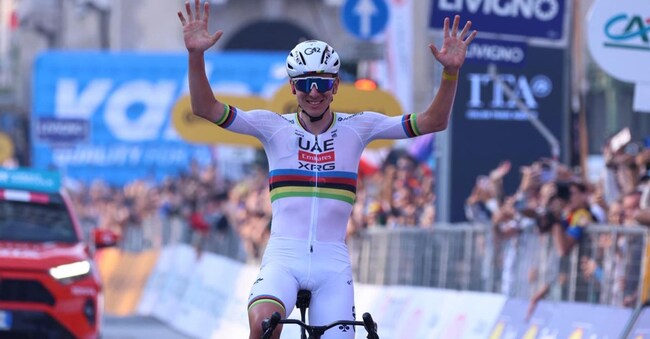
Tour of Lombardy: fifth win in a row for Pogacar, who also beats Coppi but is in danger of boring

Again, as at the Mondale and the European Championships, second place went to Remco Evenepoel, who arrived at the finish line in Bergamo with a delay of 1'48"

by Dario Ceccarelli

Lo sloveno Tadej Pogacar dell'UAE Team Emirates vince la 119ª edizione de Il Lombardia, da Como a Bergamo (241 km), sabato 11 ottobre 2025 a Bergamo. ANSA/MICHELE MARAVIGLIA

5' min read

Translated by AI
Versione italiana

5' min read

Translated by AI
Versione italiana

Although we know we are not giving you big news (if anything, the news would be if he had lost, like the man who bites the dog), we start with Tadej Pogacar's extraordinary new victory at the 119th Giro di Lombardia.

The news is that Pogacar, cycling's new monarch, has beaten even Fausto Coppi to win for the fifth time in a row this monumental classic, which, apart from a few minor challenges, always closes the season.

Loading...

Tadej beat a legend like Fausto, because the Campionissimo had won five Giro Lombardias, but not in a row like the Slovenian: he thus achieved a fivefold victory, which propels him further into the great history of a sport that, despite having known unforgettable champions such as Merckx and Coppi, is still unable to define the exact size of this phenomenon that is raising the bar beyond all hitherto known limits

To compare with the myths of the past, Merckx's seven Milan-Sanremo and Girardengo's six were not consecutive, but Pogacar's five in a row were. The Slovenian is not completely astounding for one reason: with Pogacar, we are no longer surprised by anything. He does everything so easily that even what is no longer normal seems normal.

Also this time, as at the Mondale and the European Championships, the second place goes to Remco Evenepoel, who arrived at the finish line in Bergamo with a delay of 1'48". An extraordinary proof also that of the Belgian who, unfortunately for him, has only one misfortune: to have in front of him an extraterrestrial who travels in another dimension. Every time Tadej starts, poor Remco knows that he cannot do anything about it, he has to let him go and just beat the others.

This time Tadej escaped on the climb of the Passo Ganda with about 36 km to go, after his Uae Emirates had imposed a deadly acceleration to get closer to Quinn Simmons, the day's brave breakaway rider with more than three minutes' lead over the peloton. Pogacar, now launched, first caught the American, then set off alone towards his fifth triumph.

Giving Remco what is Remco's (he never gives up, hats off to him), it must be remembered that on the third step of the podium goes Australian Michael Storer ahead of Simmons (fourth) and Isaac Del Toro (fifth), also of Emirates. For the record, in 2025 Uae collected 93 victories, which is also a record.

"I have no regrets, everything was perfect," Pogacar commented, referring to his extraordinary year in which he won 20 races, including Flanders, Liège, Tour de France, World and European Championships and Lombardia.

Trying not to be overwhelmed by his exploits as well, one cannot help but wonder to what extent the Slovenian's overwhelming dominance does not end up arousing not only legitimate enthusiasm, but also a certain boredom and growing antipathy. It's human: the Unbeatables, starting with Achilles, become obnoxious after a while. Too much is too much, say the critics. And it's not good for the show because a minimum of suspense in sport is obligatory.

moreover, even humanly it is natural to side with the weaker, the one less blessed by the gods.

One is reminded of poor Raymond Poulidor, eternal runner-up to the dashing Jacques Anquetil, who even on his deathbed, when his rival visited him at his bedside, had the effrontery to tell him: "You are out of luck my friend, you will come second this time too..."

Gino Bartali himself, despite being a force of nature, in comparison with Fausto Coppi inevitably ended up being considered the less gifted of the two, the Hector of the situation. Let's not talk about the rivalry between Merckx and Gimondi where the Italian was, by his own admission, condemned to defeat: 'It took me two years to admit that he was stronger than me, but in the end this rivalry was good for both of us: for Eddy because it humanised him, for me because I was always indicated as the strongest rival of the strongest rider of all time,' Gimondi confessed.

The problem for Pogacar (assuming it is a problem for him) is that he doesn't have a Gimondi or a Poulidor to contend with. With the Slovenian Cannibal, in fact, we can't find a real opponent to stand up to him all year round. In the spring classics, only Van Der Poel was able to beat him (Milan-San Remo and Roubaix).

The Belgian Evenepoel, a second-place finisher, never really manages to trouble him. He is a phenomenon, Evenepoel, but not as phenomenal as Pogacar.

Then the voracious Tadej not only won, but also dominated, overcame the odds, and made a breakaway that started a hundred kilometres earlier. Eddy Merckx, the last myth with whom Pogacar was confronted, admittedly won a great deal (525 races) but often had to work hard to win, not only with Gimondi, but also with Ocana, Thevenet, Baronchelli, Moser. At the finish line the Cannibal could be seen in a state of shock, with his hair stuck to his forehead, his eyes lost in emptiness, as if he had come out of hell.

Instead, Pogacar, after a run, looks like a baby just out of the bath, with a fashionable topknot and that unpunished grin faking a modesty that (rightly) does not belong to him.

The Slovenian looks more like Alfredo Binda, the Lord of the Mountains, the one with the 'round pedal' so strong that in 1930 he was persuaded not to take part in the Giro d'Italia thanks to a nice cheque for 22,550 lire. Paid not to win, just think. If Binda was there, the organisers said, fans and enthusiasts grumbled, they preferred Learco Guerra or the indestructible Costante Girardengo, also a champion, but not always as unbeatable as Binda.

Pogacar is very strong in all terrain: uphill, downhill, flat. He just lacks the ability to compete with the sprinters, but sooner or later, the critics say, he will try. Tadej has won four Tours, a Giro d'Italia, 10 monumental classics. Ahead of him only Roger De Valeminck (11) and Merckx remain with 19.

In addition to being strong in his own right, the Slovenian can also count on an equally formidable Uae Emirates squad, a battleship. His 'domestiques', riders such as Isaac Del Toro, Adam Yates and Juan Ayuso, could easily be captains in other teams.

Marco Pantani was very strong in some cases, but had mediocre teams with him. He was expected to take off his bandana and win alone. Furthermore, Pantani was very strong in the climbs, but not as gifted in the classics. He finished exhausted ('I go fast in the jumps to shorten the agony') and had a lot of accidents that often kept him out of action. Pantani was a forerunner, but did not arouse antipathy in the public, on the contrary. Only when he started winning too much, as in the 1999 Giro, the one with the Madonna di Campiglio incident, did he probably become uncomfortable.

That is why, going back to Pogacar, one would advise him not to overdo it, so as not to become obnoxious, to leave a bit of suspense in the races, and not to make too many enemies who, when he has difficulties (sooner or later it happens to everyone), will make him pay with interest.

This has always happened. But history, even cycling history, never repeats itself in the same way. And then champions, rightly so, are selfish.

Copyright reserved ©
Loading...

Brand connect

Loading...

Newsletter

Notizie e approfondimenti sugli avvenimenti politici, economici e finanziari.

Iscriviti