
Global Award for Sustainable Architecture rewards anti-crisis projects
The winners of the 2026 edition, announced in Istanbul, at the Mimar Sinan Fine Arts University, come from China, Mexico, France and Germany (although the professional lives and works in Milan)

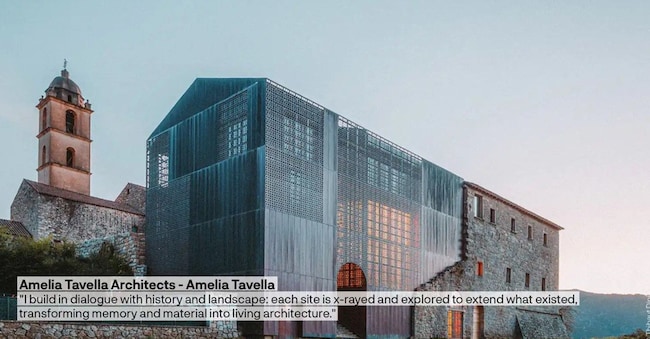
Five different geographical origins, five professional trajectories and five design dimensions, but for all of them the same direction: architecture as a concrete lever of transformation within an environmental, social and cultural crisis that is global and must be addressed. The winners of the 2026 edition of the Global Award for Sustainable Architecture were Ye Man from China, Doan Thanh Ha from Vietnam, Loreta Castro Reguera and José Pablo Ambrosi from Mexico, Amelia Tavella from France and Andreas Kipar from Germany - who lives and works in Milan - who were announced at the Mimar Sinan Fine Arts University in Istanbul, where Il Sole 24 Ore covered the ceremony and the international debate that accompanied it.
Now in its 19th year, the award founded in 2006 by Jana Revedin and realised in collaboration with Saint-Gobain, official partner for the third consecutive year, has been under the patronage of Unesco since 2011 and supported by the International Union of Architects since 2024. More than a recognition, it is an international forum for reflection on the great challenges of contemporary architecture, capable of connecting practices, geographies and generations. "Our task, for twenty years," explains Jana, "has been to dare, to transmit, to federate. Again, to relate different generations, countries and cultures so that sustainability does not remain a discourse, but becomes a shared practice. In this sense, the Global Award works to intercept practices that do not merely represent change, but produce it'.
The value that the designers who participate and win take with them (besides visibility) is the time of long shared work. Year after year, those who make the shortlist interweave months of shared work with the jury, discuss research and conflicts, build a common thought process that flows into a collective volume, this year Architecture Is Transformation, published by ArchiTangle. In twenty years, 95 architects have been honoured, five of whom went on to win the Pritzker Prize.
What sustainable architecture means today
Looking at the projects of the five winners together, the first evidence is that sustainability has definitely lost any purely formal dimension. It is not aesthetics, it is not certification, it is not applied technology. It is a posture. A way of being within the relationships between materials, community, time. In China, Ye Man speaks of 'soft architecture'. He recovers the logic of joints and wooden structures without nails to propose works in which stability arises from the relationship between elements. In Hainan, Tongde Hall rests a new wooden structure on existing masonry without affecting it; in the vernacular evolution project in the village of Naya, construction becomes an open process between architecture and community life. "Architecture today is no longer about permanence or control," explains the architect, representative of a new generation of professionals, "it is about the relationship between materials, landscape and human life. We do not build to resist nature, but to inhabit the earth gently, working within its limits'. Here sustainability is reversibility. From Vietnam, Doan Thanh Ha shifts the centre of gravity to people. The work of H&P Architects rejects the idea of a project dropped from above: architecture is built with communities. Projects such as BE Friendly Space or experiments with local materials and traditional techniques reinterpret knowledge threatened by modernisation. "Architecture has a responsibility to work with the natural, cultural and social environment at the same time," says the architect. "Built nature must coexist with nature, not cement it". Sustainability becomes a shared process.
Again, in Mexico, Loreta Castro Reguera and José Pablo Ambrosi address the scale of the city. Their work in Tijuana, in Parque Xicoténcatl, shows how architecture can act as infrastructure: recycled tyres transformed into retaining walls, soil and water systems redesigned as public spaces. "We think of architecture as infrastructure," they say. "When water, public space and landscape enter into the same project, architecture stops being an isolated object and becomes a tool capable of mending ecological, social and urban relationships. Here sustainability means recomposing urban fragments. Back in Europe, the experiences come closer to our culture, but equally speak of innovative visions.
Brand connect


Newsletter RealEstate+
La newsletter premium dedicata al mondo del mercato immobiliare con inchieste esclusive, notizie, analisi ed approfondimenti
Abbonati