
Global fragmentation must be fought by opening new markets
Tremonti: the European Union is going in the right direction, not only China and the US but also Europe

Faced with this new age of global fragmentation, Italy and Europe must react by opening up new markets and increasing investment in new technologies. New markets such as India, for example, but also Indonesia, Mexico, the Gulf countries and Africa. Unpublished routes to navigate the new world disorder were discussed yesterday at the Aspenia Talk organised in Milan by the Aspen Institute Italia, in partnership with Assolombarda and Deloitte Italy. According to the latest Sace data, despite the sea storms in 2025 Italian exports are still growing at a good rate, around 3%, after a 2024 downturn. "The international scenario in which companies move has changed profoundly but has not stopped global trade," says Fabio Pompei, ceo of Deloitte Central Mediterranean. "A new dynamism of exchanges has been triggered, less concentrated, more selective and more strategic, because it forces us to rethink markets, supply chains and alliances. What we are observing is an acceleration of diversification strategies, and India is in this sense the most emblematic case, with the free trade agreement signed on 27 January between New Delhi and Brussels. The same Action Plan for the acceleration of exports to high-potential non-EU markets, approved in March 2025, marks a very clear change of approach: Italian exports in the future will not be played on a single axis, but on a plurality of strategic guidelines'.
The Gulf countries are also an interesting target for diversification: 'The USA, France and Germany,' recalls Alvise Biffi, President of Assolombarda, 'have always been our reference countries and now they have become the first element of instability. Until now, Europe has been in a strongly regulatory phase and poorly united. But in the case of the agreement with India, Brussels has shown that it knows how to be quick. We, for our part, as Assolombarda have made a mission to the Gulf together with Sace and Simest to open the markets of those countries to our SMEs as well'.
As for the technological investments needed to remain competitive, these necessarily bring with them the energy dossier. 'The issue of increasing the power available to the country,' says Aurelio Regina, president of Confindustria's Energy Technical Group, 'is underestimated today. We focus on energy costs, but not on its availability, and in 2050 Italy will consume twice as much electricity as it does today. We need a single European energy market, but today we are still competing with other EU countries'.
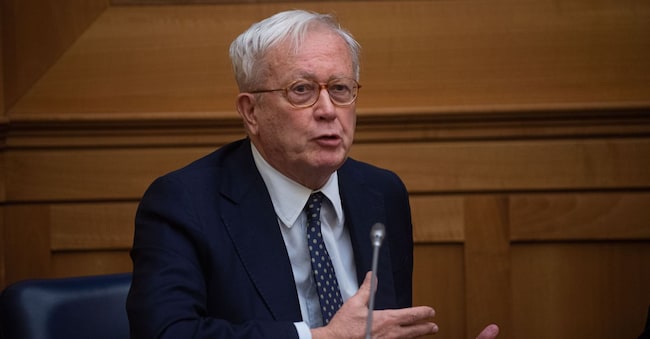
In the strengthened role of Europe in the world, Giulio Tremonti, chairman of the Foreign Affairs Committee of the Chamber of Deputies and also president of Aspen Institute Italia, is ready to bet: 'In the Ventotene Manifesto, defence and foreign policy are mentioned as necessary elements. In 2003 we opposed the idea of Eurobonds for defence, then after 23 years we came back to talk about it. I believe that Europe is going in the right direction: the world will be a table with three legs, the United States, China and also Europe'.
The agreement with India and the one with Mercosur remain the best demonstration of European dynamism, said the vice-minister of Enterprise and Made in Italy, Valentino Valentini, "but we must be careful not to make the alliance of half-powers, instead of the alliance of half-powers as hoped for in Davos by Canadian Prime Minister Carney For this reason, Italy has tried to act as a hinge between the US and the EU, to keep the Atlantic alliance alive". An alliance that, despite appearances, is not dead, as Charles Kupchan, professor at Georgetown University in Washington and senior fellow at the Council on Foreign Relations, maintains. Kupchan, while bluntly describing Trump's Greenland policy as a 'fiasco', is cautious about the end of the US-European friendship: 'It may be that in three years NATO will halve its commitment to Europe in terms of soldiers on the ground. But in Europe today there is a widespread, and I would say premature, sense that the privileged relationship with the United States has come to an end. Instead, I believe that the Atlantic alliance is not over, but Europe must be more proactive'.

