
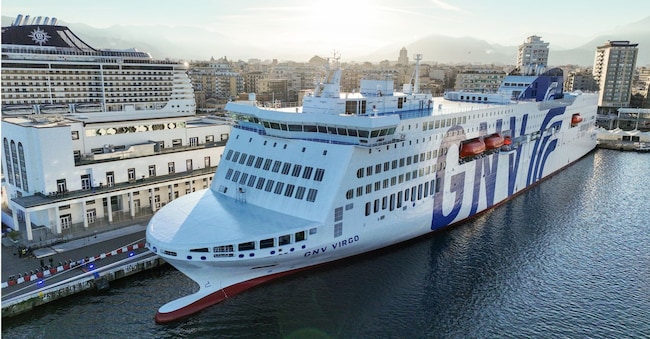
Gnv: Virgo, Italy's first LNG-powered ferry, christened in Palermo
The ship can carry up to 1,785 passengers. Managing director Catani: 'Sicily's central role confirmed, more adequate port space needed'
by Nino Amadore
Key points
An exceptional godmother, Federica Pellegrini, the conduction of Giuseppe Fiorello, and a performance by Eleonora Abbagnato accompanied in the port of Palermo the christening ceremony of Gnv Virgo, the new ship of Grandi navi veloci and the first Italian long-distance vessel powered by liquefied natural gas (LNG). An event with high public visibility, attended by national and local institutions, which marked the operational launch of the ship within the Msc group fleet.
Beyond the celebratory aspect, Virgo represents an important industrial step for Gnv: the company is in fact continuing with its renewal plan that envisages eight new ships by 2030 and more than EUR 1.2 billion in investments, with the aim of reducing environmental impact and increasing transport capacity on some of the country's busiest routes. Destined for the Genoa-Palermo route, the new unit brings to the market more advanced technological standards than the previous generation of ferries.
Vago: "A fundamental step"
"The christening of Gnv Virgo," says Pierfrancesco Vago, Executive Chairman of Gnv as well as of Msc Cruises, "marks a fundamental step in the renewal and decarbonisation of our fleet. Virgo is today the most technologically and environmentally advanced ferry in the country and, thanks to the recent refuelling with bio-Gnl, has already sailed with zero net emissions, anticipating European objectives by more than twenty years. This result is the fruit of effective cooperation between Gnv, the Msc Group, and the entire institutional and port system. This teamwork has made an unprecedented investment plan possible and confirms how decisive public-private cooperation is in accelerating the energy transition of shipping".
In service on the Genoa-Palermo route
On the technical front, Gnv Virgo uses LNG as fuel and integrates energy efficiency systems and cold ironing readiness, achieving a CO₂ reduction of up to 50% per transport unit. The first transfer to Palermo took place with bio-Gnl, allowing the ship to sail - albeit for a limited period - with zero net emissions, anticipating the European targets set for 2050. From an operational point of view, the ship has a gross tonnage of over 52,000 tonnes, 218 metres in length, more than 420 cabins, capacity for up to 1,785 passengers and 2,770 linear metres of cargo. With a maximum speed of 25 knots, Virgo will gradually replace less efficient vessels on the Genoa-Palermo line, contributing to a reduction in emissions and an improvement in service quality.
The choice of Palermo and the strategy in Sicily
The choice of Palermo for the ceremony confirms the port's central role in Gnv's strategies: 750,000 passengers and 1.7 million linear metres of goods were handled in 2025 (+16% on 2024). At regional level, the company recorded 825,000 passengers and 2.4 million linear metres of goods (+24%). Numbers that reaffirm the centrality of Sicily in the group's logistics network. "Sicily, a central territory for our operations, continues to be at the centre of our investments, with the arrival of the most modern units in the fleet," says Matteo Catani, CEO of Gnv. "To support this growth, however, it is essential that port development also proceeds in the same direction: we need adequate space, modern infrastructure, and efficient operating areas, essential elements to guarantee quality and competitiveness. Cooperation between institutions, port authorities and private operators will be decisive'.


